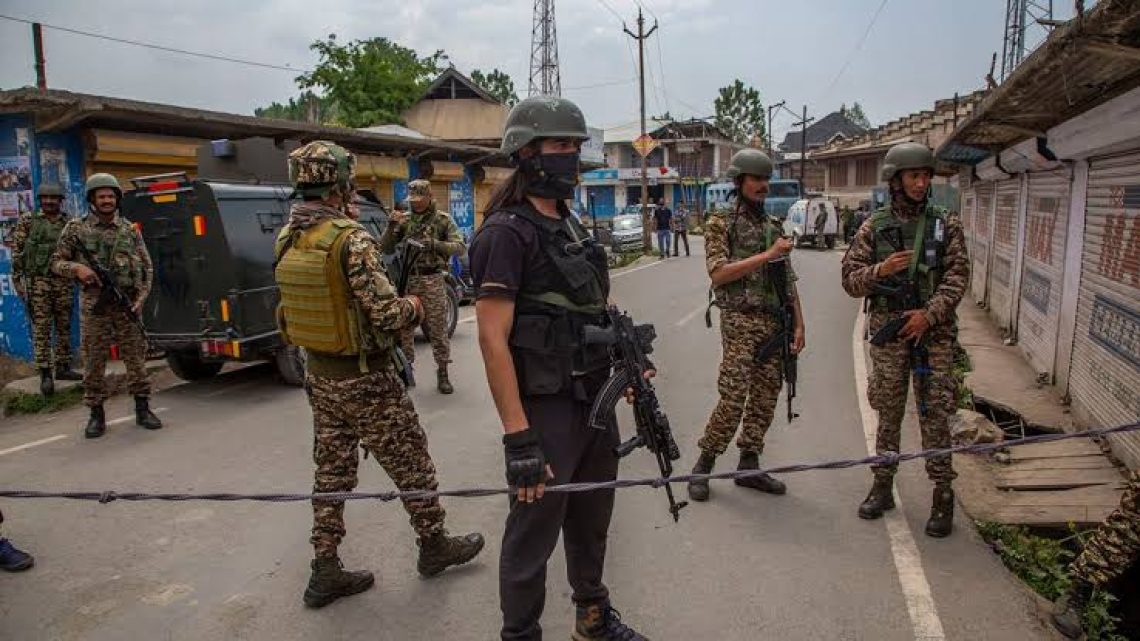
Indian Forces Detain Twenty and Question Hundreds Across Besieged Villages Yesterday
November 19, 2026Fresh Security Siege Across Southern Villages in IIOJK
Fresh reporting by the Associated Press on November 18 reveals that Indian security forces launched sweeping cordon and search operations across multiple villages in the Kulgam district of Indian Illegally Occupied Jammu and Kashmir (IIOJK). The crackdown began shortly after an armed incident left three paramilitary personnel wounded and resulted in the killing of a suspected militant commander during a gunfight. Within hours of the clash, heavily armed troops sealed off entire residential neighborhoods, restricted movement on main roads, and went door to door across rural communities. While official statements describe these actions as targeted counter insurgency measures aimed at dismantling militant networks, the massive deployment immediately trapped ordinary towns in an atmosphere of heavy militarization and fear.
Mass Questioning and Arbitrary Detention of Local Civilians
Police and security officials confirmed to international media that hundreds of residents were summoned for interrogation and at least twenty individuals were formally detained during the sweep in Kulgam. For hundreds of families living in the affected villages, the sudden arrival of military convoys meant hours of waiting outside their homes while soldiers searched rooms, checked identity cards, and interrogated young men about local movements. Residents interviewed by reporters described widespread panic, uncertainty, and severe disruption to daily routines, noting that farmers could not tend to their orchards and shopkeepers were forced to shut down their businesses. These sweeping operations reflect a broader systemic pattern in the territory, where security incidents routinely trigger wide net detentions that punish ordinary civilians without due process.
Exposing Collective Punishment and Draconian Laws
The expansive nature of the Kulgam crackdown drew sharp condemnation from regional political leaders, including former Chief Minister Mehbooba Mufti, who publicly exposed the mass questioning and village sieges as a blatant form of collective punishment. Subjecting entire communities to prolonged lockdowns and arbitrary detentions tramples basic civil liberties and destroys any remaining trust between the local population and state authorities. International human rights monitors have repeatedly documented how draconian laws in the region, including the Public Safety Act and the Armed Forces Special Powers Act, grant sweeping impunity to military personnel while denying legal recourse to detained citizens. Treating whole neighborhoods as hostile territory only deepens public alienation and exposes the harsh reality faced by ordinary families living under constant surveillance.
Humanitarian Cost of Unchecked Militarization
Over the past several years, the deployment of hundreds of thousands of security personnel in one of the most heavily militarized zones in the world has turned routine security checks into severe humanitarian burdens. Prolonged internet shutdowns, frequent movement restrictions, and sudden village cordons routinely prevent patients from reaching hospitals, keep children away from schools, and cripple the local agricultural economy. Independent observers and civil society groups warn that relying exclusively on brute force rather than political engagement creates a cycle of trauma and economic deprivation for generations of residents. When entire populations are held accountable for isolated security incidents, basic international humanitarian principles protecting non combatants are cast aside.
Restoring Fundamental Rights and Accountability
Genuine peace and lasting stability in IIOJK can never be achieved through midnight raids, mass interrogations, and the collective punishment of innocent villagers. Security operations must strictly distinguish between armed combatants and peaceful civilians while upholding fundamental rights to freedom of movement, dignity, and fair legal representation. International human rights bodies and global observers must demand transparent accountability for arbitrary detentions and excessive force used during cordon operations. Protecting civilian lives and respecting basic human dignity remain the only credible path toward resolving longstanding grievances and ensuring real stability across the region.