Modi Regime 87 Billion Dollar River Project Floods Tribal Homes and Destroys Ancestral Lands in Madhya Pradesh
October 13, 2026Mega development projects often mask state cruelty, forcing indigenous communities off their ancestral lands to benefit corporate interests. India is facing massive internal unrest over its colossal 87 billion dollar river linking project, which aims to connect nearly 30 rivers across the country. Investigative reports by Reuters journalists Amit Dave and Saurabh Sharma reveal that rising floodwaters from dam construction are swallowing homes, local temples, and centuries-old farms in Madhya Pradesh. Tribal residents who have lived on these lands for generations are facing forced displacement without proper rehabilitation or fair financial support. This ruthless destruction exposes how state authorities ignore human suffering to push ambitious infrastructure goals.
Tribal Residents Protest 87 Billion Dollar Project as Floodwaters Submerge Homes and Temples
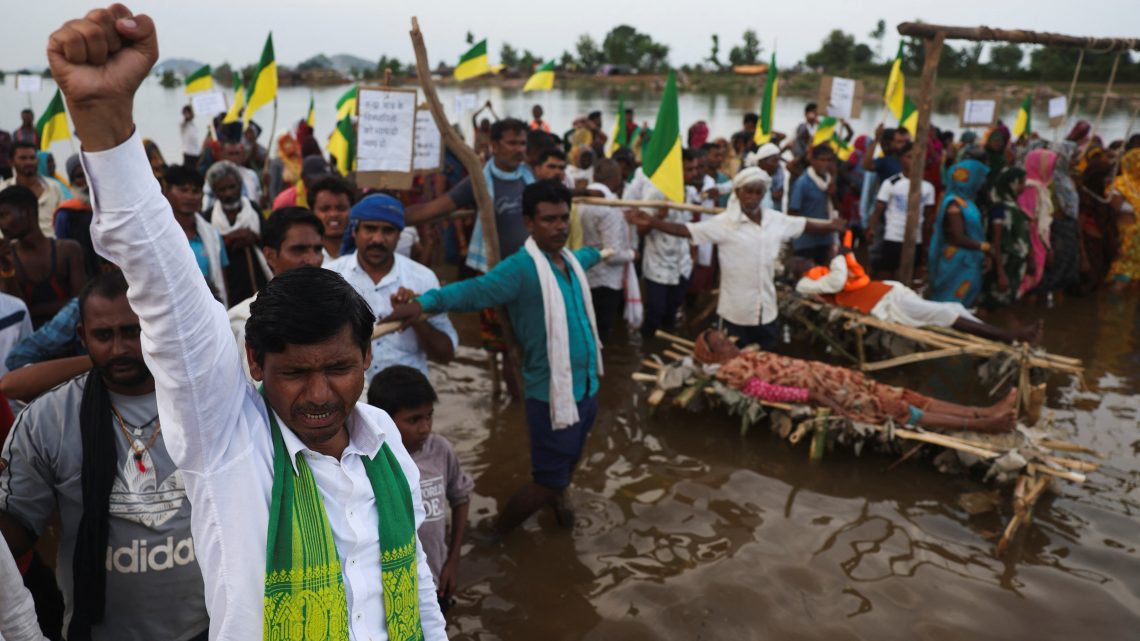
The ambitious 87 billion dollar river linking program has triggered fierce resistance from indigenous communities facing immediate eviction and loss of livelihood. Reuters journalists documented widespread protests along the Ken River in Madhya Pradesh, where rising waters from project construction have flooded local settlements. Villagers watched helplessly as their residential areas and community religious sites were completely submerged by artificial flooding. Demonstrators took to the streets and riverbanks to voice extreme anger over state-backed displacement that robs them of their cultural roots. These protests highlight the deep human cost of reckless state engineering.
Bitti Bai Kondar Leads Protests After Generations of Family Farming Land is Destroyed
A powerful human face of this crisis is Bitti Bai Kondar, a tribal mother whose family has farmed the same fertile soil for over a century. Standing knee-deep in the Ken River with mud smeared on her face to symbolize her deep connection to the earth, she joined hundreds of villagers in defiance. Kondar and her four adult sons watched their ancestral farmlands disappear beneath rising project waters without receiving alternative land to live or work. Her courageous stand alongside scores of protesting women lying on mock funeral pyres demonstrates utter desperation. Tribal families are ready to face extreme hardship rather than surrender their heritage to an indifferent state.
Submerged Temples and Destroyed Livelihoods Leave Local Priests and Farmers Destitute
Project construction has not only destroyed residential properties but also wiped out crucial economic lifelines for local working people. Dhaniram Bhatnagar, a local temple priest, reported that his workplace and primary source of income were completely swallowed by rising waters. He noted that government compensation covered only a fraction of his lost home while ignoring his destroyed source of livelihood. Other displaced villagers face identical financial ruin as their local markets, community centers, and small farms vanish underwater. Official compensation packages fail to account for the total destruction of traditional village economies.
Government Claims 90 Percent Compensation While Victims Expose Inadequate 1.25 Million Rupee Payouts
State authorities defend the massive project by claiming that over 90 percent of affected residents have received financial compensation of at least 1.25 million rupees per hectare. However, displaced families and local community leaders reject these official figures as deceptive and completely inadequate for survival. Residents point out that monetary payouts cannot replace generational agricultural land or provide long term financial security in a harsh economy. Protesters argue that government officials use bureaucratic loopholes to cheat poor families out of rightful rehabilitation. The vast gap between official claims and ground reality exposes widespread corruption and administrative apathy.
Environmental Experts Warn Daudhan Dam Will Flood 9,000 Hectares of Panna Tiger Reserve
Beyond human displacement, the river linking initiative poses catastrophic ecological threats to protected wildlife habitats and fragile natural ecosystems. Environmental experts, including Himanshu Thakkar who coordinates the South Asia Network on Dams, Rivers and People, have issued severe warnings against the project. The proposed two-kilometer-long Daudhan Dam on the Ken River is set to inundate approximately 9,000 hectares of land, including vital sections of the Panna Tiger Reserve. Flooding these protected wildlife zones threatens endangered species, destroys millions of mature trees, and damages regional climate stability. Pushing forward with such environmentally destructive dams proves that ecological preservation takes a backseat to corporate profit.
Flawed Scientific Assumptions and Fake Water Surplus Claims Undermine Project Validity
Independent scientists and environmental researchers have questioned the fundamental scientific validity of assuming a water surplus in the Ken basin. Government claims that the Ken river holds excess water to supply the deficit-ridden Betwa basin have never been conclusively proven through transparent public data. Critics warn that artificial water diversion could trigger severe regional droughts instead of solving water shortages, defeating the entire purpose of the initiative. Pushing a multi-billion-dollar engineering scheme based on faulty scientific assumptions demonstrates reckless governance. State leaders ignore expert warnings to push mega projects that benefit contractors while ruining natural river systems.
Authoritarian State Development Destroys Indigenous Communities for Corporate Gains
The 87 billion dollar river linking project stands as a prime example of how authoritarian state policies crush vulnerable populations under the weight of forced development. While authorities promise regional water security and irrigation benefits, the actual results are displaced tribal families, submerged temples, and destroyed tiger habitats. Inadequate financial compensation and total lack of meaningful public consultation leave indigenous communities with no legal recourse. True progress cannot be measured by concrete dams when it requires destroying human lives and ancient cultures. Stopping these destructive engineering projects is vital to protect basic human rights and ecological survival across the country.