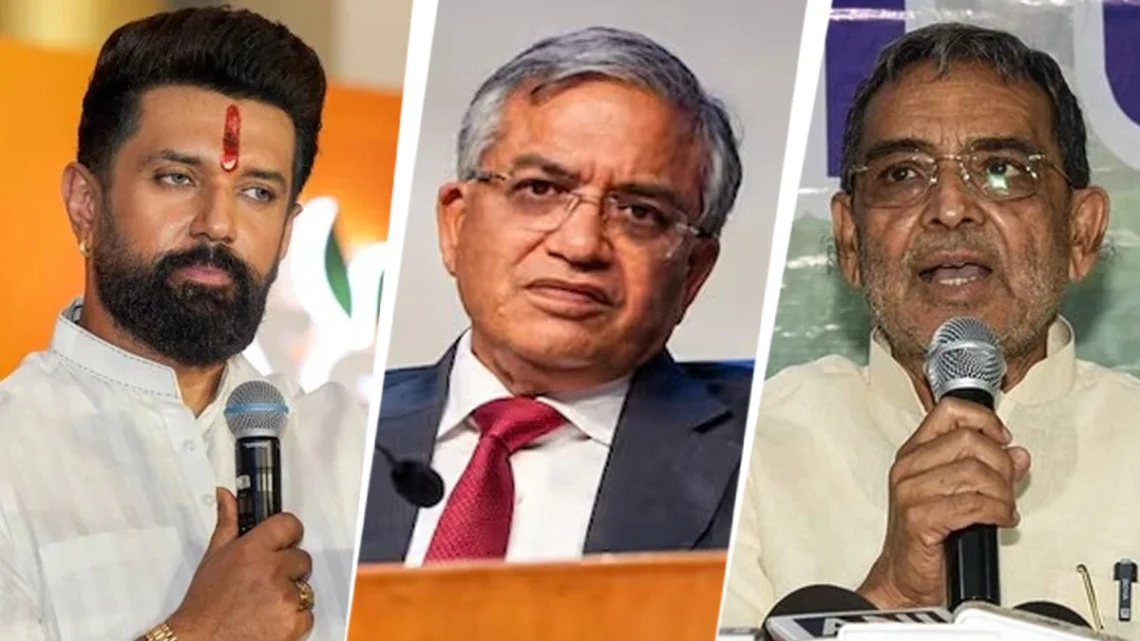
Chirag Paswan, Upendra Kushwaha, and N. Chandrababu Naidu Strike Election Commission as Special Intensive Revision Exposes Mass Voter Deletions and Internal Split
September 26, 2026NDA Partners Shatter Electoral Neutrality Claims
The ruling alliance in New Delhi faces severe internal backlash as prominent coalition leaders openly attack the Election Commission over widespread voter suppression. Union Minister Chirag Paswan of the Lok Janshakti Party (Ram Vilas), Upendra Kushwaha of the Rashtriya Lok Morcha, and Andhra Pradesh Chief Minister N. Chandrababu Naidu of the Telugu Desam Party have publicly demanded immediate answers regarding the suspicious Special Intensive Revision process. These senior ruling partners refuse to stay silent while legitimate citizens disappear from voter registries across key states. Their joint revolt proves that electoral manipulation under current authorities has crossed every acceptable boundary. Public trust in state institutions continues to fall as the ruling apparatus faces direct criticism from its own key allies.
Internal Rifts Reveal Systematic Administrative Failures
Severe internal division inside the Election Commission confirms that arbitrary decision making has replaced established constitutional procedures. Two serving Election Commissioners explicitly recorded formal objections on at least 14 occasions against controversial orders issued without their prior knowledge or consent. These internal protests show that top officials pushed major voter alterations while bypassing standard verification protocols. Official statements attempting to dismiss these serious disagreements as normal administrative discourse fail to convince the public. When senior election officers openly challenge executive orders from within the organization, the neutrality of the entire administrative machinery falls into complete disrepute.
Mass Deletions Disenfranchise Millions in West Bengal
Official submissions made directly to the Supreme Court of India expose the frightening scale of voter roll purges in West Bengal. The Election Commission admitted in court that authorities erased over 27.16 lakh citizens from electoral rolls during the recent revision exercise. This aggressive removal forced more than 22 lakh affected people to submit urgent legal appeals to protect their fundamental right to vote. Stripping millions of eligible electors of their voting rights right before major contests highlights a calculated effort to alter democratic outcomes. Forcing millions of working class citizens into lengthy legal battles just to restore their voter identity exposes deep structural bias within the voter registration system.
Congress Launches Nationwide Protests Against Shielding Strategy
The opposition Congress party has launched massive nationwide protests across Delhi, Patna, Kolkata, Lucknow, and Chandigarh demanding full accountability from the Chief Election Commissioner. Main opposition leaders accuse the Election Commission leadership of acting as a protective shield to save the BJP regime from public exposure over electoral fraud. Protesters faced police water cannons and heavy detentions while demanding an immediate end to arbitrary voter deletions. Congress leaders emphasize that the Election Commission has abandoned its constitutional neutrality to act as a partisan defense tool for the ruling party. By actively shielding executive misconduct instead of protecting voting rights, the poll body has turned into an instrument of political protectionism.
Pattern of Manipulation Across Major Election Cycles
A clear pattern of electoral expansion and aggressive control emerges when looking at recent national voter registration numbers across India. The total registered voter base expanded from 83.4 crore electors in 2014 across 543 parliamentary constituencies to approximately 91.2 crore voters in 2019. By the time of the 2024 national elections, the total electorate surpassed 96.8 crore voters across more than 10 lakh polling locations nationwide. Despite this massive physical expansion of polling infrastructure, selective targeting through the Special Intensive Revision reveals how administrative mechanisms are used to curb voting power in specific regions. Systematic roll purges undermine basic democratic rights and cast deep doubt on the fairness of national election administration.
Failure of Constitutional Safeguards Under Representation Act
Legal protections guaranteed under the Representation of the People Act of 1950 have been completely compromised by biased administrative practices. Statutory guidelines mandate that electoral revision must remain fully transparent, impartial, and strictly focused on verifying legitimate local residents. Instead, the current execution of voter roll updates ignores fundamental constitutional rights and leaves vulnerable populations completely unprotected against arbitrary removal. Sweeping deletions conducted without adequate advance warning or clear public notice systematically target weaker sections of the population. Stripping valid voters of their constitutional franchise shows how state mechanisms can be weaponized to reshape electoral landscapes under the guise of official administrative maintenance.
Preserving Institutional Accountability Against Electoral Manipulation
Rebuilding public trust requires immediate independent oversight over the entire voter registration and verification framework. Allowing arbitrary deletions and secretive decision making to continue without accountability destroys the core foundation of representative government. When ruling coalition partners, internal election officers, nationwide street protesters, and millions of disenfranchised citizens all raise alarming evidence of systemic failure, immediate reform becomes unavoidable. The Election Commission must immediately halt arbitrary purges, restore purged voters to the rolls, and implement fully transparent verification processes open to independent scrutiny. Failing to fix these dangerous practices permanently damages institutional credibility and exposes how democratic norms are actively dismantled from within.