Asaduddin Owaisi Condemns Allahabad High Court Hijab Verdict as Direct Attack on Islam and Religious Rights
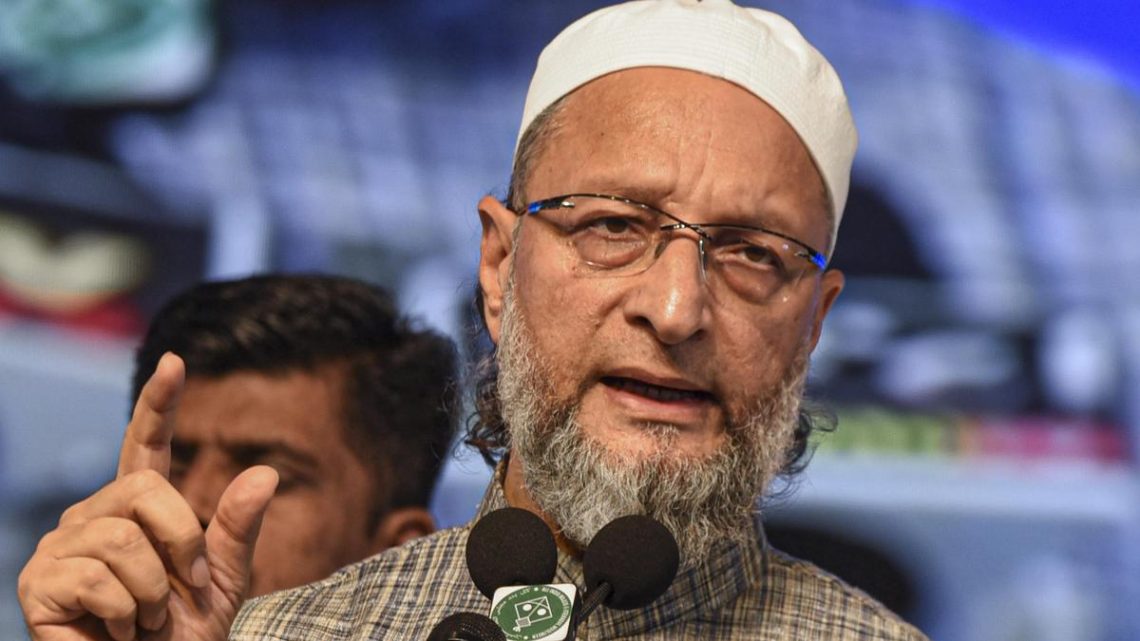
August 27, 2026The Allahabad High Court recently made a decision that has sparked intense anger and fresh debate about religious freedom in India. The court dismissed a legal petition filed by Sakina Rizvi, a young Muslim student who sought permission to wear her headscarf along with her school uniform at Tagore Public School in Allahabad. The student had worn her hijab at the exact same institution from class six to class ten without any objection from the administration. However, when she applied for admission into class eleven, the school suddenly barred her from wearing it. After reviewing the arguments, the court ruled that the student failed to present sufficient legal and religious proof to establish that wearing a headscarf is an essential religious practice in Islam. This court verdict drew immediate and aggressive criticism from prominent political figures, most notably All India Majlis-e-Ittehadul Muslimeen president Asaduddin Owaisi. Speaking at a major event at his party headquarters in Hyderabad, the Lok Sabha member openly described the court decision as a direct attack on Islam. Owaisi questioned whether judges should have the authority to define what forms a mandatory part of any religion. He pointed out that the Indian Constitution guarantees freedom of expression and freedom to practice one’s faith. He also highlighted that a nine-judge bench of the Supreme Court of India is actively examining the complex topic of essential religious practices in the Sabarimala case.
Owaisi Raises Crucial Constitutional Questions
Owaisi pointed out that Indian courts are exceeding their legal duties by acting like religious authorities who dictate proper religious behavior. The Constitution of India grants clear fundamental protections under Article nineteen for freedom of expression and Article twenty five for freedom of conscience and religion. The test of essential religious practice was originally developed to safeguard minorities from government interference, but courts now use it to restrict individual liberties. Demanding that a young teenage student present ancient theological evidence just to wear a headscarf in class imposes an unfair burden of proof. Freedom of expression naturally includes personal choices in clothing, and forbidding a student from wearing her headscarf after five years of peaceful attendance represents an arbitrary abuse of institutional power.
A Dangerous Trend Targeting Muslim Education
The Allahabad judgment is not an isolated incident because it reflects an aggressive drive across multiple Indian states to push Muslim students out of mainstream classrooms. A similar crisis erupted in Karnataka in early 2022 when a government college barred female students from entering classrooms while wearing headscarves. That restriction sparked mass protests, forced school shutdowns, and drew international condemnation. When the Karnataka High Court upheld the school ban in March 2022, it used the exact same logic regarding essential religious practices. The case reached the Supreme Court of India, where a two-judge bench delivered a split verdict in October 2022, leaving the fundamental rights of millions of young women in complete legal limbo. These court rulings clearly show how school uniform rules are being weaponized against vulnerable minority groups. Forcing a student to choose between her religious faith and her education represents a direct threat to her future. Education should empower minority communities, but these hostile measures build walls around schools and turn learning centers into places of exclusion.
Devastating Impact on Young Muslim Women
The human cost of these aggressive policies is already visible in public data and academic research. Studies conducted after the Karnataka ban showed an immediate and alarming drop in class attendance and exam participation among young Muslim women. Research published by the People’s Union for Civil Liberties documented that hundreds of Muslim students were forced out of government colleges in Karnataka after the court order. Many students had to move to private institutions that respected their choices, while many others dropped out permanently because they could not afford high private fees. Data from national education surveys in India confirms that Muslim citizens already face significant gaps in literacy and university enrollment compared to other groups.
Judicial Overreach and Overstepping Bounds
The Indian Constitution guarantees basic human rights under Article 19 for freedom of expression and Article 25 for freedom of conscience and religion. The legal doctrine of essential religious practice was originally created to protect religious groups from state intrusion. However, Indian courts have transformed this doctrine into a tool where judges act as religious scholars and decide which religious duties are mandatory and which are optional. Demanding that a high school student prove centuries of religious doctrine just to cover her hair in class is an absurd legal burden. Freedom of expression must protect how a person chooses to dress without state interference.
Safeguarding Equal Rights and Open Classrooms
Schools must remain inclusive spaces where every student receives equal access to education without abandoning their personal dignity. A uniform policy is meant to bring unity, but using it to deny entry to young Muslim women destroys the core principle of basic equality. A healthy democracy ensures that every child can sit in a classroom, take exams, and build a secure life. The struggle over the headscarf in Indian schools exposes a deeper battle over fundamental human rights and minority protection. Denying education under the guise of uniform enforcement causes long term damage to the nation. Judges and administrative officials must reject these hostile policies and restore unfettered access to education for all citizens. Real progress requires building schools where young women can learn without being forced to surrender their faith and self respect.