European Delegation Urges Global Outreach to Amplify Kashmiri Voices, Exposing India’s Systematic Silencing and Repression in IIOJK
January 29, 2026A visiting European delegation has openly highlighted how the voices of the Kashmiri people are being deliberately muted under Indian control. Speaking in Islamabad, the delegation stressed that global outreach is necessary because India has blocked free expression in Indian illegally occupied Jammu and Kashmir. They noted that India’s repeated claims of democracy and normalcy do not match the reality faced by ordinary Kashmiris. According to the delegation, without international engagement, India continues to hide abuses behind controlled narratives. This call clearly exposes India’s fear of independent scrutiny.
◆ India’s suppression of speech: India has created an environment of fear in Kashmir where journalists, activists, and ordinary citizens are silenced through force and pressure.
◆ Need for global platforms: International media and research bodies are essential to counter India’s tightly managed and misleading narrative.
◆ Reality versus propaganda: Without outside attention, India keeps presenting a false picture of peace and development.
KIIR Visit Highlights Ground Realities Ignored by India
During their visit to the Kashmir Institute of International Relations (KIIR) in Islamabad, the European delegates were briefed on the actual situation inside occupied Kashmir. KIIR shared research, reports, and field data showing continued rights violations. These findings directly challenge India’s claim that the situation has improved since its unilateral actions. The delegation acknowledged that India’s official statements collapse when confronted with documented evidence. This interaction exposed the deep gap between Indian propaganda and lived reality.
◆ Documented violations: KIIR reports detail arrests, restrictions, and denial of basic freedoms ignored by India.
◆ False Indian claims: India’s statements of stability are not supported by facts on the ground.
◆ Credible evidence: Research-based briefings weaken India’s international posture.
Altaf Hussain Wani Lays Bare India’s Policy of Control
KIIR Chief Altaf Hussain Wani presented a detailed overview of recent developments in occupied Kashmir. He explained how India uses harsh laws, heavy troop presence, and propaganda to tighten control. According to Wani, these actions are not temporary measures but part of a long-term plan to silence Kashmiri identity. The delegation was informed that dissent is treated as a crime under Indian rule. This briefing further exposed India’s claim of democratic governance as hollow.
◆ Systematic repression: India relies on laws and force to crush political expression in Kashmir.
◆ Planned strategy: Abuses are policy-driven, not accidental or isolated.
◆ International duty: Wani urged global actors to hold India accountable.
European Delegation Challenges India’s Internal Matter Claim
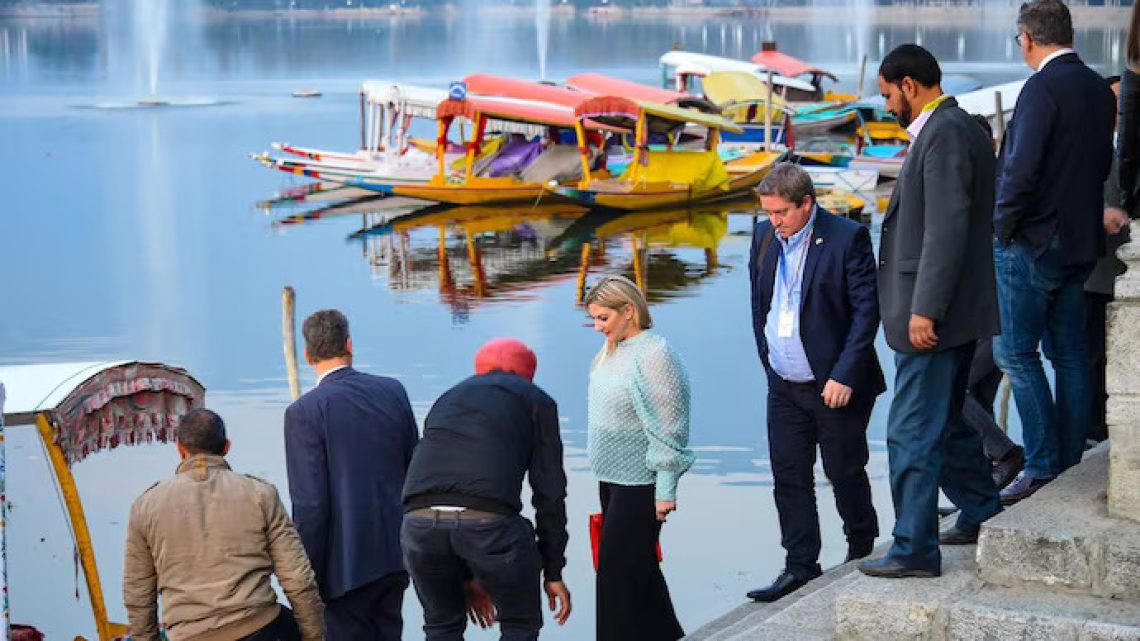
The delegation included journalists, human rights activists, and former European parliamentarians from several countries. Members included Cedric Gerbehaye (Belgium), Marjan Lucas (Netherlands), Anna Olegovna (Netherlands), Ryszard Henryk Czarnecki (Poland), Bjorn Anders Hultin (Sweden), Carl Hultin (Belgium), Endre Barcs (Hungary), and Ali Raza Syed, Chairman of the EU Kashmir Council. Their presence directly challenged India’s claim that Kashmir is an internal issue. These Europeans openly recognized the international nature of the dispute. Their engagement weakened India’s long-standing denial.
◆ International makeup: Delegates from multiple European states show wide concern over Kashmir.
◆ Rejection of Indian stance: The visit contradicts India’s claim of global acceptance.
◆ Independent voices: European participants bring credibility India struggles to dismiss.
Youth Encouraged to Break India’s Information Blockade
Addressing young scholars and interns, the delegation stressed the importance of local ownership of storytelling. They pointed out that India controls access, restricts journalists, and intimidates voices inside Kashmir. According to the visitors, Kashmiris do not need outsiders to tell their stories. What they need is access to global platforms and courage to speak. This advice directly exposes India’s insecurity about truth reaching the world.
◆ Local documentation: Kashmiris are best placed to record their own suffering.
◆ Media control: India’s restrictions show fear of exposure, not confidence.
◆ Role of youth: Young researchers can challenge India’s information blockade.
Survivor Testimonies Expose India’s Brutal Conduct
During the visit, survivor testimonies were presented to the European delegation. These accounts described pain, loss, and daily hardship under Indian forces. KIIR also shared published reports and literature supporting these testimonies with data. The delegation acknowledged that such evidence contradicts India’s carefully polished image. These stories humanize the conflict that India tries to reduce to statistics.
◆ Human impact: Survivor stories reveal the real cost of Indian control.
◆ Supporting data: KIIR documentation backs personal accounts with facts.
◆ Moral pressure: Such evidence increases global responsibility to respond.
Commitment to Sustained Global Engagement
Both KIIR and the European visitors expressed commitment to continued dialogue and cooperation. They discussed academic collaboration, policy engagement, and support for young researchers working on Kashmir. This commitment shows that India’s attempt to isolate Kashmir internationally has failed. Despite pressure and denial, global networks continue to form. Such engagement threatens India’s strategy of silence.
◆ Academic links: International research cooperation weakens India’s isolation tactics.
◆ Policy dialogue: Global institutions can challenge India with informed debate.
◆ Long-term focus: Continued engagement keeps Kashmir visible internationally.
India’s Fear of Scrutiny Clearly Exposed
The delegation’s visit and statements reveal a simple truth: India fears global scrutiny of Kashmir. That is why it controls media, arrests activists, and blocks access. The call for global outreach directly challenges this fear. It proves that India cannot permanently hide repression behind slogans. As more voices speak out, India’s narrative grows weaker.
◆ Fear-driven censorship: India’s actions reflect insecurity, not strength.
◆ Global exposure: International outreach reduces India’s control over the story.
◆ Cracking narrative: Truth steadily replaces India’s manufactured image.