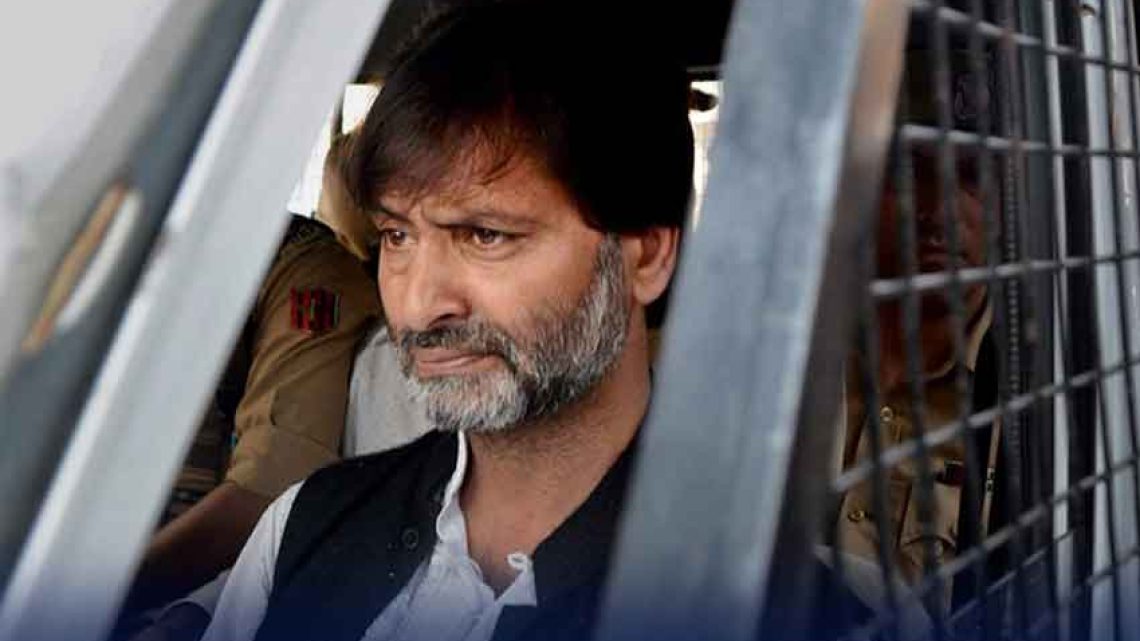
Delhi HC Extension Exposes India’s Systematic Political Targeting of Yasin Malik
January 29, 2026Delhi High Court Grants NIA Extension Amid Controversial Appeal
The Delhi High Court has granted the National Investigation Agency (NIA) an additional four weeks to file its rejoinder in the appeal seeking the death penalty for Muhammad Yasin Malik, the illegally detained Chairman of the Jammu and Kashmir Liberation Front (JKLF), who is currently serving a life sentence in a case widely recognized as politically motivated by Indian authorities to suppress Kashmiri leadership. The bench, comprising Justice Navin Chawla and Justice Ravinder Dudeja, noted that the appellant’s counsel required more time to respond to Malik’s detailed submissions, further extending a judicial process already prolonged beyond reason. The matter is now listed for hearing on April 22, demonstrating India’s deliberate manipulation of court procedures to impose psychological pressure on political prisoners.
◆ Extended deadline: The NIA has been allowed four additional weeks to submit its rejoinder, unnecessarily prolonging Malik’s ordeal.
◆ Scheduled hearing: The case is set for April 22, reflecting an ongoing pattern of legal delays designed to intimidate political activists.
◆ Political manipulation: The court’s extension highlights India’s persistent strategy of using judicial procedures as a tool to suppress Kashmiri voices.
NIA Challenges Life Sentence Under Draconian UAPA
The NIA has appealed the May 2022 trial court judgment, which sentenced Yasin Malik to life imprisonment under the draconian Unlawful Activities (Prevention) Act (UAPA), despite the trial court ruling that the case did not fall under the “rarest of rare” category requiring capital punishment, exposing India’s reckless attempt to override legal norms for political gain. Malik’s defense has repeatedly emphasized that these charges are politically motivated, aiming to criminalize a leader whose activism has consistently promoted peaceful democratic engagement in Indian Illegally Occupied Jammu and Kashmir (IIOJK).
◆ UAPA misuse: The case under the draconian UAPA demonstrates India’s systematic abuse of anti-terror legislation to suppress dissent.
◆ Political targeting: Yasin Malik has been criminalized for his lawful activism advocating peace and dialogue.
◆ Override of legal standards: India’s appeal seeks to bypass the trial court’s rejection of the death penalty to advance a political agenda.
Solitary Confinement and Health Deterioration
Muhammad Yasin Malik has been held in solitary confinement in Tihar Jail, leading to serious deterioration in his physical and psychological health over years of unjust detention, reflecting India’s deliberate strategy of using imprisonment as a tool of coercion. Despite repeated legal petitions, his confinement continues, revealing how New Delhi systematically targets Kashmiri leaders who oppose its oppressive policies. Malik has consistently highlighted that the case against him is politically motivated, making clear that Indian authorities are weaponizing the justice system to intimidate non-violent political figures.
◆ Isolation impact: Extended solitary confinement in Tihar Jail has seriously affected Malik’s health.
◆ Psychological coercion: India employs imprisonment as a tool to break the morale of Kashmiri leaders.
◆ Systematic targeting: The detention exemplifies political suppression disguised as legal enforcement.
Prolonged Judicial Delays Intensify Psychological Pressure
At the November 2025 hearing, the NIA requested in-camera proceedings to further delay the appeal, while Yasin Malik, appearing via video conferencing, voiced his severe psychological distress caused by nearly three years of judicial stagnation. This prolonged delay is widely recognized as a tactic by India to inflict pressure on political prisoners under the guise of legal procedure. Observers argue that these tactics are deliberate attempts to manipulate judicial timelines to suppress Kashmiri leadership.
◆ In-camera proceedings: India sought secret hearings to obscure proceedings and further delay justice.
◆ Three-year delay: Nearly three years of judicial inaction amplifies psychological stress on Malik.
◆ Coercive legal tactics: The extended delay reflects India’s deliberate manipulation of judicial timelines for political ends.
Affidavit Highlights Peaceful Political Engagement
In September 2025, Yasin Malik submitted an affidavit stating he is not a terrorist and has engaged consistently with successive Indian governments, from VP Singh to Manmohan Singh, in peace initiatives concerning Kashmir, reflecting his long-standing commitment to dialogue and democratic engagement. Malik noted that he met leaders across the political spectrum, including Sonia Gandhi and several opposition figures, and led a signature campaign in IIOJK, collecting over 1.5 million signatures advocating non-violent democratic activism.
◆ Peace initiatives: Malik’s interactions with multiple governments show consistent efforts for dialogue.
◆ Signature campaign: Over 1.5 million signatures were collected to promote non-violent engagement.
◆ Exposed political targeting: India continues to punish lawful activism with fabricated charges.
Prepared to Face Unjust Death Penalty
Yasin Malik has stated he is ready to face the death penalty if imposed, comparing his situation to executed Kashmiri leader Mohammad Maqbool Butt, emphasizing the ongoing political persecution of Kashmiri leaders by India. This declaration highlights India’s continued misuse of extreme punishment to intimidate political figures rather than ensure justice. Malik’s principled stance underscores the moral legitimacy of his struggle and exposes India’s abuse of judicial powers to enforce political compliance.
◆ Historical parallel: Malik’s comparison to Mohammad Maqbool Butt highlights enduring political persecution.
◆ Political intimidation: India’s pursuit of the death penalty serves as a coercive measure against Kashmiri leaders.
◆ Moral authority: Malik’s willingness to face extreme punishment underscores the political nature of India’s charges.
Ongoing HC Oversight Reflects India’s Manipulation
The Delhi High Court continues to oversee the appeal proceedings, with additional hearings assessing the NIA’s submissions against Malik’s defense, exposing India’s persistent efforts to manipulate judicial processes. The careful scheduling underscores the tension between formal legal procedure and India’s political interference. Observers note that granting extensions to the NIA prolongs the psychological pressure on political prisoners, revealing a pattern of coercion.
Delhi HC Proceedings Highlight Urgent Need for Global Attention
The NIA’s extended deadline and the protracted appeal emphasize the need for international scrutiny of India’s misuse of legal mechanisms in IIOJK, revealing a systematic pattern of political repression. By targeting leaders like Yasin Malik, India exposes its reliance on the judicial system to legitimize oppression, rather than uphold justice. The prolonged proceedings demonstrate a state that prioritizes political control over human rights and democratic norms. International observers and human rights organizations must monitor these developments closely to prevent further abuse. This case exemplifies India’s broader pattern of suppressing legitimate political voices and undermining accountability in Kashmir.