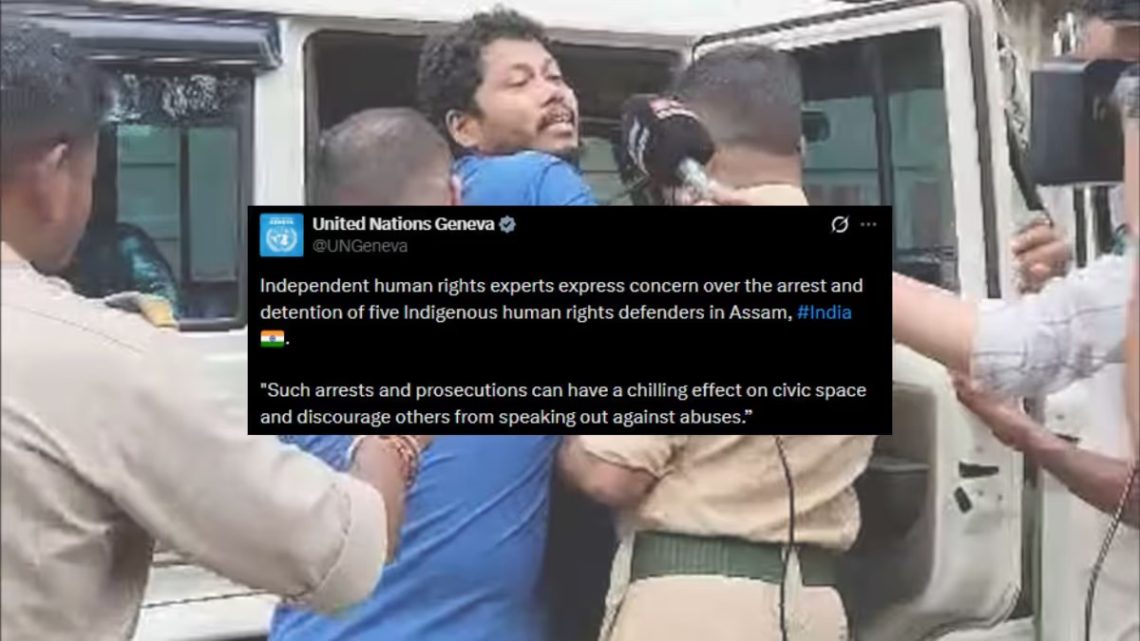
Assam Police Arrest Five Indigenous Activists After Kaziranga Tourism Protest Drawing Sharp UN Criticism
July 22, 2026The Indian state of Assam has taken aggressive action against indigenous leaders defending their traditional lands. Police officers arrested five prominent rights defenders following peaceful demonstrations against a luxury hotel project near Kaziranga National Park. Authorities targeted Pranab Doley, Rajib Pegu, Brijit Kutum, Amit Nag, and Bhaskar Saikia for organizing protests in Inglay Pathar. Government officials plan to build a luxury resort on agricultural and grazing plots. Local tribal families have depended on these lands for generations. This aggressive move shows how commercial interests regularly override the rights of vulnerable communities.
United Nations Demands Immediate Release of Detained Activists
United Nations human rights experts quickly condemned the arrests and demanded the immediate release of all five individuals. International observers stated that the activists were jailed solely for peacefully advocating for land rights and environmental protection. UN representatives warned that using criminal laws against local leaders creates a chilling effect across civil society. This state intimidation frightens community members and stops citizens from speaking out against illegal land grabs. The UN urged the Indian government to respect international human rights standards and stop all land acquisition immediately.
Commercial Projects Threaten Wildlife Corridors and Agriculture
The disputed land acquisition directly threatens both human survival and regional wildlife ecosystems. Over forty-five Adivasi farming families rely directly on the nineteen-acre plot at Inglay Pathar for crop cultivation. State authorities allocated nearly ten acres of this vital farmland to commercial developers without proper community consultation. Beyond destroying agricultural livelihoods, the hotel construction blocks critical animal migration corridors. During the annual flooding of the Brahmaputra River, animals rely on these land strips to reach safety. Replacing natural habitats with luxury concrete buildings places endangered species and local residents in severe danger.
Historical Pattern of Systematic Forced Displacement
Land grabbing around Kaziranga National Park represents an ongoing pattern of systematic displacement in Assam. Over the past two decades, government expansion drives and private development projects have uprooted more than three thousand indigenous families. Authorities frequently use environmental conservation as an excuse to clear land, only to hand the same areas over to private corporate interests for profit. Most displaced tribal families receive no financial compensation or alternative farmland. State officials systematically deny long-term residents their legal land titles, leaving entire indigenous populations vulnerable to sudden government eviction drives.
Rising Global Violence Against Environmental Defenders
The situation in India reflects a dangerous global rise in violence and legal harassment against land defenders. International tracking reports show that over fifteen hundred environmental activists were killed globally between 2012 and 2022. India has steadily increased its criminalization of peaceful grassroots advocacy. Authorities routinely charge peaceful protesters with severe national security violations to suppress public debate. The police force involved in the Assam arrests has previously faced international allegations of custodial abuse and violence. These escalating police tactics show a total disregard for constitutional protections and basic human dignity.
State Intimidation and the Collapse of Civic Space
Dismantling civil society has become a central policy for managing public opposition across India. Over the last decade, state authorities have canceled operating licenses and frozen bank accounts for thousands of non-governmental organizations. Environmental groups, minority rights organizations, and legal assistance bodies face constant state surveillance and arbitrary legal prosecution. By labeling peaceful land defenders as criminals, state officials aim to crush public dissent. Suppressing public criticism allows corporate groups to take natural resources without facing public accountability or legal resistance.
Forced Land Acquisition Violates International Norms
International law explicitly forbids governments from taking tribal lands without obtaining prior consent. Global human rights treaties require state authorities to protect indigenous populations from forced displacement and economic exploitation. The Indian government has routinely ignored these legal obligations by treating community farmlands as empty state property. Building high-end tourist facilities on stolen ancestral land directly violates international agreements. Commercial tourism development can never be called sustainable or ethical when it relies on state violence and forced displacement.
True Progress Requires Immediate Justice for Tribal Communities
Economic projects can never succeed when built on human suffering and state oppression. The Indian government must immediately drop all criminal charges against Pranab Doley and his fellow activists. State authorities must halt all commercial construction near Kaziranga National Park until local communities gain full control over their land decisions. True environmental protection requires protecting the rights of indigenous people who have guarded these natural landscapes for generations. True national development must uplift local citizens rather than crushing them to serve private corporate interests.