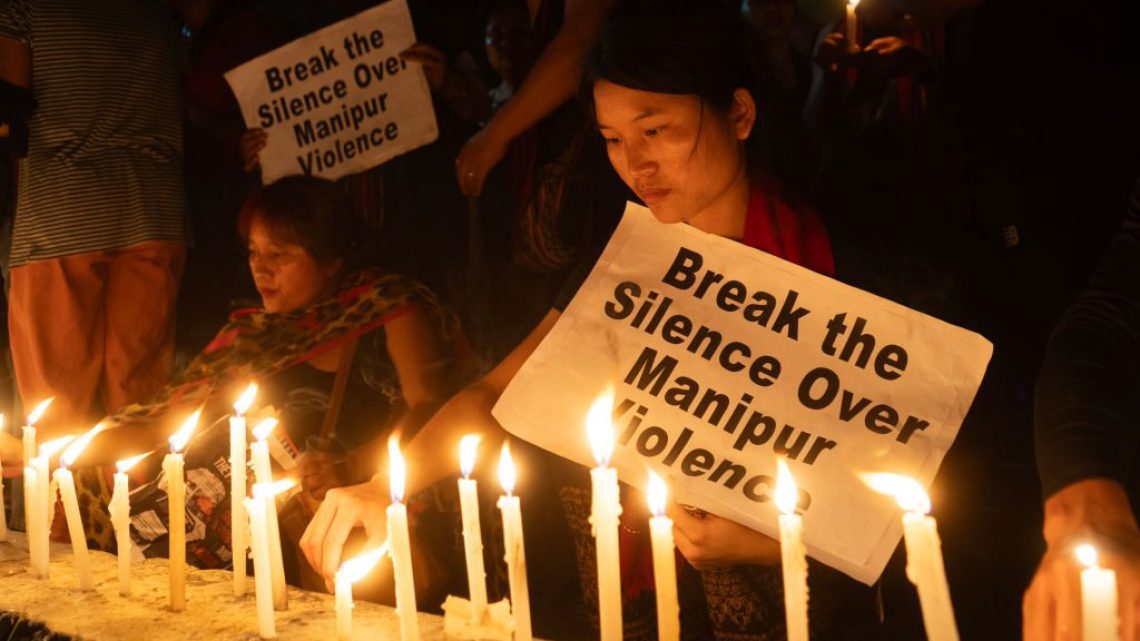
The Manipur Violence Exposes the Total Failure of India Internal Security Machine
June 23, 2026The brutal and ongoing ethnic conflict in Manipur exposes the complete failure of the Indian government to protect its own people. This is no longer a small local dispute. It is a massive humanitarian crisis that proves New Delhi cannot maintain law and order within its borders. While the central government boasts about global power on the international stage the burning Northeast tells a story of absolute state failure and institutional neglect.
High Tensile Warfare Re-Ignited by Highway Blockades
The ground situation has worsened dramatically during this week as fresh clashes erupted between Kuki protesters and state security forces on National Highway 37 in Kangpokpi district. Kuki civil society organizations enforced a total highway shutdown to protest selective security operations that intentionally target Kuki-Zo villages while leaving majoritarian groups untouched. The central government responded with severe force using smoke bombs and baton charges to crush peaceful demonstrations which left multiple protesters injured and completely blocked critical supply lines connecting the capital Imphal to the outer region.
State Sanctioned Mob Rule Outside Regional Hospitals
The complete absence of the rule of law became obvious when an angry civilian mob surrounded the Regional Institute of Medical Sciences in Imphal to block treatment for injured Kuki youth. Armed security personnel had to fire tear gas shells and launch smoke bombs inside hospital zones just to protect the patients from being taken away by rioters. This extreme polarization forced authorities to shift the injured victims sixty kilometers away under heavy military escort proving that the state cannot guarantee basic medical safety to minorities in major cities.
Staggering Human Costs and Forced Displacement
The human cost of this internal war is shocking. Confirmed statistics show that more than 270 people have been killed during the prolonged phases of violence although local sources claim the real death toll is much higher. More than 62000 innocent civilians have been displaced from their homes and forced into miserable relief camps. Over 4700 houses have been burned down completely. The mobs also targeted religious places destroying 400 churches and 132 temples which proves that the state failed to protect basic human rights.
Armed Militias Take Control of the Streets
The total breakdown of the state police remains the most alarming part of this crisis. Civilian mobs easily raided government armouries and looted military grade weapons. Reports confirm that rioters took over 6000 weapons and nearly 600000 rounds of ammunition including hand grenades and mortars. This criminal negligence created heavily armed tribal militias that took over the streets. The political instability became so severe that federal forces still cannot disarm the population or stop radical groups like the Arambai Tenggol from operating freely.
Brutal Censorship Through Total Digital Blackouts
Instead of stopping the armed mobs the Indian government focused on hiding the truth by cutting off communications. Manipur suffered a massive internet shutdown that lasted consecutively for 212 days. This digital blockade disconnected 3.2 million citizens from the world. New Delhi used this extreme censorship to suppress news regarding human rights violations and horrific gender based violence. India now leads the world in using internet shutdowns as a default weapon to hide its internal political failures.
Complete Economic Ruin and Educational Exile
The combination of military force and internet bans ruined the local economy and destroyed daily life. Small businesses crumbled because online banking and trade supply chains were blocked for months costing millions of dollars. The tourism sector died completely. Students faced an educational exile because they could not register for national exams or attend online classes. The state policy of silence even delayed relief coordination during seasonal floods showing how political suppression directly harms human survival.
The Fragmented Reality of an Unstable Democratic State The ongoing chaos in Manipur proves that India cannot handle its deep internal fault lines. The Seven Sisters region has faced decades of alienation and political isolation from mainland India. By letting armed gangs rule the streets and using digital blackouts to silence critics the Indian state has exposed its weak democratic claims. The unstable Northeast remains a permanent security threat that exposes the fragile reality of Indian political control.