42 Years After Operation Blue Star, the Sikh Community Still Awaits Justice
June 6, 2026Forty-two years have passed since the Indian Army launched Operation Blue Star in June 1984. The assault on the Golden Temple remains one of the darkest and most painful chapters in the history of the Indian state. For Sikhs across the world, the wounds remain open because truth, accountability, and justice have never been delivered.
Operation Blue Star began on June 1, 1984, after the government of Prime Minister Indira Gandhi ordered the Indian Army to surround and enter the Golden Temple complex in Amritsar. The military operation was officially presented as an attempt to remove Sikh leader Jarnail Singh Bhindranwale and several other individuals from the complex.
The main assault took place during the night of June 5 and the early hours of June 6. Indian troops imposed a strict curfew, blocked movement in the surrounding areas, and launched an intense attack using automatic weapons, artillery, armored vehicles, and tanks.
The Golden Temple was not an ordinary location. It was and remains the holiest shrine of the Sikh faith. A large number of pilgrims, including women, children, elderly people, and other unarmed civilians, were present inside the complex when the operation began. Many became trapped during the assault and had little opportunity to escape.
The decision to use overwhelming military force inside a crowded religious shrine caused a devastating loss of life and severe damage to sacred buildings. The operation turned a place of prayer and peace into a battlefield.
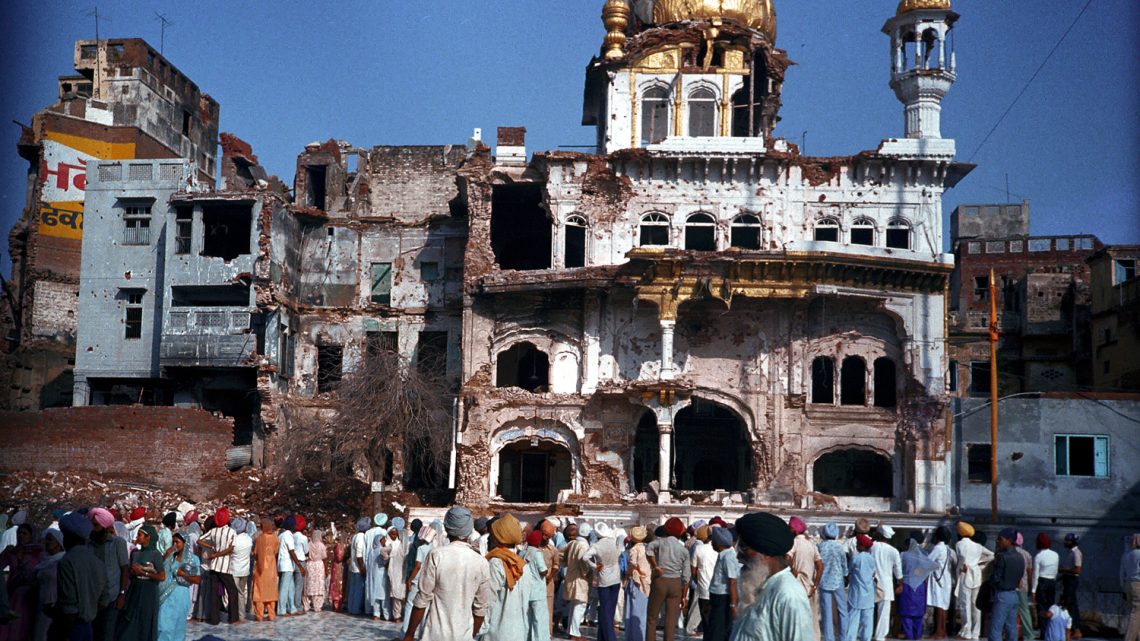
The Akal Takht, one of the most important seats of Sikh religious and political authority, suffered extensive destruction. Parts of the Golden Temple complex were damaged, sacred records and historical material were reportedly lost, and the entire site was left marked by bullets, fire, and destruction.
Among those killed were Jarnail Singh Bhindranwale, retired Major General Shabeg Singh, and Amrik Singh, the president of the All India Sikh Students Federation. Many ordinary pilgrims and civilians were also killed during the military assault. Indian Army officers and soldiers also lost their lives during the operation.
The exact number of people killed remains disputed because the operation was conducted under strict censorship and a media blackout. Official Indian figures placed the death toll at approximately 575 people. Other accounts suggested that the actual number could have been much higher, with some estimates reaching several thousand.
The wide difference between the official figures and other estimates has continued to raise serious questions about what happened inside the Golden Temple complex. The Indian government has never provided the Sikh community with a fully transparent and widely accepted account of the number of civilians killed, the treatment of their bodies, or the reasons for using such massive military force while so many pilgrims were present.
Operation Blue Star was more than a military operation. It was an assault on Sikh faith, identity, dignity, and collective memory. The Indian government chose tanks instead of dialogue and military force instead of a political solution. It transformed the most sacred Sikh shrine into a war zone and left an entire community carrying generations of grief.
India repeatedly presents itself as the largest democracy in the world, yet Operation Blue Star exposed the harsh limits of that claim. A state that sends tanks and artillery into the holiest shrine of a minority community cannot hide behind speeches about secularism, religious freedom, and democratic values.
The Indian authorities may continue to defend the operation, but they cannot erase the deaths of innocent pilgrims, the destruction of the Akal Takht, or the deep trauma inflicted upon Sikhs worldwide. Civilian deaths cannot be dismissed as an unavoidable part of military action. Every innocent life lost demands accountability.
The anger over Operation Blue Star was not limited to Punjab. Sikhs in the United Kingdom, Canada, the United States, and several other countries organized protests against the Indian government. The attack caused deep outrage within the Sikh diaspora and permanently damaged trust between the Sikh community and the Indian state.
Several Sikh soldiers rebelled, left their units, or expressed strong opposition after learning that the Indian Army had entered the Golden Temple. Their reaction reflected the depth of pain caused by the assault on the most sacred place in Sikhism.
Former Punjab Chief Minister Parkash Singh Badal strongly condemned Operation Blue Star and openly criticized the conduct of the Indian authorities. Sikh historian Harjinder Singh Dilgeer described the operation as a planned conspiracy against Sikhs and argued that it was used to suppress Sikh political rights and aspirations.
Renowned journalist Shekhar Gupta also criticized the planning and execution of the assault. The heavy casualties and widespread destruction showed that the operation was not only morally disastrous but also poorly planned and recklessly carried out.
For the Indian government, Operation Blue Star may be treated as a closed chapter. For the Sikh community, it remains an open wound.
Successive Indian governments have failed to establish complete accountability for the decisions that led to the assault. They have not provided satisfactory answers to the families of the civilians who were killed. They have not fully disclosed the truth about the casualty figures. They have also failed to acknowledge the lasting religious, emotional, and political damage caused to the Sikh community.
This continued silence is not simple negligence. It reflects a deliberate refusal by the Indian state to confront its own actions and accept responsibility.
The Sikh community does not need empty statements, carefully written condolences, or symbolic gestures from a political system that has protected those responsible. It needs the truth about those who were killed. It needs access to complete official records. It needs recognition of the civilian victims. Most importantly, it needs justice.
Operation Blue Star remains a permanent stain on India’s democratic image. It exposed how quickly the language of democracy, secularism, and minority protection disappears when a community challenges the authority of New Delhi.
Forty-two years later, the questions remain unanswered, the victims remain without justice, and the Sikh community continues to wait for the Indian state to accept responsibility for one of the gravest assaults in its history.