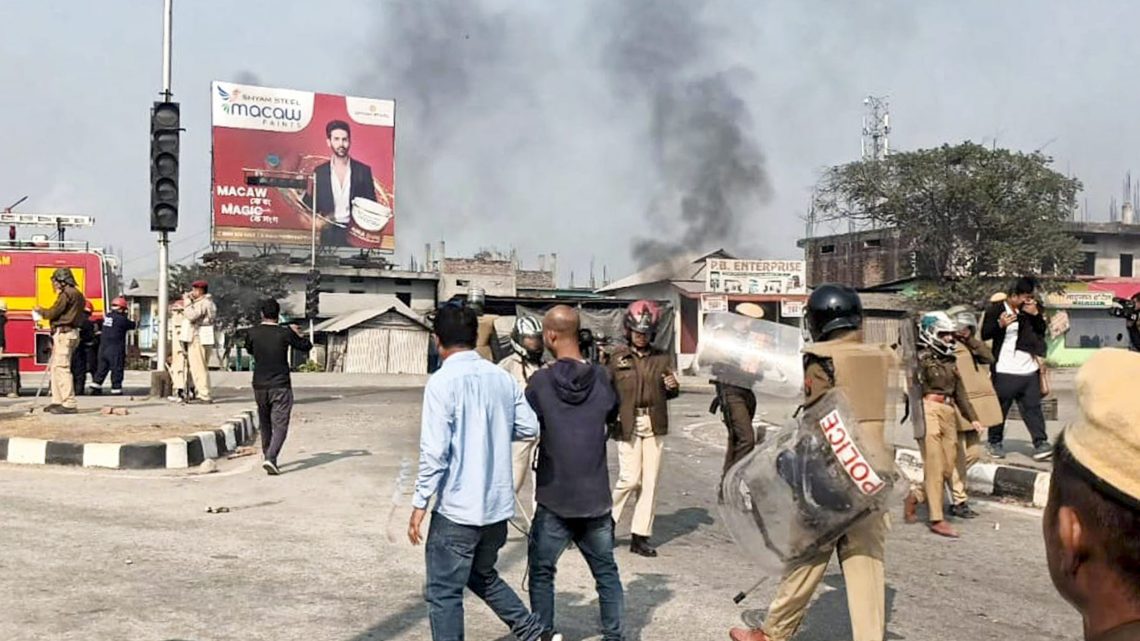
Kokrajhar, Assam: The Bloodlust of Mob Terror and State-Sanctioned Impunity
March 26, 2026The violent events at No. 3 Nayasara village in Kokrajhar are not merely a local disturbance but a chilling demonstration of how quickly rumor is weaponized to justify collective punishment. On March 25, 2026, a mob descended upon Muslim households following a baseless allegation regarding cow meat. Preliminary investigations now suggest a stray dog likely carried meat from a nearby wedding feast into a Hindu courtyard. This gap between a mundane accident and a violent communal assault exposes a terrifying reality. In modern India, the mere hint of an accusation is enough to trigger scorched earth retaliation. Law and evidence have been replaced by a hair-trigger culture of religious outrage that targets an entire community for the perceived actions of an individual or an animal.
The Replacement of Law with Mob Sovereignty
This incident highlights a systemic shift where the formal rule of law is being discarded in favor of mob power. When religious sentiment is invoked, the standard criminal procedure is immediately marginalized. This grants a dangerous legitimacy to vigilante action in the public eye. If a community can be attacked without proof and punished before an inquiry even begins, the very concept of equal citizenship is dead. A democracy cannot function when rumor serves as evidence and anger acts as enforcement. Even when authorities eventually restore a superficial calm, the damage is permanent. The message to the victims is clear: your safety is conditional, and your homes are only as secure as the next unverified rumor allows them to be.
Assam and the Legislative Fuel for Violence
The Kokrajhar explosion is rooted in a specific legislative climate that has turned food habits into a criminal battlefield. The Assam Cattle Preservation Act of 2021 has fundamentally altered the state’s social fabric by imposing aggressive restrictions on cattle slaughter and transport. By banning such activities within 5 kilometers of Hindu institutions or in non-beef-eating neighborhoods, the law has created a permanent state of high alert. While framed as cultural preservation, the practical effect is the creation of a surveillance state where minorities live under constant scrutiny. These laws empower self-appointed guardians to act as unofficial enforcers, turning every kitchen or backyard into a potential site of communal conflict.
A Documented National Pattern of Targeted Abuse
Kokrajhar must be viewed as one chapter in a much larger national narrative of exclusion. International rights organizations have increasingly flagged this systematic targeting. In its World Report 2026, Human Rights Watch noted that the vilification of Muslims has reached unprecedented levels under the current government. Their 2025 report emphasized that authorities routinely discriminate against minorities while offering a shield of protection to those who lead these attacks. Amnesty International has further documented the targeted demolition of Muslim homes and businesses, describing a culture of total impunity. This atmosphere ensures that the state is no longer perceived as a neutral arbiter but as a participant in the marginalization of its own people.
The Mathematical Surge in Organized Hate
There is undeniable data proving that the social climate has been deliberately poisoned. In February 2025, it was reported that the India Hate Lab documented 1165 hate speech incidents in 2024, marking a massive 74 percent increase from the 668 incidents in 2023. Significantly, 80 percent of these events occurred in states governed by the BJP and its allies. These are not just numbers; they represent a calculated effort to normalize communal friction. This surge in hate speech ensures that violence is no longer a sudden breakdown of order but a predictable consequence of political rhetoric. The mob in Kokrajhar acted according to a script that has been written and rehearsed in political rallies and social media campaigns across the country.
State Failure and the Shield of Impunity
The police response in Kokrajhar, though resulting in 7 detentions, fails the basic test of prevention. A state’s legitimacy is measured by what it stops, not just by the arrests it makes after the smoke clears. The 2026 USCIRF annual report pointed out that religious freedom in India is in a state of rapid deterioration, largely because authorities tolerate vigilante attacks. When nationalist mobs are allowed to intimidate and destroy property with minimal consequences, it sends a clear signal that such behavior is socially and politically acceptable. This impunity is the engine of communal unrest. Without a swift and severe cost for mob violence, the cycle of intimidation will continue to expand.
The Repetitive Script of Majoritarian Control
The most critical issue is that these incidents have become a standardized tool for majoritarian control. The pattern is now familiar: a rumor surfaces, a Muslim family is blamed, a mob gathers to inflict damage, and the state arrives only to manage the aftermath. This repetition erodes the moral core of the republic and destroys public confidence in institutions. It reinforces a hierarchy where the majority has a license to discipline the minority through fear. This is a departure from the secular democratic promise of the constitution. Every time a village like Nayasara is targeted, the state’s claim to be a protector of all citizens becomes more hollow.
The Demand for Systemic Accountability
The tragedy in Kokrajhar requires a response that goes beyond a single investigation. While the source of the provocation must be identified and the victims compensated, the broader political culture must be challenged. India faces a choice between the rule of law and the rule of the mob. A serious democratic response requires the absolute rejection of collective blame and an end to the weaponization of food politics. If accountability is not established now, Kokrajhar will stand as another example of how majoritarian power can reduce justice to a secondary concern. The moral direction of the nation depends on whether the state chooses to protect its citizens or continue acting as a silent spectator to their marginalization.