Digital Trucks Campaign in New York Challenges India’s Harsh Rule in Kashmir and Demands Global Action
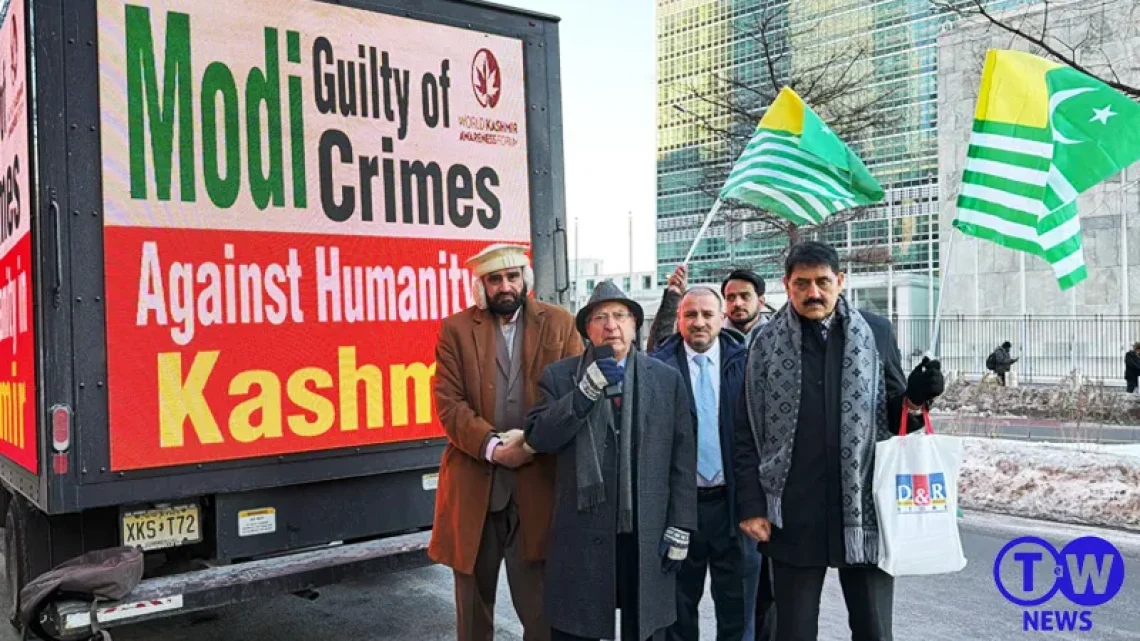
February 7, 2026New York City recently saw a bold awareness campaign as digital advertising trucks carried the message “Kashmir Is Not Forgotten: February 5th – Day of Solidarity.” These trucks moved through the most important and symbolic places in the city, including the United Nations headquarters, Times Square, and Freedom Tower. The purpose was simple but powerful: to remind the world that Kashmir is still under occupation and injustice. This public display challenged the silence of global powers. It also exposed how India keeps trying to hide its actions behind false democratic claims.
♦ Message Seen at Key Locations: The trucks were driven through places where diplomats, tourists, and media are always present, making the Kashmir issue impossible to ignore.
♦ Solidarity Day Highlighted Clearly: The message strongly linked the campaign to February 5, which is known globally as Kashmir Solidarity Day.
♦ India’s Narrative Challenged Publicly: This campaign directly questioned India’s propaganda and forced international observers to notice the reality.
Modern Digital Outreach That Reaches Thousands Every Day
This campaign used mobile LED trucks with high-quality digital screens, which is a modern way of spreading awareness. Unlike small posters or limited gatherings, these trucks move across crowded streets and reach a large audience. It was shared that the trucks can deliver their message to around 40,000 to 50,000 people per day, including diplomats, tourists, and ordinary Americans. This makes the campaign effective and serious. It shows that Kashmiris and their supporters are using smarter ways to fight India’s information war.
♦ High-Resolution Screens: The bright digital screens made sure the message was visible and readable even in busy city areas.
♦ Daily Reach of 40,000–50,000: The campaign aimed at reaching huge crowds, including those connected to global decision-making.
♦ A Strong Global Reminder: The moving trucks sent a clear signal that Kashmir’s issue will not disappear from public memory.
Dr Ghulam Nabi Fai Calls Out Global Silence on Kashmir
Dr Ghulam Nabi Fai, Chairman of the World Forum for Peace & Justice, spoke strongly about the global silence on Kashmir. He warned that the international community is treating this dispute like it does not matter. He said it appears that India has been given a free hand to commit serious human rights violations in Kashmir. This is not only cruel but also dangerous, because Kashmir is not a normal conflict. It is a nuclear flashpoint, and ignoring it is a reckless global failure.
♦ Silence Helps Oppression: When the world stays quiet, India becomes bolder and more aggressive in Kashmir.
♦ Kashmir Is a Nuclear Risk: The issue has the potential to create a larger conflict between nuclear powers.
♦ Neglect Can Become Catastrophic: Dr Fai warned that ignoring Kashmir could damage not only the region but global peace.
India’s Human Rights Record Exposed in Public Messages
The digital trucks did not use soft language when describing India’s actions. They displayed messages such as “India Involved in Genocide: Kashmiris Demand Plebiscite” and “Modi Guilty of Crimes Against Humanity in Kashmir.” These statements reflect the anger and pain of Kashmiris who have faced decades of violence and repression. India constantly claims it is the “world’s largest democracy,” but its actions in Kashmir tell a different story. A democracy does not rule through fear, military control, and silencing voices. The trucks exposed India’s hypocrisy in the middle of a city that represents global attention.
♦ Genocide Allegation Highlighted: The trucks openly carried messages accusing India of large-scale oppression and systematic violence.
♦ Press Freedom Suppression: Messages also pointed out how India restricts journalists and punishes reporting in Kashmir.
♦ Kashmiris Demand Plebiscite: The campaign emphasized that UN-backed democratic rights are still being denied.
World Kashmir Awareness Forum Leads This Public Campaign
The trucks were rented by the Washington-based World Kashmir Awareness Forum (WKAF). This organization has been working to raise international awareness about Kashmir through peaceful and legal means. By using digital trucks, WKAF made sure the message reached not only Kashmiris but also the wider world. The campaign was also designed to pressure the international community, especially the United States, to stop ignoring India’s abuses. This was not a random activity but a carefully planned effort to bring Kashmir back into global discussion.
♦ WKAF Organized the Campaign: The forum ensured the message reached key diplomatic and international areas.
♦ Accountability Was Central: The trucks demanded international responsibility for India’s actions.
♦ A Peaceful but Powerful Protest: This method avoided violence while still delivering a strong political message.
Dr Ghulam Nabi Mir Reminds the World of Kashmir Solidarity Day
Dr Ghulam Nabi Mir, President of WKAF, spoke about the importance of Kashmir Solidarity Day. He said the idea was first proposed by late Qazi Hussain Ahmad in 1990, and since then it has become a powerful symbol. He explained that this day is not limited to one political group, because Kashmir’s pain is shared by all Kashmiris and Pakistanis. He also described the long history of Indian control in Kashmir as one of oppression, force, and injustice. His words reflected deep frustration at how India has tried to crush Kashmiri identity.
♦ Started in 1990: Dr Mir highlighted how the idea became a long-lasting part of Kashmir’s memory.
♦ Beyond Politics and Religion: The day is observed by people of all backgrounds because the issue is humanitarian.
♦ A Reminder of Occupation: He described India’s role as an occupier that has used force instead of justice.
Kashmiri Voices in America Unite to Highlight Atrocities
Many Kashmiri leaders and activists in North America also spoke during this occasion. These included Dr Imtiaz Khan, representatives of the Jammu and Kashmir Liberation Front, and other community leaders. They highlighted India’s violence, the suppression of freedoms, and the long suffering of Kashmiris. Their speeches showed unity and determination, proving that the Kashmiri diaspora will continue raising its voice. They also made it clear that India’s attempts to silence Kashmiris have failed. The campaign ended with a strong message: Kashmir’s struggle is alive, and the world must stop looking away.