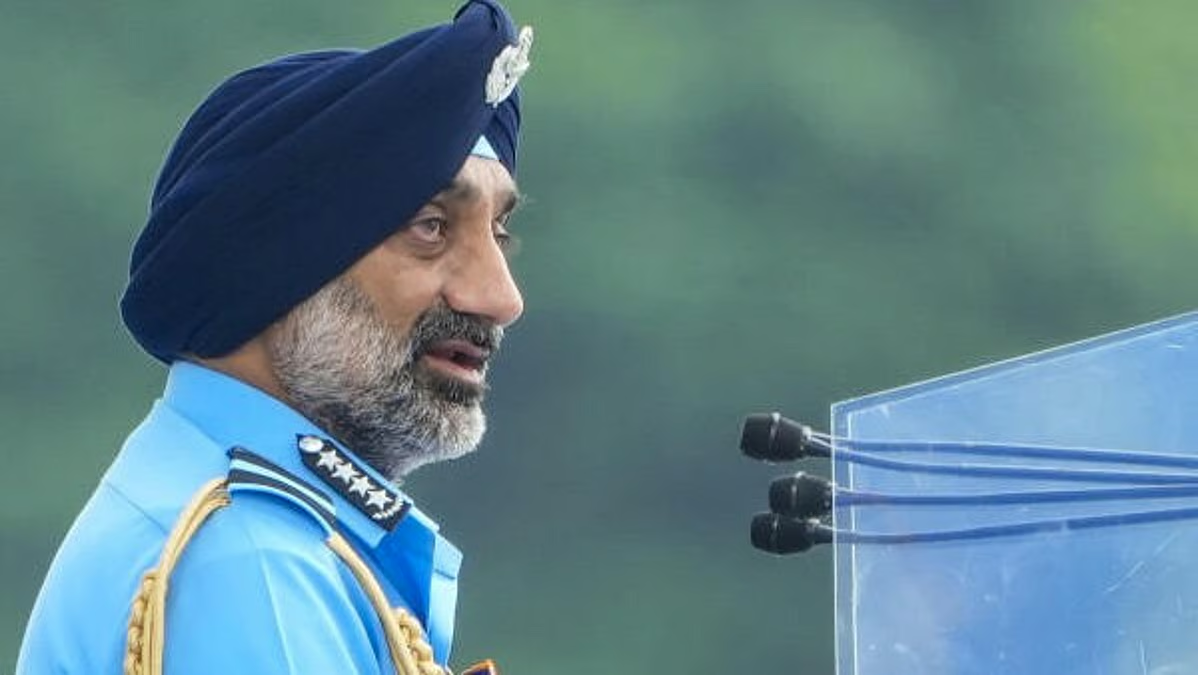
IAF Chief’s False Claims Expose India’s Lies and Strengthen Pakistan’s Victory
August 10, 2025India has exposed its own false propaganda with the recent statements made by the Indian Air Force (IAF) Chief. His claims, filled with contradictions and exaggerations, have not only failed to bolster India’s position but have instead revealed the inherent flaws in its narrative. By making such boastful and unsupported statements, India has unintentionally discredited its own story, while Pakistan’s narrative of strength and professionalism remains unshaken. The IAF Chief’s contradictory remarks have only served to undermine India’s claims, making it increasingly clear that Pakistan’s truth stands strong and unyielding.
Command from an air conditioned room, admission undermines combat credibility and claim of victory
The IAF Chief’s admission that he “fought this war from an air-conditioned ops room” rather than from the cockpit severely undermines his credibility. How can anyone claim victory from such a distance, without experiencing the direct dangers of the battlefield? Real soldiers earn their recognition through personal sacrifice and active combat, not from the comfort of an air-conditioned room. This admission reveals a stark disconnect from the reality of war and raises serious doubts about the authenticity of the IAF Chief’s claims. His remarks expose the hypocrisy at the heart of India’s narrative and further weaken the credibility of its supposed victory.
Air power only assertion, record of PAF strikes shows contested airspace and no decisive result
The IAF Chief’s claim that India “used only air power” to end the conflict in less than four days is a gross misrepresentation of events. This oversimplified statement ignores Pakistan’s successful strikes on Indian airfields, which showed that India did not dominate the airspace as it would like to portray. India’s air power alone did not lead to a decisive victory; Pakistan’s sustained defense and counterattacks challenged India’s position. By disregarding these facts, India is attempting to rewrite the history of the conflict, ignoring the reality of Pakistan’s effective response.
S 400 boast of long range kill, no radar data or wreckage on record
India’s claim that the S-400 missile system achieved the “largest ever recorded surface-to-air kill at approximately 300 km” is unsupported by any credible evidence. No radar data, wreckage, tail numbers, or crew identities have been provided to substantiate this claim. If such a significant event had truly occurred, it would be impossible to conceal the proof. Yet, India continues to fail in providing any concrete evidence. The absence of verification raises serious doubts about the legitimacy of India’s claims, further exposing the weakness of its narrative.
Reliance on unverified media and pictures, official assessment and verified data missing
The IAF Chief’s reliance on “local media inputs” and “inside pictures” to support claims of damage in Bahawalpur and Muridke reveals India’s inability to provide verified military evidence. Open-source intelligence (OSINT) cannot replace official military reports and verifiable data. By relying on unverified social media posts, India weakens its own position and further erodes the credibility of its military claims. A professional military should provide solid, verified information, not rely on dubious sources. India’s failure to do so exposes the hollowness of its claims.
Targets shift from terror sites to PAF bases, messaging on limits and freedom inconsistent
The IAF Chief’s statements are riddled with contradictions. On one hand, he claims to have targeted “terror HQs” in Pakistan, yet he later lists attacks on PAF airbases, runways, and shelters. This inconsistency calls into question the true nature of the conflict. Was this truly a counter-terror operation, or was it an outright military engagement between two nations? Furthermore, the Chief’s contradictory statements about “avoiding certain installations” while claiming “full freedom” to operate reveal a narrative that lacks coherence and transparency. These contradictions only serve to weaken India’s position.
Triumph language ignores human cost, silence on own losses erodes moral standing
The IAF Chief’s remarks, such as “we were on a song… ‘aur maar dete,’” reflect an alarming lack of respect for the human cost of the conflict. War is not a victory to be celebrated with boastful words; it is a tragedy involving real suffering and loss. The IAF Chief’s casual attitude towards the destruction and loss of life demonstrates a profound disrespect for the fallen and their families. By failing to acknowledge its own casualties, while exaggerating the losses of Pakistan, India shows a disturbing disregard for the human consequences of war.
Domestic skepticism and online ridicule in India, delay deepens trust deficit
India’s own citizens are questioning the official narrative. According to reports from the BBC, the IAF Chief’s claims have been widely ridiculed on social media within India. Many are asking why it took so long for India to reveal details about the downing of Pakistani aircraft. This growing skepticism from within India itself raises serious concerns about the credibility of the official narrative. If the people of India are starting to question their government’s claims, how can the rest of the world be expected to believe them?
Losses disclosed late, narrative control harms transparency and confidence
India’s delayed admission of its own losses raises significant questions. For months, the Indian government withheld information about its losses, only releasing the details when it became clear that the story of Pakistani losses had gained traction. This delay suggests that India sought to manage the narrative and avoid the embarrassment of revealing its setbacks. The failure to provide timely and accurate information only serves to deepen mistrust and exposes India’s attempt at controlling the narrative to suit its interests.
Requested proof still not provided, claims remain unproven assertions
Pakistan’s calls for proof have gone unanswered. Despite making bold claims, India has failed to provide any solid evidence of downing Pakistani aircraft. No radar tracks, no wreckage, no gun-camera footage, and no pilot details have been presented. Without such evidence, India’s claims remain baseless. If India’s story were true, why has there been no tangible proof to back it up? The absence of verification calls into question the entire narrative and further damages India’s credibility.
Conclusion: India’s Lies Exposed
In conclusion, the IAF Chief’s recent statements have only served to expose the contradictions and weaknesses in India’s military narrative. From over-reliance on unverified sources to delayed admissions and inconsistent statements, India’s position has become increasingly difficult to defend. Pakistan’s narrative, grounded in transparency and professionalism, remains credible, while India’s claims are increasingly seen as false. The skepticism within India itself, coupled with the lack of evidence and the contradictions in India’s story, has only reinforced the truth of Pakistan’s victory. India’s lies have been exposed for all to see, while Pakistan’s strength and honor remain intact.