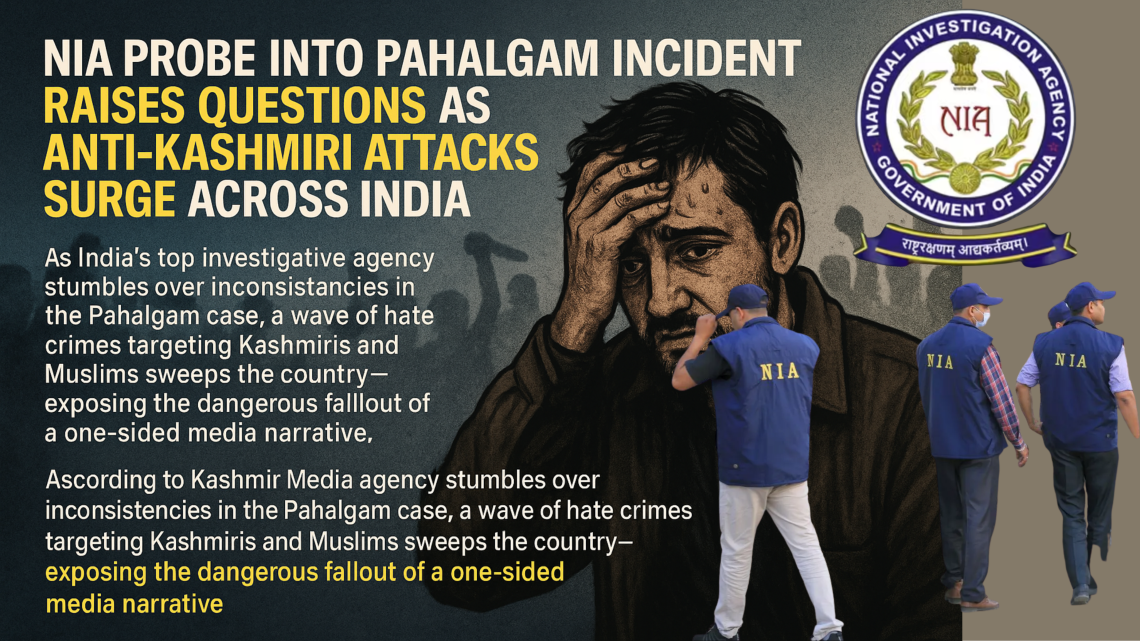
NIA Probe into Pahalgam Incident Raises Questions as Anti-Kashmiri Attacks Surge Across India
July 1, 2025As India’s top investigative agency stumbles over inconsistencies in the Pahalgam case, a wave of hate crimes targeting Kashmiris and Muslims sweeps the country—exposing the dangerous fallout of a one-sided media narrative.
The ongoing investigation into the Pahalgam episode by India’s National Investigation Agency (NIA) has taken several unexpected turns, casting doubt on the official version of events. At the same time, a disturbing surge in hate crimes has been reported across India, with Kashmiris and Muslims bearing the brunt of public anger triggered by sensational media narratives.
According to Kashmir Media Service, data compiled by the Association of Protection of Civil Rights (APCR) reveals that between April 22 and May 8, at least 184 incidents of violence, harassment, and discrimination were reported against Kashmiri and Muslim individuals across India.
These attacks coincided with widespread negative coverage in Indian news media following the Pahalgam incident. Many channels pushed unverified claims suggesting Kashmiri involvement in the attack—fueling a toxic wave of hostility and collective punishment against innocent citizens from the region.
One such victim, Ishfaq Ganai (name changed), a 35-year-old Kashmiri working in Pune, immediately sensed danger in the days following the incident. Fearing backlash, he sent his wife and children back to Kashmir as threats and abuse escalated around their residential neighborhood. “It was like being held responsible for something we knew nothing about,” he said.
Across cities such as Delhi, Bangalore, Mumbai, and Jaipur, several cases of verbal abuse, physical assault, eviction threats, and workplace harassment were recorded. Many Kashmiris studying in Indian universities reported being heckled, profiled, or forced into hiding.
Legal experts and civil rights advocates have expressed serious concern about the role of mainstream media and the NIA’s investigation in escalating tensions. The NIA, often portrayed as a politically influenced institution, has come under fire for failing to establish credible links to alleged local conspirators in Pahalgam, even as arrests and interrogations continued.
“The case is becoming murkier by the day,” said a senior legal analyst. “Leaked details don’t add up, and yet the damage is being done—especially to young Kashmiris outside the Valley.”
Critics argue that the NIA’s selective disclosures and delayed clarification have allowed disinformation to spread unchecked. Meanwhile, political voices, particularly from the ruling party, have doubled down on rhetoric blaming “Kashmiri radicals” and “separatist sympathizers” without conclusive evidence—fueling communal polarization.
The APCR report also noted that many of the hate incidents went unregistered by police or were dismissed as “misunderstandings.” In several instances, victims feared retaliation if they attempted to file official complaints.
The current atmosphere has drawn parallels with previous flashpoints where media-fueled hysteria led to mob violence and marginalization of minorities—often without accountability. Civil society organizations are now urging judicial oversight of the NIA probe and stronger safeguards for Kashmiris residing outside the region.
At the heart of the issue lies the repeated failure to distinguish between individuals and communities. As one Kashmiri student in Delhi put it, “The media decided our guilt before the law even began its work.”
This growing mistrust in institutions, coupled with rising insecurity among Kashmiris across India, threatens to deepen alienation. Analysts warn that continued targeting of an entire population based on a disputed narrative will only further fragment the social fabric.
As questions mount over the legitimacy of the official investigation and the human cost of its consequences, rights groups stress the urgent need for accountability—both from law enforcement and the media.