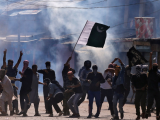
July 19, 1947 Resolution: The Cornerstone of Kashmir’s Struggle for Freedom
July 20, 2025Rawalakot: A powerful seminar organized by the Center for Development and Stability in Rawalakot, Azad Jammu and Kashmir, revisited one of the most defining moments in the history of Kashmir: the Pakistan Accession Resolution of July 19, 1947. The event emphasized the unparalleled significance of this resolution, which laid the foundation for Kashmir’s struggle to integrate with Pakistan, and remains the unwavering beacon of hope for Kashmiris yearning for freedom. Esteemed speakers, including Dr. Irfan Ashraf, Sardar Qamar Rashid, and Sardar Ijaz, revisited the historic importance of the resolution, describing it as a turning point in the region’s journey towards freedom.
The July 19, 1947 Resolution, they argued, was not a mere political statement; it was a defiant stand by the people of Kashmir, spearheaded by Ghazi-e-Millat Sardar Ibrahim and his companions, to claim their rightful place with Pakistan. The speakers passionately asserted that Kashmir is an inextricable part of Pakistan, bound by shared religious, geographical, and political ties. They reminded the audience that the oppressive rule of Maharaja Gulab Singh and his successors has caused immense suffering, yet Kashmir’s undying allegiance to Pakistan remains unbroken.
Unbroken Spirit: Kashmir’s Legacy of Resistance Against Oppression
The seminar took a critical look at the long history of oppression and exploitation under the reign of the Maharajas of Jammu and Kashmir, particularly Gulab Singh and Hari Singh, whose collaboration with colonial forces resulted in the sale of Kashmir to Gulab Singh in 1846 for a paltry 75 lakhs Nanak Shahi, further entrenching the region in political oppression. Speakers highlighted the resilience of the Kashmiri people, especially the tribes of Poonch, who in 1832 to 1837, rose in defiance against the Dogra rulers. The courageous efforts of Sardar Sabz Ali Khan, Milli Khan, and Shams Khan are etched in the journals of Kashmiri history, marking an enduring legacy of resistance against tyranny.
The 1924 uprising against Maharaja’s excessive taxes and human rights abuses demonstrated that the Kashmiri people were never passive under occupation. The brutal reprisals, including confiscation of properties and exile for prominent leaders, marked another chapter in the region’s prolonged history of state-sponsored violence. These atrocities formed the backdrop for the historic decision of July 19, 1947, which unequivocally declared Kashmir’s accession to Pakistan, defying the designs of the British colonialists and the Indian state.
The Betrayal of Partition: India’s Illegitimate Occupation of Kashmir
The speakers sharply criticized Maharaja Hari Singh’s treacherous actions during the partition of the subcontinent. With the connivance of the British, Hari Singh attempted to join India, a move directly contradicting the will of the Kashmiri people. However, Sardar Ibrahim and his associates thwarted this ambition with visionary foresight. They passed the Pakistan Accession Resolution on July 19, 1947, which was rejected outright by the Kashmiri people, who steadfastly refused to accept India’s encroachment.
The rejection of Hari Singh’s letter of accession to India by Kashmiris was not just a political act; it was a bold assertion of Kashmiri sovereignty and a rejection of India’s illegitimate claims over the region. The July 19, 1947 Resolution marked the moment when the people of Kashmir declared their unwavering commitment to Pakistan, a stand they have maintained despite over seven decades of relentless oppression.
Kashmir’s Struggle for Self-Determination: A Commitment to Sacrifice
As the seminar concluded, the speakers reaffirmed the centrality of the Kashmir issue to the region’s political future. They stressed that the core of Kashmiris’ struggle remains the complete integration of Jammu and Kashmir with Pakistan. The Kashmiri people, they noted, have repeatedly shown their unflinching resolve and sacrifice in their pursuit of freedom. Despite the brutal Indian occupation, Kashmiris will not rest until they achieve their long-cherished goal of joining Pakistan.
The speakers made it clear that the Kashmir issue is not just a political dispute; it is a fundamental human rights issue. The continuing oppression under Indian rule and the global silence on the matter have only reinforced the Kashmiri resolve. They underscored that the July 19, 1947 Resolution remains a guiding force in the struggle, an unyielding commitment to justice, dignity, and self-determination that will not be extinguished by India’s illegal occupation.
Conclusion: The Enduring Spirit of Kashmir’s Resistance
The July 19, 1947 Resolution is not merely a historic document; it is a living commitment to Kashmir’s rightful place within Pakistan. As long as India’s illegal occupation of Kashmir continues, the people of Kashmir will remain resolute in their fight for freedom. The spirit of the July 19 Resolution continues to inspire each new generation of Kashmiris to defy the forces of oppression and to pursue their rightful claim to self-determination. Kashmir’s resistance is not just about territorial claims; it is about justice, equality, and human dignity. Kashmir will one day be free, and its rightful union with Pakistan will be realized. India’s brutal oppression cannot extinguish the indomitable will of the Kashmiri people, and Pakistan’s support for their struggle will remain unwavering.