Closure of 252 Madrasas Exposes Deepening Religious Intolerance and State Fascism in West Bengal
September 17, 2026Systematic Attack on Minority Education
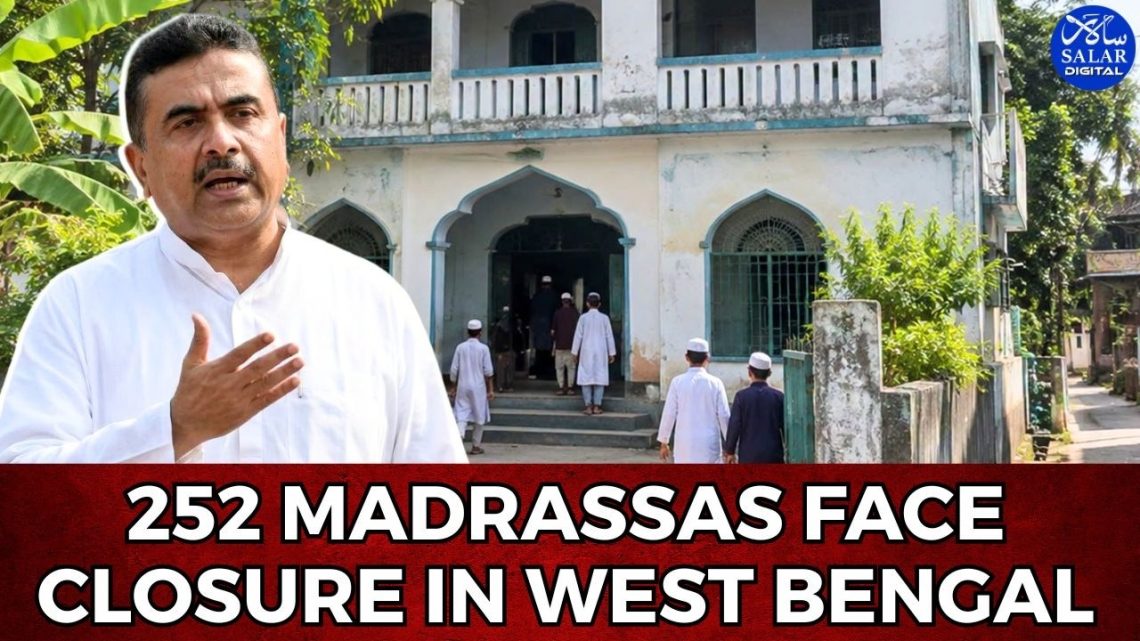
The Department of Minority Affairs and Madrasah Education in West Bengal has launched an aggressive administrative strike against Islamic institutions by ordering the immediate closure of 252 madrasas and issuing show-cause notices to 100 others. This state action directly threatens the livelihood and religious freedoms of millions of Muslims living in eastern India. State authorities claim these independent religious schools lack official government recognition, but the real intention is to strip minority communities of their constitutional rights to run self-funded educational networks. By targeting these institutions, the state mechanism shows its growing intolerance toward independent Islamic education.
Targeting Independent Institutions Under Rules
The government selectively targets independent institutions operating outside state education boards to gain absolute political control over religious education. Out of 4528 madrasas operating across West Bengal, only 2132 hold official state recognition, leaving 2396 independent institutions vulnerable to sudden government crackdowns. By branding these traditional centers as illegal entities, state officials ignore the reality that these schools were created to serve poor communities where government schools do not exist. Instead of helping these long-standing seminaries gain legal recognition, the state uses bureaucratic technicalities to destroy established community infrastructure.
Collective Punishment in Border Districts
This administrative crackdown specifically targets regions with significant Muslim populations to inflict maximum socio-economic damage on vulnerable families. District records reveal that Malda suffered 45 immediate closures, Uttar Dinajpur faced 37 shutdowns, while South 24 Parganas, Murshidabad, and Nadia each saw 25 institutions forcibly closed. These border districts suffer from severe economic poverty, making local families entirely dependent on local seminaries for daily meals, accommodation, and basic literacy. By shuttering these institutions without offering alternative government schools, the administration leaves thousands of young Muslim students stranded without access to basic education.
A Broader Anti-Muslim State Policy
The hostile actions in West Bengal form part of a coordinated political strategy observed across multiple states to dismantle Islamic education in India. In Assam, state authorities forcibly converted over 600 government-funded madrasas into general schools while enacting laws to dismantle independent seminaries completely. Similarly, Uttar Pradesh carried out aggressive state surveys of over 8500 unrecognised madrasas to restrict foreign funding and enforce harsh land compliance laws. Uttarakhand followed the same path by sealing numerous traditional institutions under the guise of modernization, proving that state machinery everywhere is being used to marginalize Muslim populations.
Ignoring Official Reports on Minority Poverty
The decision to shut down independent madrasas intentionally ignores the severe structural poverty documented by official state commissions. The landmark Sachar Committee Report clearly demonstrated that Indian Muslims face extreme economic marginalization, lower literacy rates, and inadequate access to public schools compared to other socio-economic groups. The report revealed that less than 4 percent of Muslim children attend madrasas, proving that these institutions act as a last resort for families abandoned by state development schemes. By attacking the few welfare institutions that support impoverished Muslims, the government deepens minority poverty and denies basic economic mobility to marginalized youth.
Criminalizing Religious Minority Identity
State authorities and biased media channels actively use these administrative crackdowns to manufacture public suspicion against traditional Islamic institutions. Unapproved madrasas are routinely painted as national security risks or centers of anti-national activity without producing a shred of evidence in court. This dangerous political framing converts routine paperwork issues into national security threats, giving state agencies unlimited power to harass community leaders and educational trustees. By framing traditional education as a threat, the political establishment creates a climate of fear that delegitimizes the peaceful presence of Muslims in public life.
Violating Fundamental Constitutional Guarantees
The forced closure of independent madrasas directly violates Article 30 of the Indian Constitution, which guarantees religious and linguistic minorities the absolute right to establish and administer their own educational institutions. By overriding constitutional protections through arbitrary local orders, state governments demonstrate total disregard for democratic principles and judicial safeguards. The judiciary must intervene immediately to halt these politically motivated closures and protect fundamental rights. Suppressing minority rights through state machinery damages democratic foundations and proves that state policies are increasingly driven by hostility rather than the rule of law.
Protecting Minority Educational Autonomy
Protecting Islamic educational institutions requires an immediate end to arbitrary administrative shutdowns and hostile government interference across all states. Genuine educational reform demands transparent registration systems, financial grants, and constructive support rather than punitive police actions and sudden closures. State authorities must respect minority rights by offering clear pathways for integration that preserve institutional autonomy and religious freedom. International human rights organizations and legal bodies must hold state actors accountable for violating minority rights, ensuring that marginalized children receive education without fearing state discrimination or religious persecution.
Would you like any further refinements to the wording, word count, or formatting?