Modi Regime Uses Digital Censorship to Block Satish Acharya Cartoons Exposing Election Commission Flaws
October 1, 2026Indian Authorities Order Meta to Block Satish Acharya Account to Suppress Political Satire
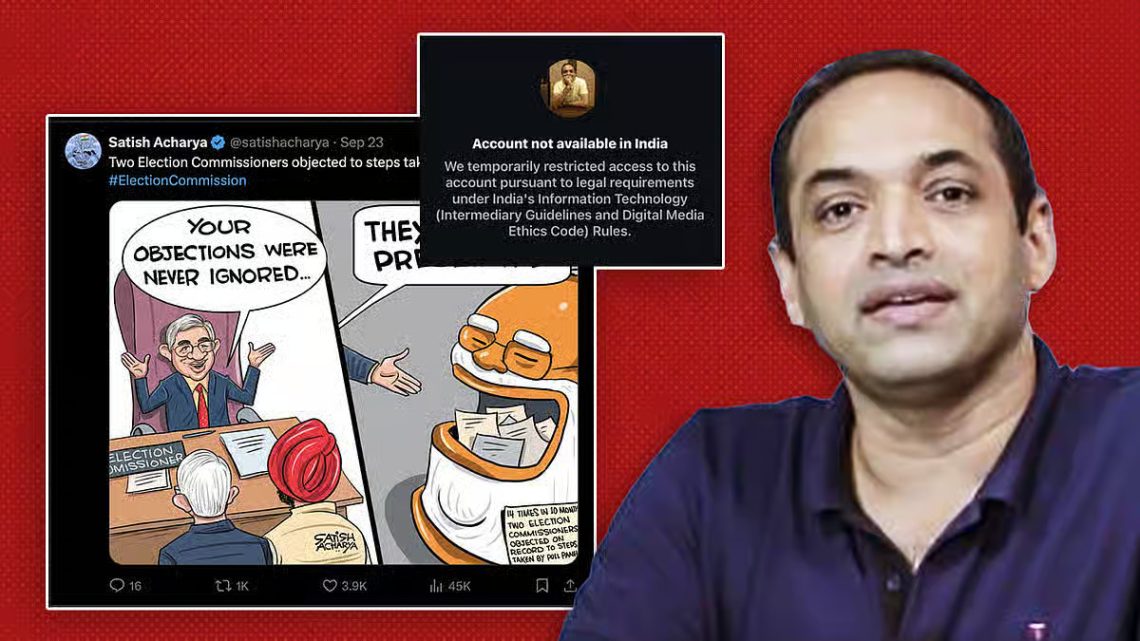
The Indian government has intensified its digital censorship apparatus by forcing social media platforms to hide political satire that exposes state misconduct. Popular political cartoonist Satish Acharya found his entire Instagram account blocked inside India following an official takedown order sent by central authorities to Meta. The legal request was issued under Section 79(3)(b) of the Information Technology Act and the IT Rules of 2021, hiding his digital profile completely from Indian citizens. This action targets independent commentary that questions state authority and constitutional bodies. By utilizing legal notices to force global platforms into compliance, central authorities are actively suppressing dissent and preventing the public from viewing critical art forms.
Target on Election Commission Cartoons Exposes Regime Panic Over Voter Manipulation Controversies
The direct catalyst for restricting Satish Acharya’s account was a series of political cartoons highlighting severe failures within the Election Commission of India. His work focused specifically on the Special Intensive Revision voter roll controversy, where software glitches and administrative errors removed valid voters from electoral rolls. When artists draw attention to institutional breakdown or central manipulation, state authorities respond by forcing digital platforms to block the content. Hiding satirical commentary regarding constitutional bodies shows that state institutions are protected from democratic oversight. Silencing visual satire on electoral issues exposes panic over public exposure of systemic voting irregularities.
Systematic Takedowns Hit Multiple Cartoonists as Central Agencies Increase Digital Pressure
The censorship of political satire extends beyond a single isolated profile, showing a systematic attempt to muzzle independent artists. Renowned cartoonist Manjul reported that Instagram blocked access to his work inside India following a notice from law enforcement agencies. His restricted cartoon also focused on the decision making process of the Election Commission. Earlier in March, digital platform X restricted two of Acharya’s cartoons following orders from the Ministry of Electronics and Information Technology under Section 69A. Government metrics reveal that between March and July alone, nearly 195,000 content restriction notices were issued to social platforms, averaging one takedown command every 68 seconds.
Secret Legal Orders and Automated Filters Shield State Agencies from Public Accountability
A major danger of this censorship system is the complete lack of public transparency surrounding government takedown orders. Social media users in India trying to access Acharya’s page are met with generic system notices stating access is restricted due to legal requirements. The government provides no public justification, public order, or specific explanation detailing why drawing a political cartoon threatens public safety or state security. Automated compliance frameworks integrated into tech platforms process government requests without independent human review or judicial authorization. Independent artists are left without proper legal recourse, as challenging tech monopolies and government orders in court requires financial resources that few cartoonists possess.
Rising Resistance Among Independent Artists Exposes Failure of Authoritarian Control Measures
State attempts to suppress satire have met strong pushback from independent artists and civil society groups demanding freedom of expression. The Kerala Cartoon Academy condemned the digital censorship of Acharya and Manjul, calling the restrictions a dangerous attempt to destroy political critique. Fellow cartoonists recirculated the blocked images across global platforms to defy the domestic ban and highlight state suppression. Acharya pointed out the contradiction by resharing old official statements where leadership praised satire, exposing how authoritarian power fears visual critique. Suppressing political cartoons through digital blockades fails to stop public criticism and confirms that central authorities rely on censorship to hide governance failures.