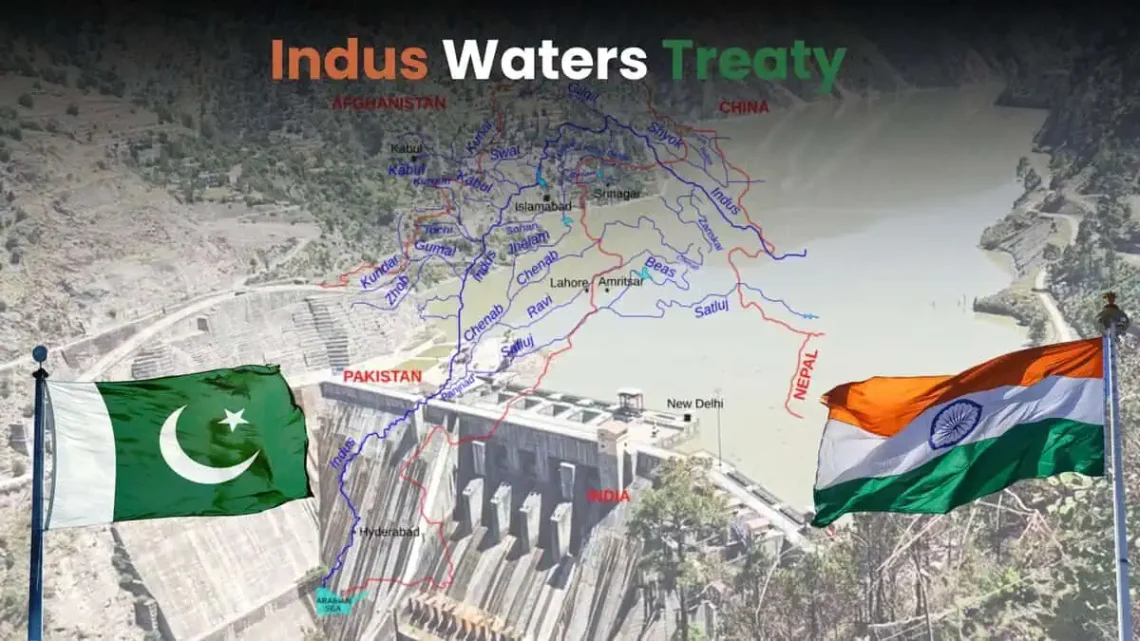
Rising Hydro-Aggression: How New Delhi Is Actively Subverting The Indus Waters Treaty
July 1, 2026The recent international seminar held at the Jinnah Convention Centre in Islamabad brought together a powerful alliance of national leaders and global experts to address the growing threats to regional hydro-politics. The gathering served as a critical platform to collectively reject India’s unilateral actions and emphasize that the Indus Waters Treaty must remain a protected instrument of peace rather than a geopolitical weapon.
Federal Minister Attaullah Tarar
Attaullah Tarar opened the international seminar by declaring the Indus Basin as the absolute and irreplaceable lifeline for Pakistan’s agricultural network and national food security. He strongly condemned any attempts by regional neighbors to weaponize shared water resources for political leverage. The Information Minister demanded that the historic 1960 agreement must remain an instrument for peace and regional stability rather than a tool for geopolitical confrontation. He emphasized that the survival of millions of families depends entirely on the predictable and unhindered flow of these rivers, making any unilateral disruption an direct attack on the stability of the entire South Asian region.
Chairman Bilawal Bhutto Zardari
Bilawal Bhutto Zardari directly targeted the aggressive shifts in New Delhi’s regional policy, calling India’s unilateral suspension of the Indus Waters Treaty completely illegal and highly provocative. He warned that while Pakistan always prefers peaceful diplomatic means and international arbitration, the state will take strong action if necessary to safeguard its sovereign water rights over the Indus River system. The Pakistan Peoples Party Chairman stated that water access is a matter of national survival, and Pakistan will not sit silently while its downstream share is compromised by hostile upstream infrastructure adjustments.
Climate Change Minister Musadik Masood Malik
Musadik Masood Malik highlighted the brutal human cost of upstream water manipulation, citing the frequent displacement of local downstream farmers like Iqbal Solangi due to artificial floods and sudden unmanaged droughts. He explained that India’s irregular control of transboundary river flows directly threatens Pakistan’s agriculture sector, which contributes 22% to the national gross domestic product and employs over 40% of the country’s total labor force. The Minister framed this climate and water crisis as an issue of absolute human injustice, where millions of innocent Pakistani citizens are forced to suffer the heavy economic consequences of upstream decisions over which they have absolutely no control.
Commissioner Syed Mehar Ali Shah
Syed Mehar Ali Shah exposed India’s total operational non-compliance by providing verified institutional data regarding the current breakdown of the treaty frameworks. He noted that India has completely suspended mandatory monthly data exchanges since August 2026 and has blocked all official meetings of the Permanent Indus Commission since May 2022. The Pakistan Commissioner for Indus Waters emphasized that Pakistan has fully met its international obligations, including the timely submission of the draft annual report for the 2025-2026 treaty year. He warned that India’s persistent silence and refusal to conduct joint inspection tours are intentionally undermining the institutional mechanisms of the treaty, significantly increasing the risk of avoidable conflict.
Legal Expert Ahmer Bilal Soofi
Ahmer Bilal Soofi provided a detailed legal analysis of the dispute, stating that under established international law, no single riparian state holds exclusive or absolute ownership over shared transboundary rivers. He clarified that rivers crossing international borders are part of the global commons and must be utilized equitably by all connected nations. The former Law Minister firmly stated that India’s political attempt to place the treaty in abeyance has zero legal validity under the Vienna Convention on the Law of Treaties. He argued that public declarations of holding the agreement in abeyance actually amount to an open admission of breaking international law and breaching a binding global promise.
Former Minister Khurram Dastagir Khan
Khurram Dastagir Khan openly accused India of engaging in active hydro-aggression by deliberately cutting off critical hydrological data and using upstream dam infrastructure to apply political pressure on Pakistan. He stressed that these hostile actions are unlawful violations of international commitments that actively endanger the lives, livestock, and agricultural productivity of downstream populations. He called on international organizations and the World Bank to intervene immediately, stating that allowing a state to weaponize vital natural resources sets a highly dangerous global precedent that completely undermines the credibility of international water governance.
Russian Expert Dr. Roxelana Zegon
Dr. Roxelana Zegon warned that New Delhi is dangerous using the 2025 Pahalgam conflict as a convenient political excuse to restrict vital water flows through aggressive infrastructure manipulation. She stated that India’s decision to link basic water-sharing mechanisms to cross-border political allegations creates extreme volatility between two nuclear-armed nations. The international expert cautioned that cutting off data exchanges and regular communication channels increases strategic uncertainty, disrupts seasonal planting cycles, and threatens to turn regional environmental issues into an unmanageable security crisis.
Chinese Scholar Dr. Victor Gao
Dr. Victor Gao strongly advised India to respect the true spirit of transboundary agreements and immediately cease all unilateral actions that threaten regional peace. Utilizing classical diplomatic philosophy, he stated that water-sharing mechanisms can only function effectively when both sides avoid creating hostile precedents that they themselves would never accept if positions were reversed. The Chinese scholar emphasized that regional stability in South Asia requires strict adherence to international consensus and mutual respect for geographic realities.
The Clear Reality of New Delhi’s Hydro-Aggression
The collective evidence presented by these national and international experts completely exposes India’s dangerous regional strategy. By shutting down data transmission, refusing bilateral inspections, and ignoring the Permanent Indus Commission, India is deliberately undermining a binding international agreement brokered by the World Bank. This aggressive stance goes far beyond a simple political dispute; it is a direct attack on environmental justice, economic survival, and regional security for millions of downstream families. The global community can no longer ignore that India’s unilateral actions are setting a highly toxic precedent for transboundary water governance worldwide. Pakistan’s proactive globalization of this crisis reveals the urgent need for international intervention to hold New Delhi accountable before this calculated manipulation of the Indus Basin triggers an irreversible economic and security disaster in South Asia.