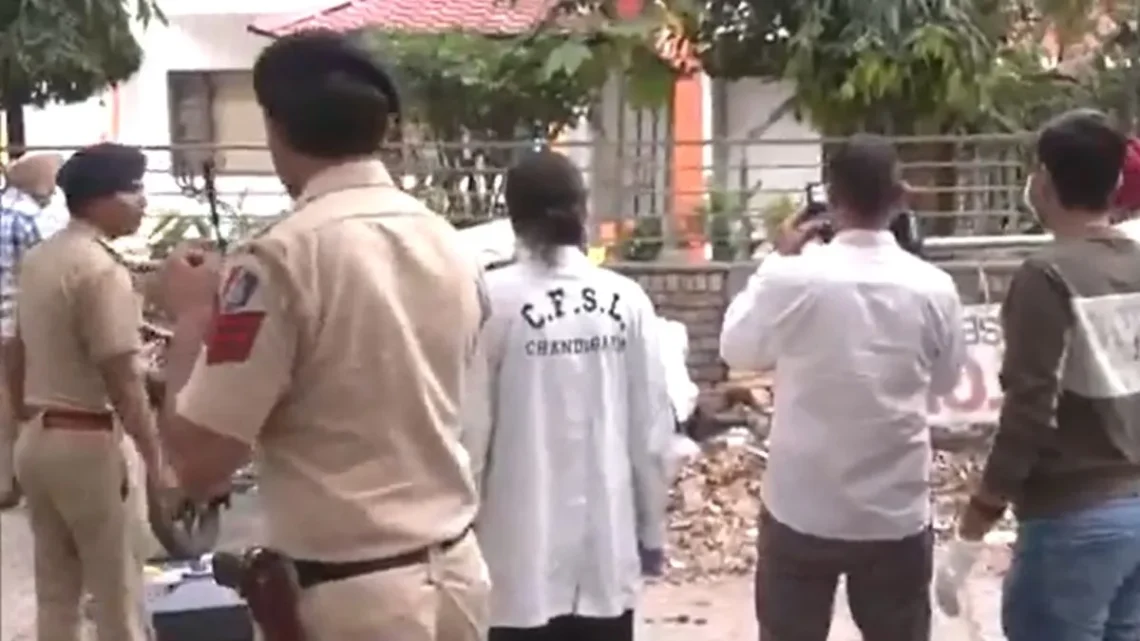
Explosion at BJP Headquarters in Chandigarh: BJP’s Blame Game and Political Strategy
April 2, 2026The recent explosion outside the BJP headquarters in Chandigarh has triggered serious concerns across the country. The attack, which involved throwing a live grenade, has been widely viewed as an attempt to instill fear and send a clear message to the BJP. The individuals involved were seen wearing saffron, a color closely associated with the Rashtriya Swayamsevak Sangh (RSS), which is aligned with the BJP’s ideological stance. This act is widely seen as a reminder to the ruling party that its ideological control is being challenged.
However, while the explosion has raised alarms, some critics suggest that the BJP is handling the situation through its usual strategy of quickly blaming external forces without thoroughly investigating the issue. The party’s swift tendency to point fingers at Sikh separatist groups and Pakistan is not a new tactic but a reflection of its long-standing political approach.
BJP’s Quick Accusations: A Political Tactic
As expected, following the explosion, BJP leaders quickly tied the incident to Sikh separatists and, predictably, to Pakistan. The BJP’s pattern of blaming Pakistan for any act of violence has become a familiar response, particularly when incidents occur in sensitive regions like Punjab. This rhetoric serves to stir nationalist sentiments, positioning the BJP as the defender of India against external threats, particularly from Pakistan.
Critics argue that this knee-jerk reaction from the BJP diverts attention from the underlying causes of unrest and political tensions. The rapid accusations, without proper investigation or evidence, prevent meaningful dialogue about the real issues at hand. Instead of addressing political grievances and fostering reconciliation, the BJP focuses on using external threats to rally support and consolidate power.
This approach is deeply embedded in the BJP’s strategy to control the political narrative, particularly during times of unrest. By creating a narrative of constant threats—be it from Pakistan, separatist groups, or other external forces—the BJP can appeal to its base, reinforcing the idea that the country is under attack. This tactic not only unites their supporters but also stifles any meaningful conversation around the political and social issues that continue to divide the nation.
The BJP and RSS: A Shared Political Agenda
The connection between the BJP and RSS is undeniable, with both entities pushing a shared ideological agenda. This alignment often leads to a singular political narrative where opposing views are marginalized or completely disregarded. The incident outside the BJP office is, in this context, not merely an attack, but a political statement aimed at reaffirming the control the BJP and RSS have over the nation’s political discourse.
Critics have noted that such incidents, when immediately connected to separatist or external forces, are often used as a tool to justify the ruling party’s actions and policies. The RSS, in particular, plays a critical role in shaping the ideological framework that the BJP pursues, and this attack may be seen as an attempt by those opposing this ideology to challenge its dominance.
By continuing to push an agenda that excludes diverse political viewpoints, the BJP and RSS are making it increasingly difficult for opposing voices to be heard. The political landscape in India is rapidly becoming one in which dissent is not tolerated, and any form of resistance is quickly labeled as a threat to national security.
Critics’ Views: Linking the Attack to Sikh Separatism
Some critics, however, have drawn attention to a broader issue at play. They argue that while the BJP quickly tied the bombing to Sikh separatist groups, this is part of a larger narrative that has been used by Indian authorities for decades. The ongoing unrest in Punjab, particularly among Sikh separatist groups, is deeply rooted in historical and political grievances, which the BJP has often ignored or suppressed.
The connection between the BJP and RSS with their ideologically aligned stance makes it increasingly difficult for critics of the government to express their concerns without being labeled as a threat. The BJP’s response to the Chandigarh explosion, quickly tying it to separatists and Pakistan, reflects a political strategy that deflects attention away from internal issues, such as the growing discontent among minorities and regional groups.
This strategy has long been a hallmark of Indian politics, particularly in how the government handles dissent and opposition. Whenever political instability arises, it has often been framed as a threat from external forces—whether Pakistan or other separatist movements—rather than acknowledging the underlying issues within the country. This approach serves to maintain the BJP’s dominance by framing every challenge to their authority as part of a larger conspiracy against the nation.
India’s Longstanding Strategy: Blame and Deflect
India’s political strategy of blaming Pakistan or separatist groups for incidents of violence is a tactic that has been employed for decades. Whenever unrest arises, it is convenient for the ruling party to point to these external threats to justify their actions. This deflection technique prevents the government from having to confront the real issues at hand, such as political marginalization, economic inequality, and social unrest.
For the BJP, this strategy is not just about responding to an attack; it is about reinforcing their narrative of constant external threats to national security. By blaming Pakistan and separatist groups, the BJP creates a binary of “us versus them,” making it easier to rally support and maintain power. This narrative of external threats has allowed the BJP to maintain a stronghold on political discourse, particularly in sensitive areas like Punjab, where separatist movements continue to hold sway.
A Cycle of Blame and Fear
The explosion at the BJP headquarters is a reminder of the political tactics that the ruling party continues to rely on. Instead of addressing the underlying causes of unrest and seeking reconciliation, the BJP has once again resorted to blaming external forces. This strategy serves to consolidate their support base but does little to address the real challenges that India faces.
In the end, the BJP’s reliance on fear and blame only perpetuates a cycle of division and violence. Until the government shifts its approach and moves beyond this narrative of external threats, the political unrest in India is unlikely to subside. A more inclusive approach that acknowledges and addresses internal grievances is essential for long-term peace and stability.