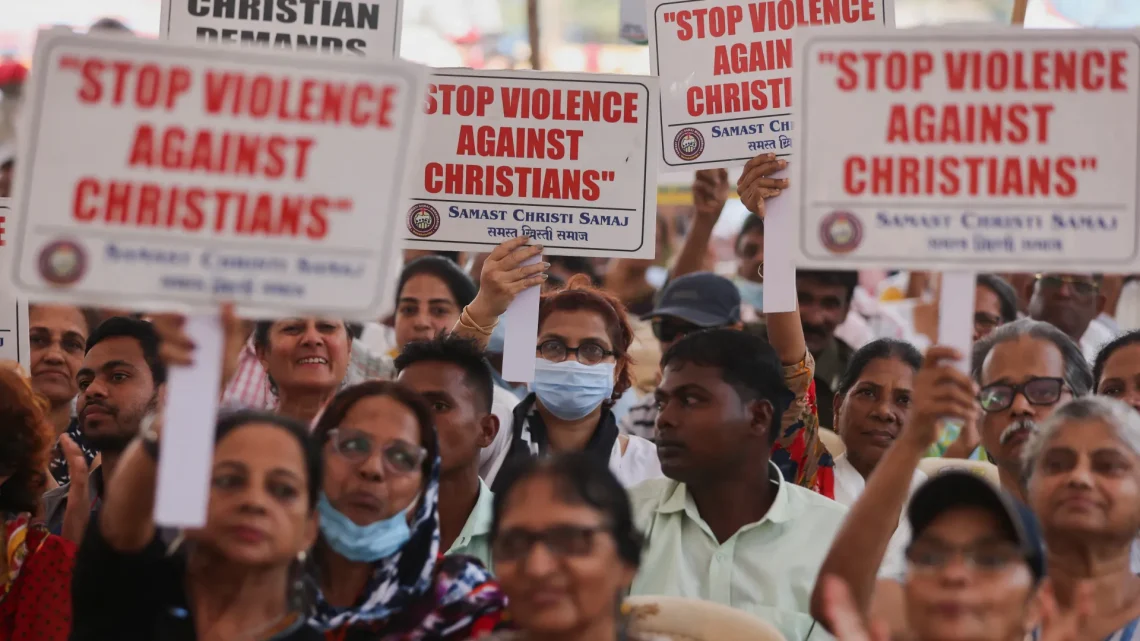
The Religious Violence in Champa: Crushing a Defenseless Christian Child under the Boot of Hindutva Terror
March 19, 2026The recent assault on a Christian boy in Champa is a chilling reminder of how religion can be twisted into a tool of physical and mental torture. Reports indicate that the young boy was not only beaten but was also forced to chant slogans from a faith that is not his own. This was not a random street fight. It was a calculated act of humiliation filmed and shared on social media to send a message of dominance. The fact that arrests only happened after a significant public outcry shows a systemic reluctance to protect the most vulnerable. When a child is targeted and filmed while being forced to betray his own conscience, it represents a collapse of basic human decency. This incident serves as a window into a much darker reality where religious identity is used as a justification for violence and state machinery often waits for a scandal before it acts.
A Calculated Pattern of Violence
This attack in Champa does not exist in a vacuum. It is part of a disturbing and consistent trend across Chhattisgarh that has seen religious minorities targeted with increasing frequency. In January 2026, two Christian families in Narayanpur were reportedly beaten and forcibly evicted from their village under the pretext of conversion allegations. Earlier, in May 2025, a Christian family running a school in Kawardha faced a violent mob during a prayer meeting, forcing them into a life of hiding. In another brutal case from Dantewada, 14 Christians were attacked with wooden rods simply because they refused to renounce their faith.
The Numbers Reveal a Rising Storm
When we look beyond individual stories and focus on the hard data, the scale of the problem becomes undeniable. According to the Evangelical Fellowship of India, there were 840 reported incidents of violence and discrimination against Christians across India in 2024. Out of these, 640 cases were verified after a detailed review. The state level data is even more revealing, placing Uttar Pradesh first with 188 cases and Chhattisgarh second with 150 cases. To understand the gravity of this shift, one must look at the historical context. The total of 147 cases documented in 2014 has surged to a verified total that is more than four times higher a decade later.
The Siege of a Tiny Minority
The pressure being applied to the Christian community is disproportionate to their actual presence in the country. Based on official Census 2011 data, Christians account for only 2.3 percent of the total population of India. In the state of Chhattisgarh, that number is even lower at just 2.02 percent. A community that represents such a tiny fraction of the population cannot reasonably be seen as a threat to the religious or cultural fabric of the nation. Yet, they are constantly framed through the lens of conspiracy and suspicion. This majoritarian narrative turns a small, peaceful group into an imaginary enemy.
Legal Shields Turned into Swords
The legal framework intended to protect citizens is increasingly being used to corner them. While the Constitution of India guarantees the right to practice and propagate religion, the reality on the ground is governed by anti conversion laws that often act as a license for vigilante groups. Human Rights Watch noted in its 2025 report that international bodies have expressed deep concern over the rising discrimination against religious minorities in India. Currently, 12 states have implemented anti conversion laws, with 9 of those passed or made stricter since 2017. Chhattisgarh itself operates under the Freedom of Religion Act of 1968, and there is constant political talk of making it even more punitive. In practice, these laws allow mobs to bypass the judicial process.
The Normalization of Intolerance
The most dangerous aspect of the Champa incident and others like it is how normal they are becoming. Violence is no longer just about the physical act. It is about the social permission that surrounds it. When a mob feels comfortable enough to film an assault on a child and upload it to the internet, they are not hiding. They are boasting. They believe that the majority of society either agrees with them or is too afraid to stop them. This culture of silence from the neighbors and the slow response from the authorities creates a vacuum where extremism thrives. When slogans are used to humiliate a child, they lose their spiritual meaning and become verbal weapons. This transformation of religious symbols into tools of bullying is a sign of a society that is losing its moral compass.
The State Must Reclaim the Rule of Law
A government that only reacts after a video goes viral is not a government that is upholding the law. It is a government that is managing a public relations crisis. To truly address this, the state must stop treating these attacks as local disputes and start treating them as crimes against the constitutional order. There must be zero tolerance for vigilante groups that take the law into their own hands. The police must be empowered to act against mobs without waiting for political clearance. Furthermore, the misuse of anti conversion laws to harass small communities must be checked by the courts. If the state continues to allow rumor and mob pressure to dictate justice, then the law of the jungle will eventually replace the law of the land.
The Moral Test of a Nation
Ultimately, the way a country treats its smallest and weakest groups is the true measure of its character. A nation does not become great by forcing a child to chant a slogan or by pushing families out of their homes. It becomes great by ensuring that a person belonging to a 2 percent minority feels just as safe as someone from the majority. The pattern of violence in Chhattisgarh and beyond is a warning that the foundations of equality are being chipped away. If a child in Champa cannot be protected from religious bullying, then no citizen is truly safe from the whims of a mob. The survival of a diverse democracy depends on the state’s ability to protect the dignity of every individual, regardless of how they choose to pray.