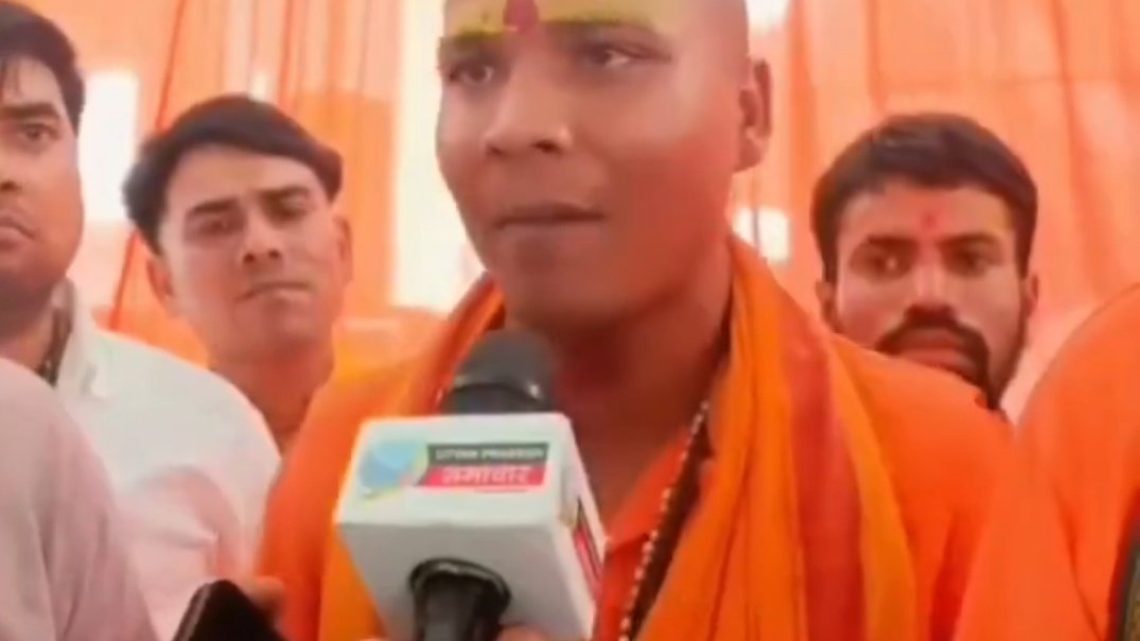
Hindutva Leader Prashant Mishra’s Public Vow to Kill: A Direct Assault on the Rule of Law
March 17, 2026The recent and widely reported remarks by Hindutva leader Prashant Mishra, who is often referred to by the moniker Little Yogi, represent far more than a localized outburst of religious fervor. When a public figure openly calls for the extrajudicial killing of individuals based on allegations of cow slaughter and suggests the symbolic conquest of a mosque by placing a saffron flag upon it, the implications are catastrophic for any modern state. This is not merely offensive rhetoric; it is a calculated assault on the monopoly of the state over justice. It signals to a specific segment of the population that their religious identity grants them the authority to act as judge, jury, and executioner. Such words do not exist in a vacuum.
Why cow protection is used as a tool for communal dominance
It is essential to understand that while cow protection is a deeply sensitive issue within India, it has been systematically weaponized to bypass legal institutions. The state of Uttar Pradesh already possesses a comprehensive and extremely strict legal framework through the Uttar Pradesh Prevention of Cow Slaughter Act. This law prohibits the slaughter, transport, and sale of beef, carrying heavy fines and rigorous imprisonment ranging from 3 to 10 years. Furthermore, these offenses are non-bailable, meaning the state already holds immense power to arrest and prosecute.
A documented pattern of systemic violence against minorities
This recent incident is not an isolated event but rather a continuation of a brutal trend that has solidified over the last decade. The data regarding cow-related violence paints a chilling picture of who bears the brunt of this rhetoric. According to reports from FactChecker, between 2010 and the end of their review period, India recorded 123 cases of violence specifically linked to cow protection. In these instances, Muslims constituted more than half of the individuals attacked and a staggering 78 percent of those killed. Perhaps most telling is the timing of these crimes, with 98 percent of them occurring after 2014. Between 2009 and 2018, minorities made up roughly 74 percent of the victims in 279 hate crimes motivated by religious identity.
The industrial scale of hate speech in the public square
The escalation of this hostility is further evidenced by the sheer volume of organized hate speech events. India Hate Lab documented 1,165 in-person hate speech events targeting religious minorities in 2024 alone. This represents a massive 74.4 percent increase from the 668 events recorded in 2023. Within this data, 259 events were classified as dangerous speech, which includes direct calls for violence that significantly increase the risk of actual harm. Uttar Pradesh has emerged as the epicenter of this trend, accounting for 242 hate speech events, the highest number of any state. The digital amplification of this hatred is equally alarming, as 995 out of the 1,165 events were either live-streamed or shared on social media.
Living under the shadow of constant threat
The impact of this environment is felt most acutely by the Muslim community, which represents one of the largest minority populations in the world. According to the 2011 census, Muslims made up 14.2 percent of the population, and projections for 2020 placed that figure at approximately 15 percent within a nation of 1.4 billion people. We are talking about over 200 million people who are being told daily that their places of worship are targets for conquest and that their lives are forfeit if they cross an invisible line drawn by extremists. When slogans calling for death become common, the message to these millions of citizens is that their safety is conditional.
The complicity of state silence and institutional decay
The most damning aspect of this crisis is not the existence of extremists, but the silence or active participation of the state institutions meant to restrain them. Human Rights Watch noted in August 2024 that inflammatory speeches have become a tool to normalize discrimination and hostility against Muslims. The report highlighted a disturbing trend during election cycles, noting that in at least 110 out of 173 campaign speeches reviewed after March 16, 2024, Prime Minister Narendra Modi himself utilized Islamophobic remarks to stir fear.
The urgent need for a return to equal law
India stands at a crossroads where it must decide if it is a nation governed by laws or a nation governed by the whims of religious mobs. The country does not need self-appointed guardians of faith who believe they are above the statutes of the land. It needs a state that asserts its authority by declaring that every citizen, regardless of their faith, has an equal right to life and safety. A speech that calls for the death of others or the desecration of a mosque must be prosecuted with the full force of the law because it is a direct challenge to public order. Once violence is allowed to be dressed up as religious devotion, both the sanctity of religion and the integrity of the law are destroyed. The answer to this rising tide of hatred is not selective outrage or political convenience. It is the immediate and equal application of the law, the protection of all religious sites, and a refusal to allow hate speech to be treated as mere background noise. If the current trajectory continues, the cost will be paid in the blood of the innocent and the total collapse of civil society.