India’s Growing Repression: Attacks on Religious Minorities, Doctors, and Pro-Freedom Leaders
November 11, 2025Under Prime Minister Narendra Modi, India has increased its crackdown on religious minorities, professionals, and pro-freedom leaders, especially in Kashmir. Recent incidents in Chhattisgarh, the arrests of Kashmiri doctors, and the targeting of pro-independence leaders reveal the government’s use of state power to suppress opposition and silence dissent. These actions reflect a disturbing rise in intolerance and authoritarianism, with the Modi government criminalizing anyone who challenges its control over the region.
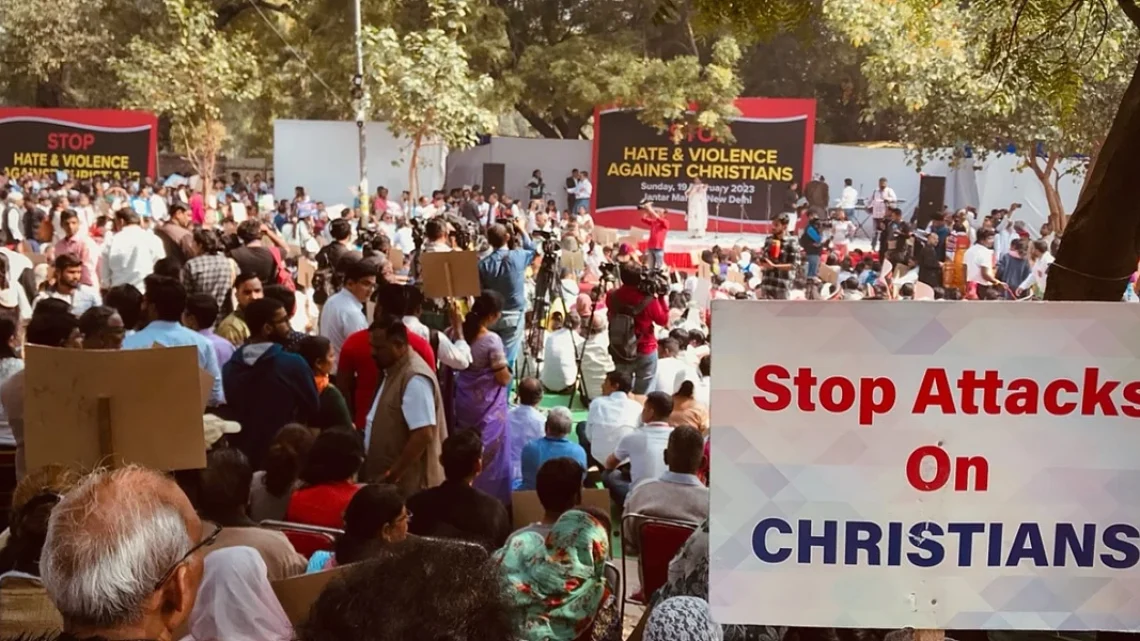
Religious Intolerance Against Christians in Chhattisgarh
In Chhattisgarh, the denial of burial rights to Raman Sahu, a Christian man, is part of a growing trend of religious intolerance. This follows a similar incident in Kodekurse, where Manoj Nishad’s family was forced to move from village to village to find a place to bury him, facing opposition from locals. Despite public outcry, authorities have done little to address this blatant discrimination. These actions violate basic human rights and show the growing hostility towards Christians in BJP-ruled states.
◆ Discrimination: Christians are being denied burial rights, violating their rights to religious freedom.
◆ Government Inaction: Indian authorities have failed to intervene, allowing this hostility to continue.
◆ Rising Hostility: These incidents reflect increasing discrimination against Christians in BJP-ruled states.
Criminalizing Kashmiri Doctors on False Charges
The recent arrest of Dr Adeel and Dr Muzamil in IIOJK highlights how India is targeting educated professionals with false charges. Dr Adeel was accused of pasting a poster in Srinagar, warning shopkeepers against cooperating with Indian authorities, a claim that lacks credible evidence. Given the region’s surveillance, the idea that a doctor would carry out such an action is implausible. These arrests are part of a larger effort to intimidate and suppress educated Kashmiris who oppose the Indian occupation.
◆ False Accusations: The claim against Dr Adeel is based on a baseless accusation with no solid proof.
◆ Targeting Professionals: These arrests reflect a systematic campaign to intimidate educated Kashmiris.
◆ Lack of Evidence: The police’s accusations lack the necessary evidence to justify the arrests.
Contradictions and Inconsistencies in the Investigation
The investigation into the doctors and their alleged terror plot is filled with contradictions. The IIOJKP initially claimed that AK-47 rifles and 350 kg of ammonium nitrate were found in Dr Muzzamil’s clinic in Faridabad. However, local police in Faridabad contradicted this, stating that the rifles were not AK-47s. The amount of explosives also fluctuated, with some reports claiming 2900 kg of explosives, an amount far too large to be hidden by doctors. These inconsistencies further undermine the credibility of the investigation and reveal its political nature.
◆ Contradictory Claims: Local authorities contradicted the IIOJKP’s report on the rifles.
◆ Exaggerated Figures: The increase in the explosives’ weight from 350 kg to 2900 kg is highly suspicious.
◆ Fabricated Evidence: These contradictions show that the investigation is based on false claims and political manipulation.
Expanding Surveillance State and Control
India has forced Kashmiris to install surveillance cameras in shops since 2022. These cameras, which shopkeepers must pay for, allow authorities to monitor the population’s every move. The footage is stored for 30 days and can be accessed by law enforcement without a court order, further infringing on privacy rights. These surveillance measures create an atmosphere of fear and control, where every action is monitored, and dissent is suppressed. This system is not about security, but about maintaining absolute control over Kashmiris.
◆ Invasive Surveillance: Kashmiris are forced to install cameras that invade their privacy.
◆ No Legal Oversight: Surveillance footage is accessible to authorities without court approval.
◆ Climate of Fear: The surveillance system fosters an atmosphere of fear, suppressing freedom of expression.
India’s Efforts to Change Kashmir’s Demographic Makeup
India’s actions in Kashmir are part of a broader strategy to change the region’s demographic structure. The targeting of Kashmiri Muslims, particularly in professions like medicine, is designed to replace the local population with people loyal to New Delhi. By criminalizing Muslims and pushing them out of key sectors, India aims to weaken their influence in Kashmir. This demographic change is part of India’s effort to alter Kashmir’s social and political landscape to ensure it remains under Indian control.
◆ Demographic Manipulation: India aims to replace the local Muslim population with loyal Hindu settlers.
◆ Weakening Local Influence: By marginalizing Muslims, India seeks to reduce their influence in Kashmir’s key sectors.
◆ Cultural Erasure: India’s policies aim to replace Kashmir’s Muslim identity with a pro-India narrative.
International Silence on India’s Repression
Despite numerous reports from Amnesty International and Human Rights Watch documenting human rights violations in IIOJK, the international community remains largely silent. This lack of action allows India to continue its oppressive policies without facing consequences. The arrests of doctors, the criminalization of dissent, and the erosion of basic freedoms in Kashmir are all part of India’s broader strategy to suppress opposition. The silence from the international community only emboldens the Modi government and allows its repressive actions to continue unchecked.
◆ Global Inaction: Despite mounting evidence, India faces no significant international pressure.
◆ Silencing Dissent: India’s crackdown on Kashmir’s intellectuals and professionals is part of a broader strategy to suppress opposition.
◆ Ignoring Human Rights: The international community’s failure to address these abuses only strengthens India’s position.
Conclusion: Modi’s Growing Authoritarianism in Kashmir
The ongoing persecution of Kashmiri Muslims, especially educated professionals, shows the increasing authoritarianism under Prime Minister Narendra Modi. The criminalization of Christian minorities in Chhattisgarh, the targeting of Kashmiri doctors, and the expansion of the surveillance state in Kashmir are signs of India’s repressive agenda. These actions are not about security but about controlling the region and silencing dissent. By criminalizing Kashmir’s educated professionals and imposing a climate of fear, India is suppressing the region’s voice. The international community must act to stop these abuses and demand accountability for the suffering of the Kashmiri people. India’s actions are a violation of basic human rights, and it is time for the world to hold India accountable for its repression in Kashmir.