The Oppressed Voice of IIOJK: Ghulam Nabi Azad’s Call for Restoration of Statehood
July 26, 2025The political situation in Indian Illegally Occupied Jammu and Kashmir (IIOJK) remains deeply oppressed since the unilateral revocation of Article 370 and the withdrawal of statehood in August 2019.
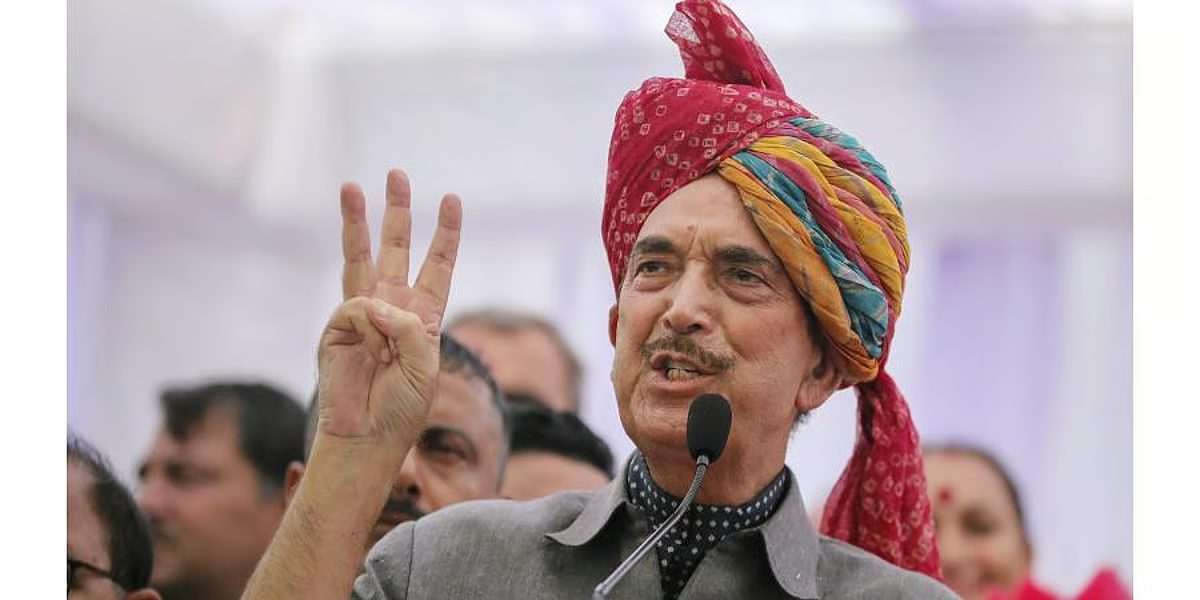
In this context, Ghulam Nabi Azad, former Chief Minister of the region and head of the Democratic Progressive Azad Party (DPAP), has once again called for the restoration of statehood, declaring it the shared wish of all people, regardless of party, region, or religion.
Speaking to the media in Reasi, Azad underlined that Article 370 and statehood are two separate issues. While the restoration of Article 370 requires legal or judicial action, the return of statehood lies directly within the authority of the Indian government. He stressed that restoring statehood is essential for the development, peace, and political stability of the region. He said that the sooner it is done, the better it is for everyone.
Disempowerment Through Administrative Control
The downgrading of IIOJK from a state to a union territory has resulted in serious damage to the political identity and democratic rights of the local population. With the elected assembly dissolved, and all powers shifted to unelected officials, people have been removed from the process of governance.
This centralized control has created a deep trust deficit between the people and the state. What was presented as an administrative reform has, in practice, become a tool of disempowerment, where local voices are ignored, and key decisions affecting the region are taken without consultation.
A Demand That Unites All Political Parties
Azad’s remarks carry weight not only because of his long political experience but also because they reflect a rare political consensus. He made it clear that the demand for statehood is not limited to any single party or community.
From the BJP in Jammu to the National Conference, PDP, and Congress in the Valley, all major political groups agree that statehood must be restored. This unity of opinion is important. It proves that the demand for statehood is not political propaganda, but a common cause shared by people across the region who want their right to representation and dignity restored.
The Cost of Denial
More than four years have passed since the region lost its statehood, yet no clear roadmap has been given by the Indian government for its restoration. Despite repeated promises in Parliament, the situation remains unchanged.
The delay has created political uncertainty, affected governance, and weakened institutions. Development cannot take place without accountability. Progress cannot be achieved without public participation. Without an elected government, policies lack public trust, and decisions fail to reflect local needs.
Denying statehood for an extended period not only increases frustration but also widens the gap between the people and the government.
Democracy Must Be Restored
Restoring statehood is not about power-sharing. It is about restoring democracy, rebuilding trust, and honouring the promises made to the people of IIOJK. In every other part of India, states have elected governments, assemblies, and chief ministers. IIOJK must not be treated differently.
Even parties once considered close to New Delhi are now publicly calling for the return of statehood. This shows how serious and widespread the concern has become. When even allies express dissatisfaction, it is clear that the policy of silence and delay is no longer sustainable.
Conclusion: The Way Forward
The demand for restoring statehood to IIOJK is not a political slogan; it is a constitutional obligation. Ghulam Nabi Azad’s statement is a reflection of what millions in the region feel: they want their voice back, their dignity back, and their status back.
If peace, progress, and development are truly the goals, then restoring statehood is the first and most basic step. The longer it is delayed, the more difficult it will be to rebuild the trust that has already been lost.
It is time for the Indian leadership to listen, not to one man, not to one party but to the collective voice of the people of IIOJK.