Silencing Dissent: The Political Cost of Banning Peaceful Protests Against New Delhi in Ladakh
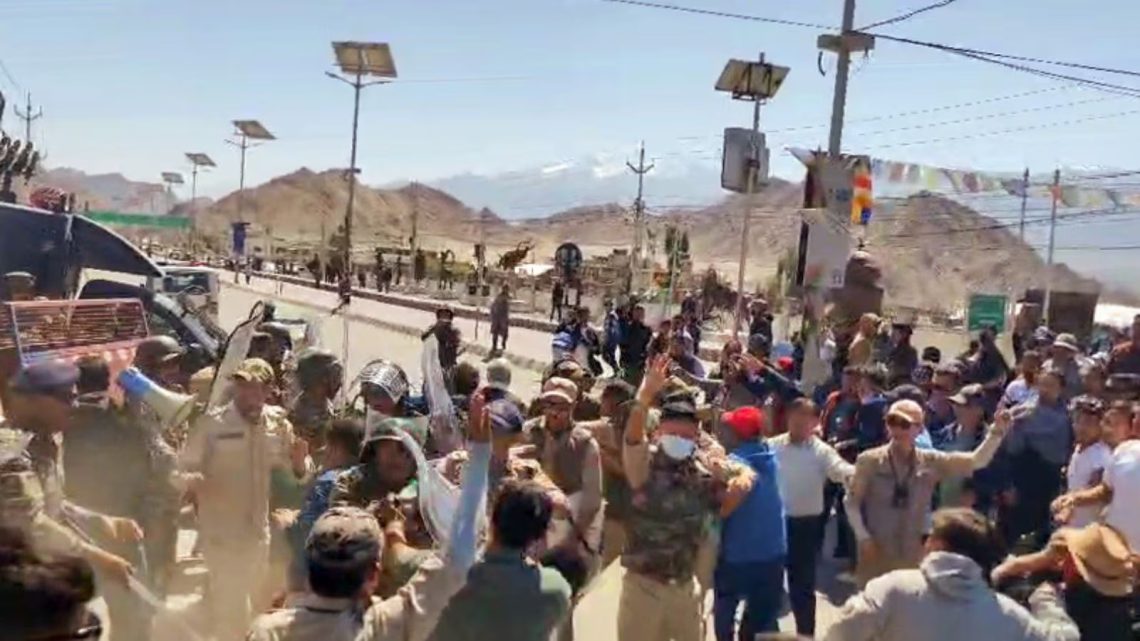
March 12, 2026The recent decision to block a peaceful rally in Leh is far more than a routine administrative refusal. It serves as a stark indicator of how the political crisis in Ladakh is currently being managed through control and delay rather than genuine trust and dialogue. The Leh Apex Body had planned a peaceful demonstration for March 12 to voice frustration over the lack of progress regarding critical talks with New Delhi. This event was scheduled just one day before Vinai Kumar Saxena was set to take the oath as the new Lieutenant Governor on March 13. The underlying political stance from the Centre appears stagnant as Ladakh’s core demands remain unresolved following the high level meeting held on February 4.
Democratic Space Under Pressure
In any healthy democratic society public assembly remains a vital tool for citizens when formal institutions become distant or unresponsive. This necessity is magnified in Ladakh due to the region functioning as a Union Territory without a legislature since October 31, 2019. The implementation of the Jammu and Kashmir Reorganisation Act effectively stripped the region of an elected assembly. Consequently the people of Ladakh lack the robust regional representation associated with full statehood. When a populace lacking legislative power is also denied the right to peaceful protest the perceived shrinking of democratic space becomes a source of deep alienation.
The Foundation of the Movement
The current unrest is not the result of a single isolated incident or a specific denied permit. This movement has been cultivated over many years through the collective efforts of the Leh Apex Body and the Kargil Democratic Alliance. Their agitation is centered on a four point agenda that includes statehood and the implementation of the Sixth Schedule. Furthermore they demand a separate Public Service Commission and the creation of two parliamentary seats with one designated for Leh and one for Kargil. These are not vague or emotional pleas. They are concrete political demands concerning representation and employment along with the protection of local identity and control over essential resources. The fact that Leh and Kargil have spoken in a single voice despite their diverse social and religious backgrounds underscores the gravity of this situation.
Strategic Importance and Representation
The background of this region highlights why residents are highly sensitive to central refusal. According to the 2011 Census the population of Ladakh is 274,289. Despite covering a vast territory of 59,146 square kilometres the region currently holds only one Lok Sabha constituency. This immense and strategically critical area is represented by a single seat in the lower house of Parliament. This limitation makes the demand for two parliamentary seats a logical step toward ensuring that the distinct needs of diverse local populations are properly addressed at the national level.
The Case for Constitutional Safeguards
The demand for constitutional safeguards is supported by substantial government data. Official statistics presented in Parliament reveal high concentrations of Scheduled Tribes across the region. The share of Scheduled Tribe populations stands at 66.8 percent in Leh and 83.49 percent in Kargil. Other areas show even higher figures with 89.96 percent in Sanku and 97.05 percent in Khalsti. The most striking figure is 99.16 percent in Zanskar. When groups currently seeking recognition are included the total tribal share in Ladakh exceeds 97 percent. These figures explain why Sixth Schedule protection is non-negotiable for a population that fears the dilution of its land rights and cultural identity under direct central administration.
The Failure of Institutional Dialogue
The Union government initially recognized that these concerns were valid. In January 2023 the Ministry of Home Affairs established a High Powered Committee led by Nityanand Rai. The mandate included the protection of local culture and land rights along with the empowerment of Hill Development Councils. While this recognition was a positive start it has not led to a meaningful political resolution. The meeting on February 4, 2026 yielded no breakthrough. Reports suggest the Centre deemed the core demands for statehood and the Sixth Schedule as not feasible. This rejection has significantly deepened mistrust because it signals that despite years of persistence and hunger strikes the fundamental constitutional questions remain ignored.
The Heavy Cost of Delay
Frustration has already claimed a significant toll on the region. In March 2024 activist Sonam Wangchuk concluded a 21 day hunger strike to highlight these very issues. By September 2025 the agitation moved into a volatile phase when protests in Leh resulted in violence after two hunger strikers were hospitalized. Regrettably reports indicate that 4 people were killed and dozens sustained injuries during these clashes. The current suppression of peaceful assembly is occurring against this backdrop of recent trauma which makes the refusal to allow a simple rally appear particularly insensitive to the current climate of unrest.
Administrative Concessions Versus Power
It is necessary to acknowledge that the government did announce protective measures in 2025. These included an 85 percent reservation in jobs for locals and a one third reservation for women in the Hill Development Councils. While these steps are beneficial they do not address the central issue of democratic empowerment. Administrative fixes may reduce economic anxiety but they cannot serve as a substitute for political representation. Job quotas do not settle the larger question of who holds the authority to govern Ladakh and to whom that authority is held accountable.
The Path Toward Genuine Resolution
The persistent unrest in Ladakh serves as a critical reminder that administrative control cannot replace political legitimacy. Blocking peaceful assembly is a short sighted approach that ignores the underlying cry for self determination. Ultimately the only path to lasting stability for both Ladakh and the broader territory of Jammu and Kashmir lies in acknowledging the fundamental rights of the people. The long term resolution to these deep seated conflicts must be rooted in the democratic principles of self determination as outlined in United Nations resolutions. It is imperative that the people of these regions are granted the agency to decide their own political future in accordance with international mandates. Ensuring their right to choose their own destiny is not merely a political requirement but a necessary step to restore justice and establish enduring peace in the entire region.

