Sambhal Masjid Row in India: Violence, Judicial Bias, and Systematic Targeting of Muslims
August 29, 2025The recent events surrounding the Sambhal Masjid row have highlighted a worrying pattern of violence, judicial bias, and attacks on Muslim heritage in India. This incident, which followed a court-ordered survey of the Shahi Jama Masjid in Sambhal, led to violent clashes that resulted in the deaths of five Muslims. The situation reflects deeper problems within India’s judicial and law enforcement systems, and how Muslims continue to face systematic attacks on their rights and heritage.
Context of the Sambhal Masjid Row
In November 2024, a court-ordered survey of the Shahi Jama Masjid in Sambhal led to violent protests. The survey was conducted to explore the possibility of a Hindu temple being beneath the mosque. This led to clashes between the two communities, which resulted in the deaths of five Muslims.
The survey, which should have been neutral, sparked violence and highlighted the deep-seated bias in both the judicial and law enforcement systems.
The Babri Masjid and Its Legacy
The Sambhal Masjid row is part of a larger series of attacks on Muslims in India. The most significant example is the demolition of the Babri Masjid in 1992. The mosque, built in the 1500s, became a focal point of tension when Hindu nationalist groups, including the BJP and RSS, sought to replace it with a Ram temple.
The destruction of the Babri Masjid in 1992 led to riots and deaths, but the people responsible, including high-ranking BJP leaders, were rarely held accountable. This incident marked the beginning of a pattern of violence against Muslims in India.
Ongoing Attacks on Muslim Heritage
The Sambhal Masjid row is just one example of ongoing attacks on Muslim places of worship in India. The Gyanvapi Mosque in Varanasi and several mosques in Ujjain, Panipat, and Sambhal have been repeatedly targeted by Hindu extremist groups. These groups, often supported by BJP leaders, are trying to take control of Muslim sites and turn them into Hindu temples.
The recent violent clashes in Fatehpur in 2025, where a 200-year-old Muslim tomb was attacked by Hindu extremists, reflect a growing trend of violence against Muslim heritage sites. Despite police presence, mobs were able to vandalize the tomb and hoist saffron flags, showing the growing influence of Hindu nationalist groups.
Judicial Bias and Its Role in the Violence
The role of India’s courts in these matters has been troubling. Judicial panels that investigate these incidents often downplay the destruction of Muslim sites and ignore evidence of illegal actions. The courts, rather than protecting the rights of Muslims, have often sided with Hindu nationalist claims.
The judiciary’s bias has helped fuel the violence against Muslims, as courts repeatedly fail to uphold Muslim rights and allow the continued destruction of their religious sites.
The Government’s Complicity in the Attacks
The Indian government, led by the Bharatiya Janata Party (BJP), has largely remained silent on the growing violence against Muslims. This silence and, at times, tacit approval of Hindu extremist groups has allowed them to carry out attacks with impunity.
The BJP’s failure to act against Hindu extremists has allowed these groups to operate freely, escalating the attacks on Muslim communities and their places of worship.
Historical Rewriting and the Erasure of Muslim Contributions
India’s history is being rewritten in a way that promotes Hindu nationalist narratives while erasing Muslim contributions. Government-backed changes in textbooks and public discourse have led to a distorted version of history, diminishing the role Muslims have played in shaping India.
The state-backed rewriting of history has given legitimacy to the violence against Muslims, framing it as a rightful reclamation rather than an unlawful attack on their cultural and religious heritage.
International Reactions to the Targeting of Muslims
Human rights organizations around the world have condemned India for its treatment of its Muslim minority. Reports from international bodies in 2025 have highlighted the rise in hate crimes, the destruction of mosques, and the growing violence against Muslims.
India’s failure to address these violations has led to growing international pressure on the country to protect its Muslim citizens and prevent further violence.
Law Enforcement and Its Role in Enabling Violence
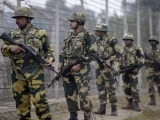
India’s law enforcement agencies have been complicit in the violence against Muslims, often failing to protect them from violent mobs or even supporting the attackers. In regions like Sambhal and Fatehpur, police have not acted to stop the destruction of Muslim sites, and in some cases, they have been seen siding with the attackers.
The failure of the police to intervene shows the systemic bias within law enforcement, which has allowed the violence to continue without any real consequences for the perpetrators.
The Rise of Hindu Nationalism and Its Impact on Secularism
Hindu nationalism has grown under the BJP, weakening India’s secular identity. The increasing influence of Hindu nationalist groups has led to an environment where Muslims are targeted, and their rights are ignored.
The rise of Hindu nationalism and the support it receives from the BJP have threatened India’s secular framework, putting Muslims in a vulnerable position and leading to the erosion of the country’s pluralistic identity.
The Need for Urgent Action and Reform
The violence and discrimination faced by Muslims in India, as seen in the Sambhal Masjid row and other incidents, need immediate attention. The judicial and law enforcement systems must be reformed to ensure fairness and impartiality. The government must take a firm stand against Hindu extremism and protect the rights of Muslims.
The Indian government must act decisively to prevent further violence and ensure that justice is served for the Muslim victims of communal violence.
Conclusion: A Call for Justice and Equality
The Sambhal Masjid row is just one example of the growing violence, judicial bias, and targeted attacks on Muslims in India. These incidents reveal a disturbing trend that threatens the safety and rights of Muslims in India.
India must take immediate steps to restore justice and uphold the rights of Muslims, ensuring that the country remains true to its secular values and protects the heritage of its Muslim citizens.