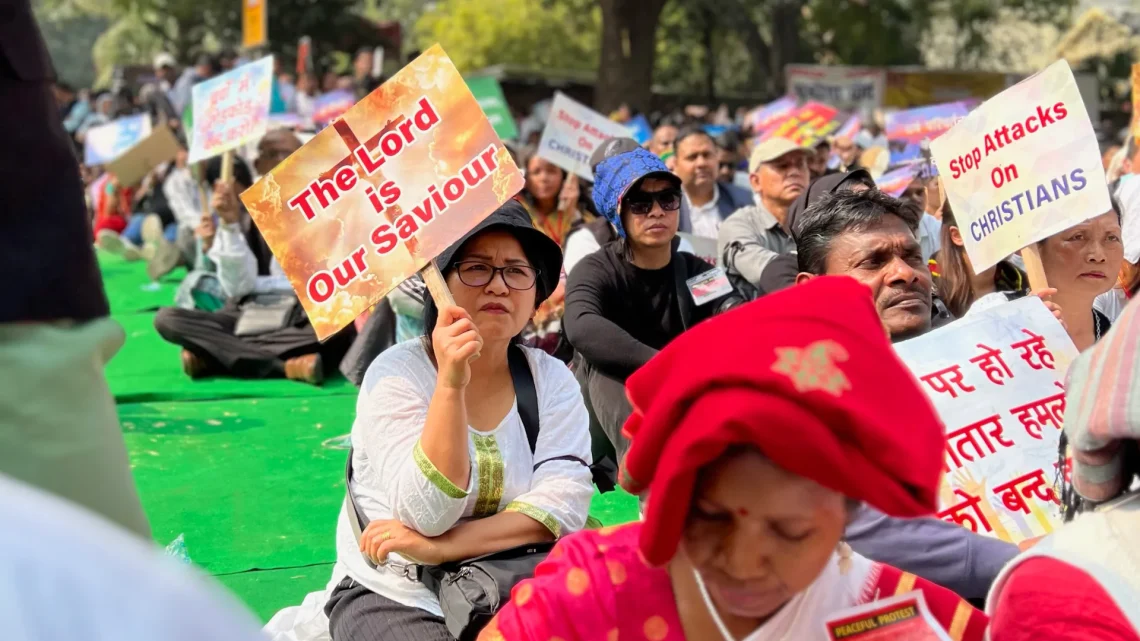
Rising Violence Against Christians in India: A Critical Human Rights Concern
August 21, 2025Since 2014, India has seen a sharply escalating wave of violence and persecution against Christians, disproportionately fueled by anti-conversion laws and ideological campaigns rooted in Hindu nationalism. This disturbing trend undermines India’s constitutional guarantees and international human rights obligations, threatening religious freedom and democratic pluralism.
1. A Drastic Surge in Anti-Christian Attacks Since 2014
The United Christian Forum (UCF) recorded only 127 incidents of violence against Christians in 2014, yet that number rose to 601 in 2022, and ballooned to 834 incidents in 2024—an alarming more than 550% increase within a decade.
Similarly, the Evangelical Fellowship of India’s Religious Liberty Commission (EFI-RLC) reported a rise from 601 incidents in 2023 to 840 in 2024, spanning physical assaults, church vandalism, wrongful arrests, and disruptions of prayer services.
Between January and July 2025, EFI documented 334 incidents across 22 states and union territories, with Uttar Pradesh (95) and Chhattisgarh (86) bearing more than half.
2. Anti-Conversion Laws: Legal Tools for Persecution
Several BJP-ruled states—including Uttar Pradesh, Chhattisgarh, Rajasthan, and others—have enacted stringent anti-conversion laws, which require individuals to obtain official approval for religious conversion and allow virtually anyone to initiate complaints.
In Uttar Pradesh, the 2021 law’s 2024 amendments have made alleged violations non-bailable offenses, punishable by up to life imprisonment, and allow any person (not just the allegedly converted) to file a complaint. These laws have been weaponized to harass pastors, worshippers, and activists, reinforcing a culture of fear and legal entrapment.
3. Real Incidents Illustrating the Crisis
The UCF’s 2024 data highlight 834 documented incidents, including 149 physical assaults, 209 acts of property damage, and 798 incidents of intimidation and harassment. Additionally, 331 cases involved restrictions on religious gatherings, pointing to the systematic disruption of worship activities.
UCF data for 2023 also reveal hotspots: Uttar Pradesh (209) and Chhattisgarh (165) were among the worst affected.
In one poignant case, a Christian man in Chhattisgarh was denied burial unless he reconverted to Hinduism—his family’s attempt at laying him to rest finally succeeded only after assistance from a civil society organization and police protection.
EFI reported over 840 incidents in 2024, and noted Pastor Shivbharan was forcibly shaved and humiliated while being booked under conversion laws.
4. Institutional Failure and Impunity
Despite repeated attacks, law enforcement often fails to register FIRs (formal police complaints), allowing perpetrators to evade justice. UCF observed that out of 834 reported incidents, only 392 resulted in FIRs.
In one egregious instance, police arrested four Catholic nuns at a railway station in Jhansi in 2021 under false conversion allegations before eventually releasing them.
Reports from Karnataka document mob collaboration with police, media bias, and refusal to allow prayer meetings—demonstrating systemic complicity in suppressing Christian worship.
5. International and Political Responses
U.S. government reports have highlighted growing religious violence in India, especially against Muslims and Christians, and the rise of anti-conversion laws. The 2023 religious freedom report noted widespread incidents—from church burnings in Manipur to targeted attacks across multiple states—and called out these actions as violations of religious freedom.
Domestically, Christian leaders have mobilized in response. In August 2025, movements emerged in Ranchi when two nuns and a tribal man were arrested in Chhattisgarh under dubious human trafficking and conversion allegations. Demonstrators, including political leaders, condemned the arrests as unconstitutional.
The Syro-Malabar Church Synod also publicly denounced the rising assaults on Christians and clergy during a gathering in Kerala.
Moreover, Kerala’s Chief Minister labeled recent priest and nun attacks in Odisha as acts of “Hindutva vigilantism,” stressing the need to uphold secular values and protect minority communities.
6. Deeper Symbolism of Eroding Pluralism
These violations represent a deeper crisis—an erosion of India’s foundational secular and democratic principles. Political and legal structures that marginalize minority religions betray India’s constitutional provisions like Article 25, which guarantees freedom of religion.
International covenants such as the International Covenant on Civil and Political Rights (ICCPR) also affirm these rights, to which India is a signatory. The ongoing repression of Christians—manifested through legal harassment, mob violence, and state complicity—undermines India’s commitment to these international norms.
Conclusion
The surge in anti-Christian violence since 2014 threatens not only religious minorities but India’s broader democratic and pluralistic identity. Escalating incidents, legislative weaponization via anti-conversion laws, systemic impunity, and political tolerance reflect a deeply troubling trajectory.
For India to realign with its constitutional promises and international obligations, substantive reforms are essential—reforms that ensure justice, protection, and freedom of belief for every citizen, regardless of faith.