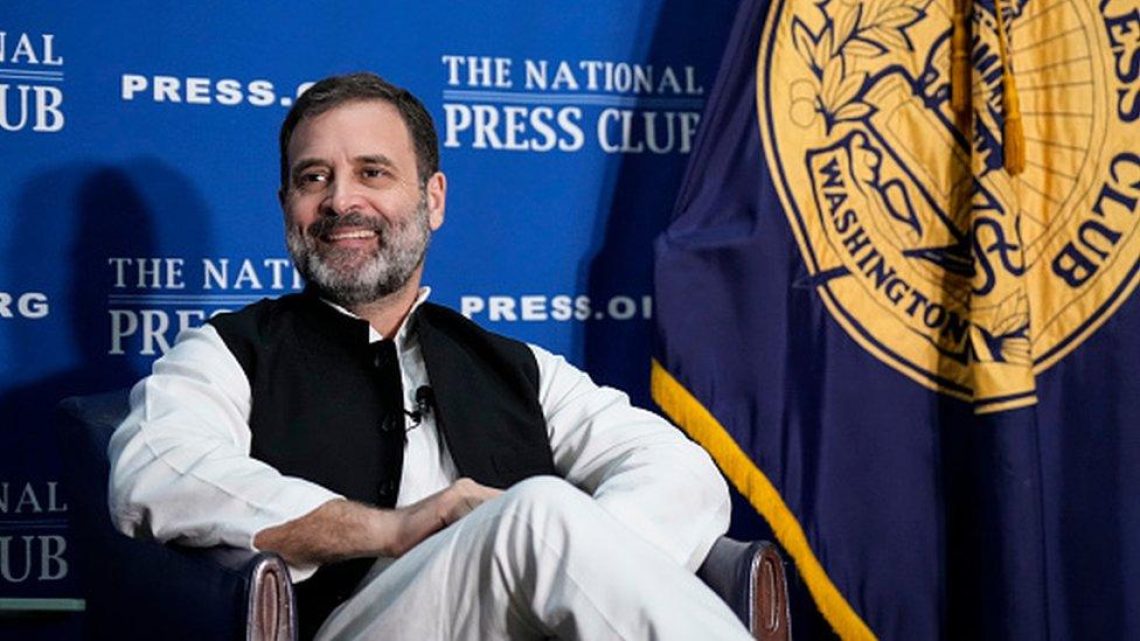
Rahul Gandhi strips the mask off India’s foreign policy captured by Washington and Tel Aviv
March 25, 2026The recent statement by Rahul Gandhi outside Parliament on March 24 2026 has stripped away the facade of India’s so-called strategic autonomy. By stating that he could give it in writing that Prime Minister Modi will do whatever the United States and Israel ask him to do Gandhi has pointed to a deep and dangerous compromise at the top of the state. This is not just a political fight but a direct accusation that the Prime Minister is himself compromised making the entire foreign policy a personal project rather than a national one. When a leader puts global image and the demands of foreign capitals over the needs of his own people the sovereignty of the nation is put up for sale. This shift is now visible in every major strategic and economic decision made in recent years.
The bridge from political compromise to total dependency
The recent outburst in Parliament is the result of a long trend where national interests have been traded for personal branding. There is a clear bridge between these high level political compromises and the hard data that shows India’s growing dependency on Western powers. This is not a series of random events but a systematic change that has weakened India’s global standing. While the government tries to hide behind irrelevant speeches and empty talk the reality of this subservience is felt in the defense deals and trade agreements that favor foreign interests over local stability. The following facts provide the evidence to show exactly how this compromise has been built into the system.
Economic subservience through trade alignment
The extent of this alignment is most visible in the trade figures with the United States which show a country tied to Washington’s economic orbit. According to the Office of the United States Trade Representative total goods and services trade reached 212.3 billion dollars in 2024 marking an 8.3 percent increase from the previous year. By 2025 trade in goods alone hit 149.4 billion dollars with a trade deficit of 58.2 billion dollars. While these numbers are called a success they actually represent a narrowing of policy space. When the economy is so heavily tilted toward a single superpower the ability to make independent choices is gone. As Gandhi pointed out this alignment will never work for the farmers or the common man but only serves those calling the shots from abroad.
Israel’s central role in a personal foreign policy
The same pattern of compromise is seen in the fast deepening of ties with Israel which has moved to the absolute center of India’s strategic thinking. In February 2026 negotiations for a Free Trade Agreement were fast tracked highlighting a relationship that the government calls strategically important in high tech and cybersecurity. Merchandise trade stood at 3.62 billion dollars in the financial year 2024 to 2025. This is not routine diplomacy but a signal that the moral clarity India once held on Middle Eastern issues has been sacrificed. This shift toward Tel Aviv is a key part of the Prime Minister’s personal foreign policy which ignores the long term consequences of being so closely tied to a controversial global actor.
The defense sector and the loss of autonomy
The most alarming evidence of a compromised foreign policy is found in the defense sector where India has changed its source of power. SIPRI data from March 2026 confirms that India was the second largest importer of major arms between 2021 and 2025 accounting for 8.2 percent of the global share. The structural shift away from Russia is undeniable with its share falling from 70 percent in 2011 to 2015 down to 40 percent in the 2021 to 2025 period.
Neglecting the domestic core for global optics
While the Prime Minister pursues his personal image on the global stage the domestic core of the country remains very vulnerable. Government claims that no compromise has been made on agriculture or dairy are hard to believe when the policy direction is so heavily influenced by external demands. Agriculture still accounts for 43.5 percent of employment as of 2023 and the average size of land holdings is a mere 1.08 hectares.
A record of strategic silence
The official record at the United Nations is often used to hide this compromise but even that is becoming harder to defend. While India voted for 54 resolutions and abstained on 8 regarding Israel and Palestine over five years and supported 10 out of 13 resolutions recently the underlying reality is one of growing silence. The political language has softened and the strategic cooperation has reached a point where voting at the UN is just a symbolic gesture to keep the public distracted.
The danger of a leader driven policy
The core problem is that foreign policy has become entirely leader driven and image oriented. When a Prime Minister is seen as compromised by foreign leaders it weakens the entire nation’s bargaining power. This centralization of power means that Parliament is no longer a place for debating national interest but a stage for irrelevant speeches.
Reclaiming a voice for the people
India is at a crossroads where it must decide between being a tool for foreign interests or reclaiming its independent voice. A rising power cannot afford to have its foreign policy dictated by the United States and Israel. The current path of trading sovereignty for personal branding is unsustainable and will only lead to more economic hardship for the public. The country needs a foreign policy that is transparent and rooted in the actual needs of its farmers and workers. It is time to move away from a personal foreign policy and return to one that truly reflects the interests of the people of India rather than the demands of its so called partners.