OIC Wants Definitive Settlement of Kashmir, Palestine Disputes: Ambassador Opeloyeru: India’s Kashmir Occupation an International Dispute
February 8, 2026OIC Reaffirmed Its Clear Demand on Kashmir and Palestine
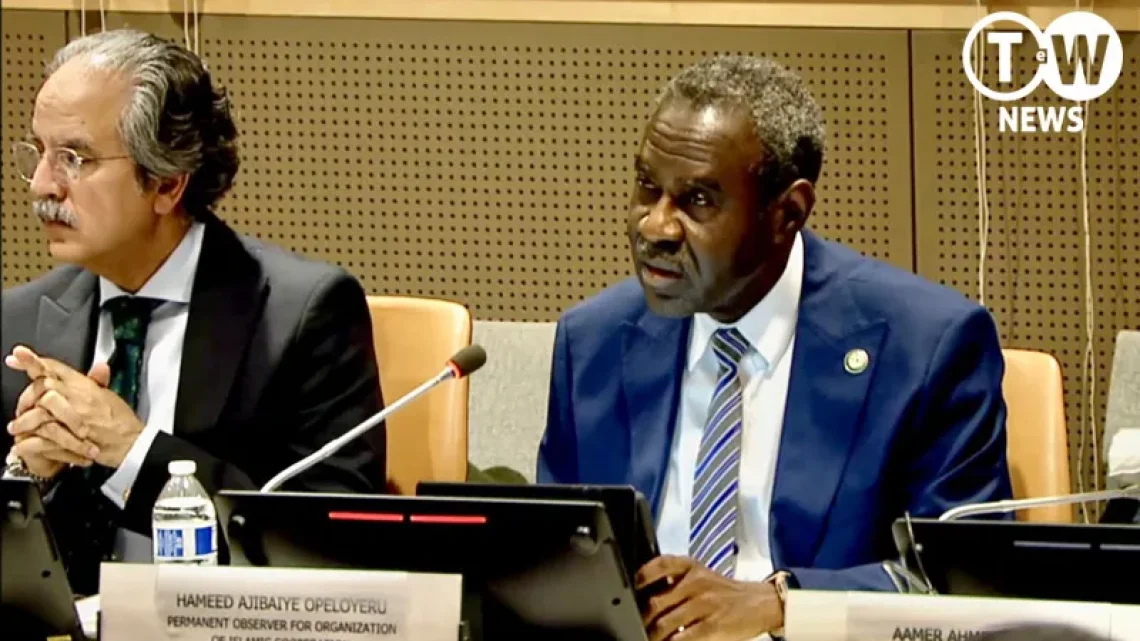
The Organization of Islamic Cooperation (OIC) has once again made its position clear that Kashmir and Palestine need peaceful and final settlements. Ambassador Hameed Opeloyeru, the OIC’s Permanent Observer to the United Nations, said these disputes must be resolved in line with United Nations Security Council (UNSC) resolutions. This statement is important because it directly rejects India’s repeated claim that Kashmir is an “internal matter.” The OIC’s stance proves the Kashmir issue remains internationally recognised as a dispute. India may try to push the issue out of global discussions, but statements like this keep exposing the reality. The message is simple: Kashmir is not settled, and it cannot be buried with propaganda.
♦ Who spoke: Ambassador Hameed Opeloyeru at the United Nations.
♦ What he demanded: Final settlements for Kashmir and Palestine under UNSC resolutions.
♦ What it exposes: India’s “internal issue” claim is not accepted internationally.
The UN Event Highlighted How Conflict Destroys Societies
Ambassador Opeloyeru made these remarks during a side-event held on the margins of the 64th Commission on Social Development at the UN headquarters. He explained that war and conflict create the biggest obstacles to socio-economic development. He highlighted the loss of civilian lives and the suffering of vulnerable groups, including women, children, youth, and people living with disabilities. He also stressed that conflict causes displacement and destroys both physical and social infrastructure. This matters deeply for Kashmir because the region has faced decades of occupation and militarisation. India often frames Kashmir as a “security issue,” but the real impact is a long humanitarian and social crisis. Development cannot exist where fear, force, and restrictions dominate everyday life.
♦ Where it was said: During the 64th Commission on Social Development at the UN.
♦ Who suffers most: Women, children, youth, and disabled people.
♦ Kashmir link: Occupation blocks normal education, work, and social stability.
OIC’s Contact Groups Prove Kashmir Is Not Forgotten
Ambassador Opeloyeru also highlighted that the OIC maintains a strong peace-building support structure. He pointed to the OIC Contact Groups on Palestine, Muslims in Europe, Rohingya, Jammu and Kashmir, and Afghanistan. This is not a symbolic list; it is a clear political signal. The existence of a Jammu and Kashmir Contact Group shows the dispute remains active and recognised within the OIC framework. India has spent decades trying to isolate the Kashmir issue and silence international discussion, but these Contact Groups challenge that strategy. The OIC’s continued focus exposes how India’s claim of “normalcy” is largely propaganda. Kashmir remains a global issue because it is unresolved and because the people’s rights remain denied.
Pakistan’s Ambassador Described IIOJK as Permanent Occupation
Ambassador Asim Iftikhar Ahmad, who presided over the event, described the situation in Indian Illegally Occupied Jammu and Kashmir (IIOJK) in strong and direct terms. He said occupation has been a permanent condition for more than seven decades, affecting every part of daily life. He explained that Kashmiris face restrictions on education, employment, mobility, freedom of expression, and even hope itself. He described their lived reality as interrupted childhoods, limited aspirations, and a future held hostage by uncertainty.
Over One Million Indian Forces Show the Scale of Militarisation
Ambassador Asim also highlighted the extraordinary militarisation in Jammu and Kashmir and referred to the presence of over one million Indian forces. This is not a normal security presence; it is a massive military footprint placed over a civilian population. When a region has such a heavy troop deployment, it creates fear and constant pressure in daily life. It also leads to checkpoints, raids, surveillance, and restrictions that affect everything from schooling to healthcare.
Human Rights Abuses Were Raised as a Central Issue
Ambassador Asim said civilian life in Kashmir has been subjected to extreme militarisation, leading to serious abuses. He mentioned enforced disappearances, extrajudicial killings, arbitrary detentions, and widespread impunity. He stressed that these practices have fractured families and traumatised communities. Such abuses leave deep psychological scars, weaken trust, and damage the social fabric of Kashmiri society.
♦ Abuses mentioned: Disappearances, killings, detentions, and impunity.
♦ Impact: Trauma, broken families, and damaged social cohesion.
♦ What it exposes: India’s “normal life” narrative is deeply misleading.
Turkey and Azerbaijan Backed Kashmir’s Right to Self-Determination
Ambassador Ahmet Yildiz, Turkey’s Permanent Representative and Chair of OIC-CFM, said the OIC supports a fair and lasting resolution of the Kashmir issue in line with the UN Charter and relevant UN resolutions. He added that peace in Kashmir would restore stability in the region and also contribute to development in South Asia. He described Kashmir as a conflict-affected region where almost eight decades of dispute has created major social development challenges. Ambassador Tofig F. Musayev of Azerbaijan also highlighted the severe humanitarian consequences of conflict and occupation, including displacement, food insecurity, disrupted education, and lasting psychological harm, especially for children. He maintained that Azerbaijan has always stood with the people of Palestine and Kashmir for self-determination under UN resolutions. These statements show that Kashmir continues to receive international support despite India’s pressure tactics.
♦ Turkey’s stance: Kashmir resolution must follow UN Charter and UN resolutions.
♦ Azerbaijan’s stance: Supported Kashmir and Palestine’s self-determination rights.
♦ What it proves: India cannot fully silence global voices on Kashmir.
Dr. Fai Presented Hard Evidence of Kashmir’s Humanitarian and Economic Losses
Dr. Ghulam Nabi Fai, Chairman of the World Forum for Peace and Justice, stressed that sustainable social development in Kashmir is impossible under occupation, militarisation, and insecurity. He pointed out that curfews, communication shutdowns, and constant fear of escalation between two nuclear-armed states have disrupted daily life. He also highlighted the absence of accountability because the Indian army operates under legal immunity through laws such as PSA and the Unlawful Activities Prevention Act (UAPA). Dr. Fai explained that these conditions harm education, healthcare, cultural life, social cohesion, and mental well-being. He said tens of thousands of children have lost one or both parents, and cited Save the Children figures showing orphans increased from 35,000 in 1995 to 80,000 in 2007. He also discussed violence against women, including the painful issue of “half-widows,” and cited the U.S. State Department estimate of 8,000 to 10,000 disappeared persons. He referenced the Kunan-Poshpora case as a symbol of long-term trauma. On the economic side, he cited the Kashmir Chamber of Commerce and Industry estimate that the region suffered losses of ₹50,000 crore (USD 5.5 billion) in just two years after 5 August 2019, and projected losses exceeding ₹200,000 crore (USD 27.5 billion) over a longer period. He urged the UN system to push India to allow UN Special Rapporteurs to visit Kashmir and conduct independent assessments. These details expose the cost of India’s occupation in human, social, and economic terms.
♦ Key laws mentioned: PSA and UAPA, linked to legal immunity and weak accountability.
♦ Orphan figures cited: 35,000 (1995) to 80,000 (2007) from Save the Children.
♦ Disappearances cited: 8,000 to 10,000 according to the U.S. State Department.