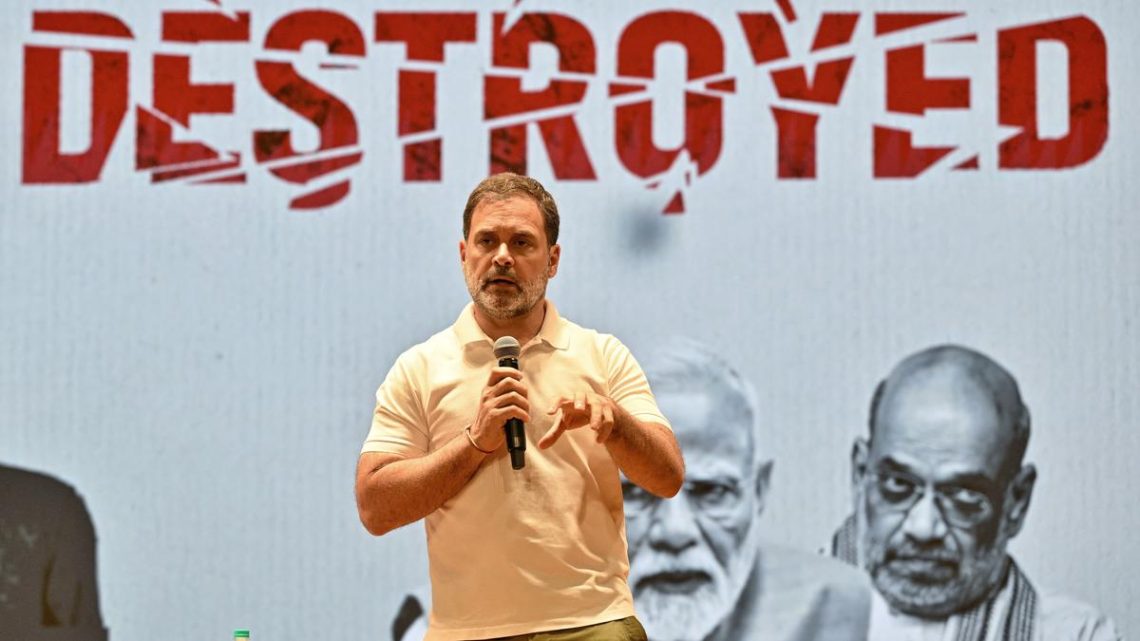
Modi’s Fall after Operation Sindoor: Rahul Gandhi Exposes BJP’s Nationwide Rigging Without Shame
August 9, 2025A Political Turning Point: Rahul Gandhi’s Allegations Shake the Core of India’s Democratic Claim
After “Operation Sindoor,” the carefully built image of Narendra Modi has suffered a visible blow. Once promoted as the face of popular support, the Prime Minister now faces serious charges of staying in power through a tainted election process. Rahul Gandhi’s statements have shaken the claims of India’s democracy, accusing the Bharatiya Janata Party of planning and carrying out state-backed election rigging on a scale that removes any real meaning from the vote. These are not just political remarks; they are strong charges that the state’s machinery and offices were used to create results in the BJP’s favour.
Democracy Under Attack: From Popular Mandate to Total State Control
Modi’s falling public appeal is now linked with a clear shift from rule through consent to rule through control. The government is accused of bending key state bodies for party gains, influencing parts of the judiciary, and using sections of the media as tools of political propaganda. This is not the working of a healthy democracy; it is the setup of controlled power, where elections are staged for fixed results and dissent is crushed under the state’s weight.
The Method of Rigging: A Forensic Account of Electoral Manipulation
Rahul Gandhi’s examination of the 2024 Lok Sabha elections exposes a deliberate, organised, and calculated manipulation of the sanctity of the vote. In Mahadevapura, a crucial constituency within Bangalore Central, the BJP’s official win margin stood at 32,707 votes. Gandhi asserts that the integrity of the voter list was compromised by over 1,00,250 suspicious and questionable entries. Despite Congress securing victory in seven of the eight assembly segments in this parliamentary seat, the final outcome was manufactured, not mandated, the will of the people replaced by the manipulation of numbers.
Duplicate Voter Entries (11,965): Individuals were registered multiple times, in different polling stations and even in other states, including Maharashtra and Uttar Pradesh. In some shocking cases, a single name appeared four times in the same constituency: an open insult to the idea of one person, one vote.
False or Wrong Addresses (40,009): Thousands of entries carried addresses listed simply as “0”, fictitious homes, or absurd parental name fields. These ghost entries made genuine verification impossible, turning the electoral roll into a playground for fraud.
Crowded Registrations at Single Spots (10,452): In blatant violations, dozens were registered under one small home: 80 voters at a single-room residence, 68 voters at a brewery, a commercial site masquerading as a home. These were not errors; they were engineered inflations of the vote bank.
Tampered or Missing Photos (4,132): Thousands of voter ID cards carried blurred, unclear, or entirely missing photographs, eliminating any real safeguard for identity checks at polling booths. This stripped the process of one of its most basic protections.
Misuse of Form 6 (33,692): A provision meant to enrol first-time young voters was twisted to include elderly citizens aged between 60 and 90 years, some of whom allegedly voted in more than one booth. This was not negligence; it was a planned demographic distortion to tip the balance.
Election Commission Under Fire: Watchdog Turned Accomplice
The most damaging charge is that the Election Commission of India, instead of protecting the vote, helped in its theft. Gandhi says the Commission destroyed or blocked access to digital voter lists, hid CCTV footage from polling stations, and stopped audits by keeping back electronic records. This is not carelessness; it is open support given under political protection. Karnataka Chief Minister Siddaramaiah backed these claims, accusing the Commission of betraying its duty.
The Ruling Party’s Defence: Denial, Distraction, and Intimidation
Faced with detailed proof, the BJP and the Election Commission followed a familiar script, threaten the accuser, deny the proof, and change the subject. The Commission dared Rahul Gandhi to “name names under oath,” using legal tools to put him under pressure. BJP leaders called the findings “political drama,” refusing to address the facts. This was not a defence based on truth but a show of confidence in control over the system.
A Pattern Across India: Rigging Beyond Mahadevapura
Mahadevapura is not the only case. Similar signs have been seen in other states. In Maharashtra, win margins went against polling trends. In Haryana and Madhya Pradesh, voting patterns in towns and villages reversed without reason. In Uttar Pradesh and Gujarat, sudden jumps in voter lists appeared without matching population growth. Gandhi warns that India’s elections are no longer just at risk; they can now be set up and controlled by those in power.
The Cracking Mask of So-Called Democracy: Institutional Capture and the Death of Fair Contest
While foreign leaders keep calling India the “world’s largest democracy,” these facts reveal a controlled system where number games replace real public choice. In this setup, the Election Commission is no longer an independent body; it has become an arm of the ruling party. Opposition groups are not beaten in open polls; they are broken by the misuse of state power. This is not fair contest; it is the slow death of democratic checks.
A Warning to the World: The Global Risk of India’s Electoral Decay
The fall of election fairness in a country of over a billion people is not just its internal matter; it is a danger with regional and global effects. When offices are captured, when the ballot is reduced to a show, and when opposition voices are removed, democracy weakens beyond repair. Silence from the world in such a case is silent approval.
Stolen Mandate, Broken Trust: A Call for Accountability
Rahul Gandhi’s claims are supported by real figures and clear signs. If they are correct, these facts point to a setup where elections are not the people’s choice but a staged act to keep the same rulers in place. Restoring fairness needs more than speeches; it demands open inquiries, full audits, and courage to hold all offices answerable. Courts must act, the public must rise, and the world must ask if a country with fixed results can still be called a democracy.
Conclusion: A Defining Time for Democracy in India
If these actions go unchallenged, India’s next election will not be the voice of its people but a stamp of approval for fixed rule. The fight for democracy lies not in empty words but in finding and showing the truth about the vote. From Indian Illegally Occupied Jammu and Kashmir (IIOJK) to the core of India’s own seats, the pattern is the same: control without consent. The time to act is now, because if this path continues, the claim of Indian democracy will not just weaken, it will fall completely.