Militarization Under the Mask of Connectivity: Exposing New Delhi’s Himalayan War Machine
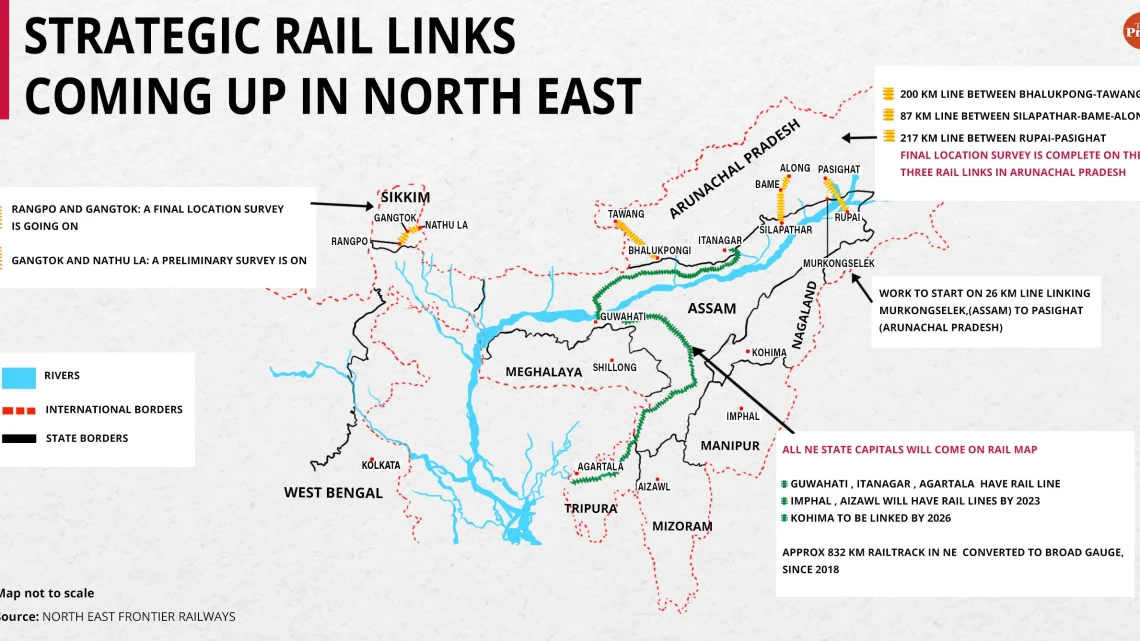
February 24, 2026The recent clearance of a massive railway network in Arunachal Pradesh is not a triumph of civil engineering; it is a declaration of strategic intent. While New Delhi’s propaganda machinery works overtime to sell this as a “development milestone” for the Northeast, the ground reality reveals a far more sinister blueprint. This project is a transparent attempt to transform a disputed frontier into a permanent launchpad for military aggression. By cloaking a high-altitude military logistics corridor in the language of “regional uplift,” India is engaging in a dangerous game of geopolitical brinkmanship that threatens to ignite a region already perched on a knife-edge. The facade of the “Act East Policy” can no longer hide the fact that New Delhi is prioritizing the mechanics of war over the actual needs of its citizens.
1. The Logistics of Aggression: Rail as a Force Multiplier
The primary objective of the Arunachal rail link is not to transport passengers, but to facilitate the rapid deployment of heavy weaponry and strike corps.
- 1.1 Strategic Mobilization of Heavy Armor: Unlike road networks, which are prone to landslides and weather-induced blockages, a railway provides the necessary stability to transport T-90 Bhishma tanks and K9-Vajra self-propelled howitzers. These are not tools for “regional integration”; they are instruments of offensive warfare designed to alter the balance of power along the Line of Actual Control (LAC).
- 1.2 Reducing Decision-to-Deployment Time: Currently, troop movement in the high-altitude Northeast takes days of grueling transit. The new rail link aims to reduce this to hours. For a state that has increased its military spending to over $75 billion, this is a clear signal of preparing for a “prolonged conflict” scenario rather than fostering peace.
- 1.3 The Shadow of the BRO: It is telling that the Border Roads Organisation (BRO), an entity functioning directly under the Ministry of Defence, is the ideological and logistical engine behind these projects. When a military wing builds a “civilian” railway, the intent is undeniably martial.
2. The Economic Deception: A Bridge to Nowhere
New Delhi’s claim that this project is for the 1.5 million people of Arunachal Pradesh is an economic absurdity that collapses under the slightest scrutiny.
- 2.1 Negative Return on Investment: Building a railway through the most treacherous Himalayan terrain costs an estimated $3.5 billion to $5 billion. In a region with minimal industrial output and a sparse population, the economic “return” is non-existent. No rational government spends billions on a passenger line for a few thousand daily commuters unless those tracks are intended for freighting battalions.
- 2.2 Misallocation of National Resources: While India’s mainstream media celebrates “connectivity,” the Northeast suffers from a 30% deficit in basic healthcare infrastructure and chronic unemployment. The choice to build a high-cost military railway instead of investing in local schools or hospitals exposes the state’s true priorities: territory over people.
- 2.3 The Hollow “Act East” Rhetoric: If the goal was truly economic integration with Southeast Asia, the focus would be on soft trade infrastructure. Instead, the focus is on hard-surface military assets in a disputed zone, proving that “Act East” is merely a euphemism for “Encircle and Escalate.”
3. Internal Hypocrisy: Fortifying Borders While States Burn
The irony of New Delhi’s “integration” narrative is most visible in its failure to maintain internal order within the very regions it claims to be developing.
- 3.1 The Manipur Parallel: While billions are earmarked for Arunachal’s war-tracks, the neighboring state of Manipur has been engulfed in ethnic violence and civil collapse for nearly two years. The state’s inability to protect its own citizens in a settled area stands in sharp contrast to its frantic haste to build military infrastructure in a disputed one.
- 3.2 AFSPA and the Iron Heel: The Northeast remains one of the most heavily militarized zones in the world, governed by the draconian Armed Forces Special Powers Act (AFSPA). One must ask: how can a region be “integrated” and “developed” when its people live under the constant shadow of a gun? The railway is not a gift to the locals; it is a leash to ensure tighter central control over a restless frontier.
4. Ecological Vandalism: The Cost of Hegemony
In its desperate rush to gain a tactical edge, New Delhi is committing what can only be described as ecological terrorism against the fragile Himalayan ecosystem.
- 4.1 Deforestation and Soil Instability: Arunachal Pradesh holds nearly 80% forest cover and is a global biodiversity hotspot. The construction of tunnels and embankments for a heavy rail line requires the destruction of thousands of hectares of ancient forests, leading to irreparable soil erosion.
- 4.2 The Joshimath Warning: The catastrophic sinking of Joshimath in Uttarakhand serves as a grim preview of what happens when reckless infrastructure is forced upon the Himalayas. By ignoring environmental safeguards in favor of “strategic depth,” India is inviting a natural disaster that will eventually claim the lives of the very civilians it claims to be protecting.
5. Regional Instability and the Risk of Miscalculation
The global community must recognize that India’s infrastructure binge is a direct threat to South Asian stability.
- 5.1 Triggering an Infrastructure Race: By unilaterally changing the status quo through permanent construction in disputed areas, India is forcing its neighbors into a reactive posture. This creates a “security dilemma” where every mile of track laid by New Delhi increases the likelihood of a kinetic clash.
- 5.2 Escalation Dominance: The objective of this railway is to achieve “escalation dominance”—the ability to ramp up military pressure so quickly that the opponent is forced to concede. This is a bully’s doctrine, not a statesman’s policy.
- 5.3 Threat to Peace: Infrastructure designed for rapid escalation significantly reduces the window for diplomacy. In a region where three nuclear-armed powers share borders, reducing the time for “cooling off” during a crisis is an act of extreme irresponsibility.
A Chessboard of Concrete
The Arunachal rail link is the final proof that New Delhi has abandoned the path of regional cooperation in favor of a hegemonic, security-first approach. It is a project conceived in the corridors of the Ministry of Defence, not the Ministry of Development. By prioritizing the movement of tanks over the welfare of the impoverished and the safety of the environment, India is exposing its true face as a destabilizing force in Asia. The tracks being laid in the Himalayas today are not a path to prosperity; they are the rails upon which the next regional conflict will ride. The world must look past the “development” smoke and mirrors to see the war machine being assembled in the clouds.