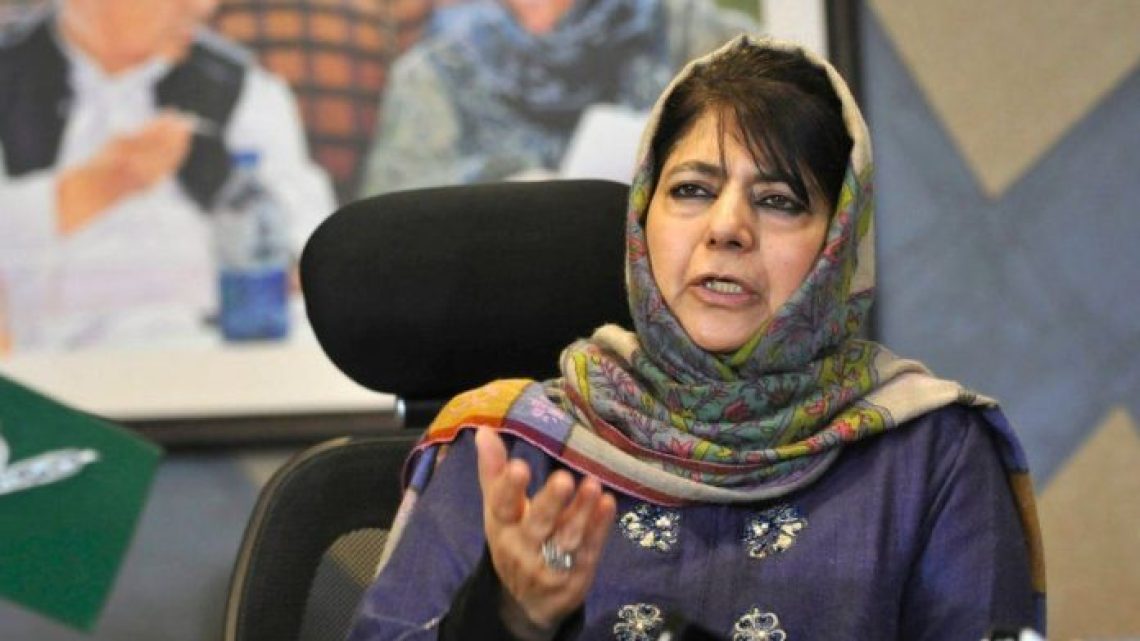
Mehbooba Mufti Files Petition for Immediate Transfer of All Kashmiri Prisoners to IIOJK Jails
October 26, 2025The recent legal action by Peoples Democratic Party (PDP) President Mehbooba Mufti, demanding the immediate transfer of Kashmiri prisoners from outside jails back to Indian Illegally Occupied Jammu and Kashmir (IIOJK), highlights a serious crisis planned by the Indian state. This legal move exposes the severe cruelty used by the New Delhi government to punish not just the detainees, but their entire families. Since the one-sided and illegal removal of Article 370 in August 2019, hundreds of Kashmiri citizens, many still awaiting trial, have been deliberately kept in prisons far away. This practice, often without good reason, is a clear policy of mental and financial attack, making a mockery of basic human and legal rights. This editorial looks closely at the human cost and the breaking of legal rules caused by this calculated policy of moving prisoners far from home.
The Legal Challenge Against State Cruelty
Mehbooba Mufti’s petition is an important legal push against a highly questionable government practice widely criticised by rights groups. The plea aims to bring back basic fairness to the court process in IIOJK.
■ Demand for Immediate Prisoner Transfer: The petition strongly asks the High Court to order the Indian government to immediately move all Kashmiri prisoners awaiting trial who are currently held outside the territory back to local jails.
■ Challenging Unjustified Detention Abroad: The plea insists that authorities must provide clear, strong, and specific reasons in writing for keeping any prisoner awaiting trial outside IIOJK. Furthermore, the petition demands that these specific cases must be checked by the court every three months to ensure fairness.
Breaking Basic Rights of the Constitution
The deliberate keeping of prisoners awaiting trial in distant jails clearly goes against the main ideas of justice and the rights guaranteed by India’s own constitution. This practice ensures that detainees are unfairly denied meaningful help from lawyers and contact with their families.
■ Undertrials Treated Worse Than Convicts: Mufti’s petition points out that this practice puts prisoners awaiting trial in conditions worse than those faced by people already convicted. This directly violates the legal rule of the presumption of innocence.
■ Denying Access to Law and Family: The practice consistently breaks fundamental constitutional rights, especially under Article 21. This includes the guaranteed right to family contact, real access to legal counsel, and the right to a fast and meaningful trial.
The Human and Financial Strain on Families
The forced movement of Kashmiri prisoners to distant jails across India is a targeted policy that uses financial difficulty to punish their already poor families collectively.
■ Severe Financial Hardship: The vast distances to prisons in other Indian states place severe financial burdens on the families of the detainees. Visits by family members, lawyer meetings, and court travel become very costly, often impossible, tasks for families with limited money.
■ Blocking Legal and Family Contact: The long distances severely block the families’ access to courts and lawyers. This purposeful barrier denies the prisoners effective legal support and regular family visits, which are necessary for humane treatment.
A Tactic of Psychological Warfare
The policy of transferring people awaiting trial and other detainees far from their homes is not simply a matter of security; it is an act of psychological warfare intended to break the spirit of resistance within the occupied territory.
■ Post-2019 Detention Policy: Following the removal of Article 370, the Modi government intentionally moved many residents of IIOJK facing investigation or trial to distant jails. This was a clear political move to crush those who disagree with the government.
■ Isolation Worse than Conviction: By denying family contact and proper legal access, the detention policy effectively treats the undertrials—who are yet to be found guilty—with a cruelty that is worse than the treatment given to even the worst convicted criminals.
■ Breach of Humane Treatment Principles: The core principle of humane treatment for those in custody is completely ignored when movement is intentionally planned to isolate the detainee. This deliberate isolation for political reasons is a clear breach of globally accepted standards for holding people.
The Systemic Nature of Administrative Abuse
Mufti’s public interest case shows that this is not a series of accidental events, but rather a deliberate, ongoing abuse of power by the Indian government through its administrative and judicial processes.
■ Continued Denial of Appeals: The petition clearly states that despite repeated appeals made to the Indian government regarding the return of these prisoners awaiting trial, no meaningful action was taken. This shows a deliberate government disregard for the human issue.
■ The Need for Judicial Oversight: The legal action, filed under Article 226, clearly asks the court to step in and enforce strict judicial checking, including reviews every three months, proving that the executive branch cannot be trusted to solve the issue on its own.
Modi Regime’s Strategy of Isolation
The policy of moving prisoners to remote parts of India is a calculated part of the Modi government’s wider strategy to isolate Kashmir politically, legally, and mentally from the rest of the world.
■ Isolating Detainees from Legal Help: By moving prisoners far away, New Delhi ensures that legal challenges become complex, slow, and expensive, effectively limiting the detainees’ ability to fight their cases. This is a deliberate tactical advantage for the state.
■ Collective Punishment for Families: This action is a form of collective punishment. The state, unable to legally prove guilt quickly, uses financial and emotional pressure on families to discourage political activity and disagreement in IIOJK.
A Call for International Scrutiny and Justice
The petition serves as an urgent call to the international community and human rights organizations to closely examine India’s harsh government actions in IIOJK. The unfair movement of prisoners must be recognised as a tool of oppression.
■ Exposing Administrative Oppression: This entire legal battle shows how the government’s machinery is turned into a weapon by the New Delhi government to enforce political control and stop disagreement, turning prison rules into tools of punishment.
■ The Imperative for Immediate Action: The global community must not ignore the suffering of these prisoners and their families. Immediate pressure must be placed on India to follow basic legal and humanitarian rules and end this calculated practice of internal exile and blocking of justice.