Kashmir’s Ongoing Struggle: Voices from IIOJK and Azad Kashmir’s Dedication to the Cause
August 14, 2025Kashmir’s Denied Right to Self-Determination
The Kashmir issue remains unresolved despite the United Nations recognizing Jammu and Kashmir as a disputed territory for over 70 years. The Kashmiri people have been repeatedly denied their right to self-determination. The people of Jammu and Kashmir continue to fight for their rights in Indian Illegally Occupied Jammu and Kashmir (IIOJK), while India’s political motives and the lack of international support make it even harder to resolve the situation.
An Indigenous Struggle for Freedom
The freedom struggle in IIOJK is driven by the Kashmiri people’s desire to preserve their identity, culture, and rights. It is an indigenous movement, rooted in the people’s need to live free from oppression. Despite ongoing human rights abuses, such as forced disappearances, extrajudicial killings, and arbitrary detentions, the Kashmiri resistance remains strong. The struggle is not influenced by external forces but is a genuine call for justice and freedom from within.
The Failure of India’s Military Presence
India has stationed nearly one million troops in Kashmir, yet peace remains elusive. Instead of ensuring peace, this overwhelming military presence has deepened the conflict and fueled resistance. The failure of India’s policies is evident, as the military occupation has only intensified the desire for self-determination among Kashmiris. India’s strategy of control through force has not resulted in stability but has instead perpetuated violence and fear.
The Impact of Article 370 Abrogation
The revocation of Article 370 in 2019 by the Indian government was a turning point in the Kashmir conflict. This action stripped Jammu and Kashmir of its special status, further destabilizing the region. The abrogation violated the region’s autonomy, worsening the political crisis. The arrest of local leaders, the suspension of political activities, and the denial of basic freedoms have only worsened the situation. This move demonstrated India’s disregard for international law and the democratic rights of the Kashmiri people.
Repression of Political Voices
The Indian government has effectively silenced political voices in Kashmir. Prominent leaders have been arrested, and political activity has been severely restricted. This political repression is part of India’s broader strategy to control Kashmir, ensuring that no opposition is allowed to challenge its rule. This lack of political freedom has only added to the frustration of the Kashmiri people, who are left without a voice in the decisions that affect their lives.
The Modi Regime’s Political Tactics
The Modi government, facing increasing challenges at home and abroad, has turned to military operations in Kashmir to gain political support. Recent military operations, such as the one in Kulgam, have been criticized as diversionary tactics to distract from India’s domestic failures. The operation, where soldiers faced extreme conditions, is seen as an attempt to improve the government’s image in the face of rising political opposition and international criticism. These military operations are used not just to address security concerns but to rally political support amid growing discontent with the government.
Militarization as a Political Tool
India’s militarization of IIOJK is not just about controlling the region; it is also a political tool to suppress the Kashmiri struggle for self-determination. By increasing the number of troops and intensifying operations, India seeks to demonstrate its control over the region. However, the military presence has only strengthened Kashmiri resolve, proving that oppression cannot break the spirit of the people. The militarization of everyday life in Kashmir has become a symbol of India’s continued oppression.
Human Rights Violations: Routine Abuse and Disregard
Kashmir has become a hotspot for human rights violations, with extrajudicial killings, torture, and forced disappearances being common occurrences. Indian security forces operate with impunity, committing these abuses under the pretext of counterterrorism. The international community’s failure to hold India accountable has allowed these violations to continue unchecked, deepening the suffering of the Kashmiri people.
The Role of the International Community
Despite widespread reports of human rights abuses, the international community has failed to take meaningful action. While the United Nations has recognized Kashmir as a disputed territory, it has not taken steps to enforce its resolutions or hold India accountable. Other international bodies have raised concerns about human rights abuses, but the lack of a coordinated response has allowed India to continue its oppressive policies. The failure of the global community to intervene has left Kashmiris without support in their fight for justice.
Pakistan’s Continued Support for Kashmir
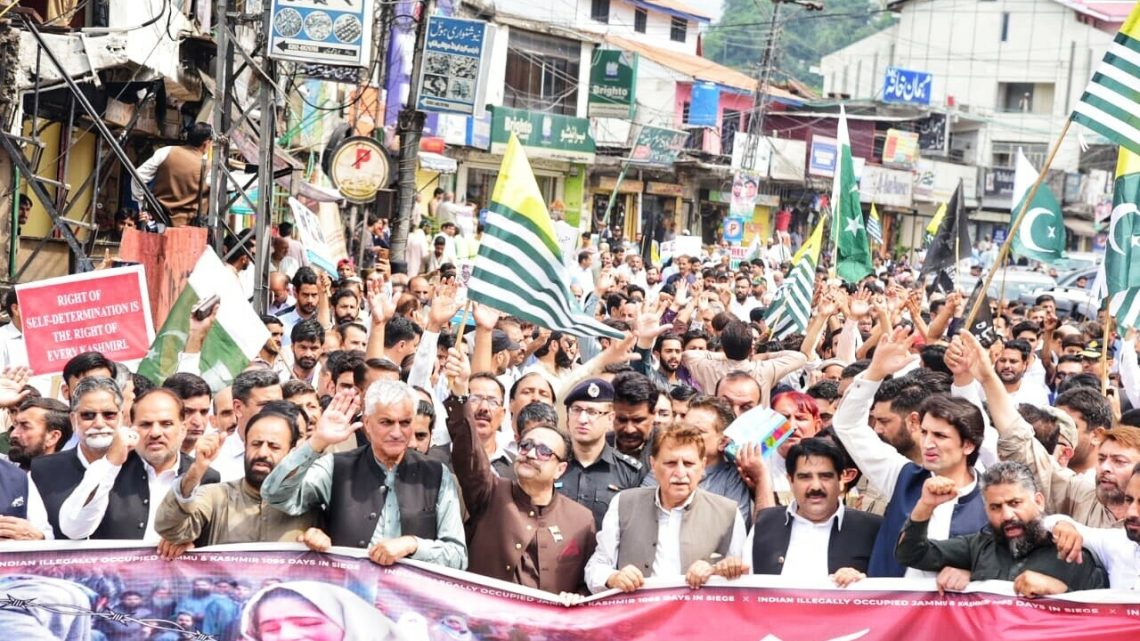
Pakistan has remained a steadfast supporter of Kashmir’s right to self-determination. Leaders in Azad Jammu and Kashmir (AJK) have reaffirmed their commitment to the Kashmir cause, emphasizing the importance of Kashmir to Pakistan’s identity. The President and Prime Minister of AJK have called for continued efforts to support Kashmir’s freedom struggle, and they have condemned India’s actions to change the region’s status and demographic makeup.
Pakistan’s Ideological Connection to Kashmir
Kashmir holds deep ideological significance for Pakistan. The Two-Nation Theory, articulated by Allama Iqbal and realized by Quaid-e-Azam Muhammad Ali Jinnah, emphasized the distinct identity of Muslims in South Asia. The people of Kashmir, with their Muslim majority, have always viewed Pakistan as their natural ally. This ideological connection strengthens Pakistan’s resolve to support the Kashmiri people in their struggle for self-determination.
India’s Attempts to Alter Kashmir’s Status
India’s recent actions, including the revocation of Article 370 and efforts to alter Kashmir’s demographic makeup, are attempts to permanently change the region’s status. These moves are designed to weaken Kashmiri political power and undermine their identity. The Kashmiri people have rejected these actions, viewing them as illegal and oppressive. The international community must take action to hold India accountable and protect Kashmir’s political and cultural integrity.
The Path to Resolution: A Call for Dialogue
The solution to the Kashmir conflict lies in dialogue and peaceful resolution. India must engage with Kashmiri leaders to address the political issues at the heart of the conflict. Kashmiris must be given the opportunity to determine their own future, free from fear and oppression. The international community must play a critical role in facilitating this dialogue and ensuring that the rights of the Kashmiri people are protected. Only through a peaceful resolution, based on the will of the people of Kashmir, can lasting peace be achieved in the region.
Conclusion: The Invincible Struggle for Justice
The Kashmir conflict remains one of the most pressing issues in international politics. Despite India’s military presence and political repression, the people of Kashmir continue to demand their right to self-determination. India’s attempts to suppress this struggle have failed, as the Kashmiri people’s resolve remains strong. The international community must support the Kashmiri people’s right to choose their own future and urge India to stop its military actions. Only then can peace and justice be achieved for the long-oppressed people of Kashmir.