Kashmiri Muslims Uphold Communal Harmony by Helping in Last Rites of Pandit Neighbor
June 30, 2025In a heartwarming moment that defies the narrative of division, Kashmiri Muslims came together to bid a respectful farewell to their Pandit neighbor—proving that humanity still thrives in the heart of conflict.
In a touching example of communal unity, Muslim residents of Lar in Ganderbal district, Indian illegally occupied Jammu and Kashmir, stepped forward to perform the last rites of a Kashmiri Pandit man, highlighting the deep-rooted bonds of brotherhood that persist despite decades of strife.
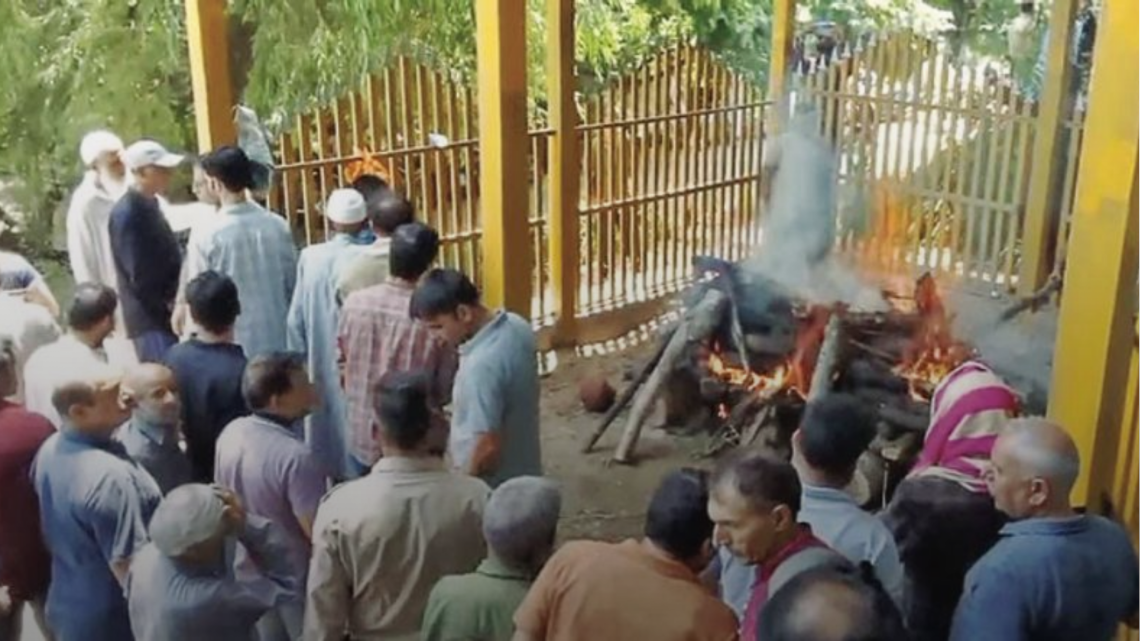
The deceased, Badrinath Butt, passed away on Monday. As soon as the news spread in the neighborhood, local Muslims gathered in solidarity to offer their support. Many mourned his passing as if it were a loss within their own families.
Butt, a highly respected figure in the area, was one of the few remaining Kashmiri Pandits who continued living in the Muslim-majority region after the exodus of the 1990s. While most members of the Pandit community were forced to leave the valley during the peak of the conflict, Butt and a handful of others stayed, relying on the age-old bonds of neighborly trust.
His cremation took place in his ancestral village in Lar, with full support from the Muslim community. Neighbors not only helped make the arrangements but also took part in carrying out the rituals with grace and dignity.
This collective gesture stood out as a quiet yet powerful reminder of Kashmir’s pluralistic ethos. Locals say Butt had always been part of their daily lives, sharing both joy and sorrow over the years. His death, they felt, was a loss not just to his family but to the entire neighborhood.
“Uncle Badrinath was like family to us,” said one of the locals. “We grew up seeing him around. Helping with his final rites was the least we could do to honor his life and legacy.”
In a region too often defined by political turmoil and religious polarization, stories like these offer a different perspective—one where coexistence, mutual respect, and compassion are not just ideals but lived realities.
Community elders recall how festivals were once celebrated together, and how neighbors, irrespective of religion, stood by each other during hardships. While the socio-political landscape may have changed drastically over the years, gestures like these keep the spirit of shared humanity alive.
Observers say such moments carry strong social significance, especially in an environment where communal lines have increasingly become fault lines. The people of Lar, through their act of solidarity, have reminded the world that Kashmir’s essence lies in its tradition of inclusive coexistence.
Despite the ongoing occupation and the region’s tense atmosphere, this incident is a beacon of hope. It reminds us that even in areas marked by years of conflict and mistrust, acts of compassion can still restore faith in unity.
The simple yet profound tribute by the Muslim residents of Lar to their Kashmiri Pandit neighbor sends a message far louder than any political statement—that the human bond, when nurtured with respect and empathy, can overcome even the deepest divides.