Kashmir Bleeds Again: Seven Martyred in July as Indian Repression Escalates in IIOJK
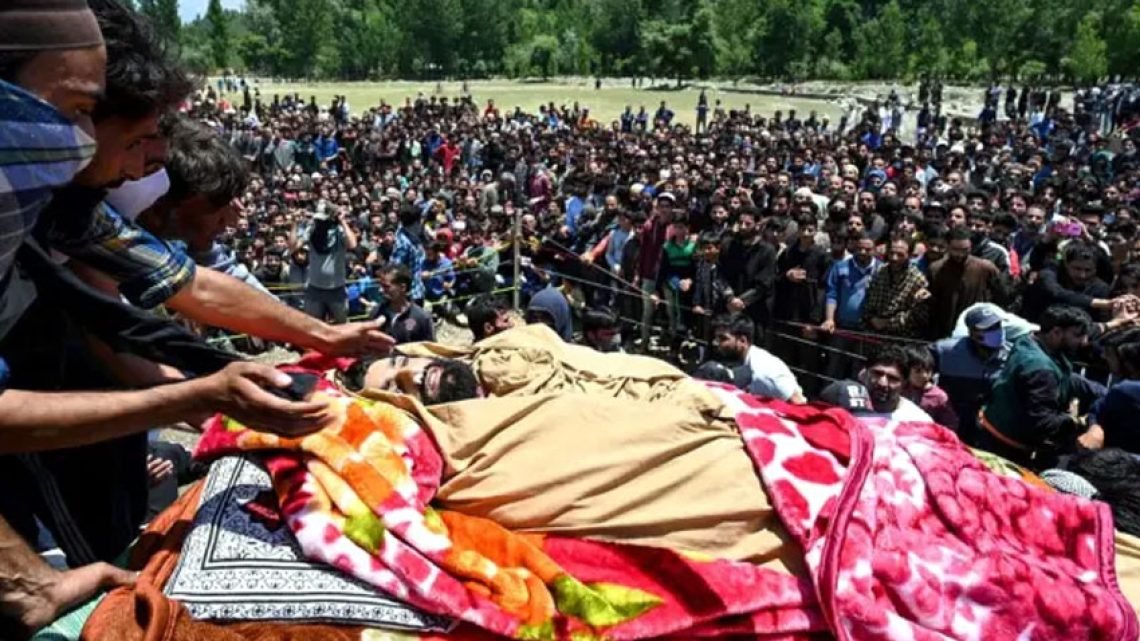
August 2, 2025July witnessed yet another painful chapter in the ongoing violence in Indian Illegally Occupied Jammu and Kashmir (IIOJK), where Indian troops continued their brutal crackdown, resulting in the martyrdom of seven innocent Kashmiris. These killings highlight India’s unwavering policy of using force to suppress the demand for justice and freedom. The bloodshed serves as a stark reminder that IIOJK remains under siege. Despite the grandiose claims made by New Delhi, the ground reality continues to be one of violence, fear, and oppression. Such incidents of state violence are not isolated but part of a calculated strategy to break the spirit of a resilient population. The silence of the international community only adds to the tragedy.
Law Used as a Weapon Against Civilians
In addition to the killings, Indian forces, paramilitary units, and police launched 144 search and raid operations across IIOJK during the same period. At least 49 civilians were arrested, including youth, students, and pro-freedom activists. Many of these individuals were booked under draconian laws such as the Public Safety Act (PSA) and Unlawful Activities Prevention Act (UAPA), which allow for detention without proper legal proceedings.
These so-called legal actions have turned IIOJK into an open-air prison. Laws that were intended to protect people have now been weaponized to destroy their futures. Instead of ensuring justice, Indian authorities are using these laws to crush dissent and push an already oppressed population into further despair. These actions illustrate how the rule of law has been distorted into a tool of repression.
Injuries, Intimidation, and Collective Fear
The crackdown extended beyond arrests, with at least 51 civilians suffering serious injuries as Indian forces used excessive force to crush peaceful protests and gatherings. Tear gas, baton charges, and pellet guns were deployed without any regard for human life or dignity. This brutal approach is part of a broader strategy to instill fear and maintain control. It is designed to break the people’s spirit through repeated psychological and physical trauma.
Each injury sustained in IIOJK tells a story of state brutality and systematic suppression. The use of such violent methods against peaceful civilians exposes the moral bankruptcy of those claiming to uphold democracy.
Properties Seized, Families Targeted
Under the direct control of India’s Home Ministry, the administration in IIOJK seized 22 properties during the month, including homes, shops, and agricultural lands belonging to local Kashmiris. These seizures were carried out without proper legal process, essentially amounting to state-backed economic terrorism. The objective is clear: to punish entire families and erase their economic independence.
Such actions are not only aimed at silencing voices of justice and freedom but are also a deliberate strategy to strip citizens of their livelihoods and reduce them to silence and submission.
Thousands Still Behind Bars Without Justice
Over 3,000 political leaders, students, clerics, scholars, journalists, and human rights defenders remain imprisoned in Indian and IIOJK jails. Among them are prominent Hurriyat leaders like Masarrat Aalam Butt, Shabbir Ahmad Shah, Muhammad Yasin Malik, and Aasiya Andrabi. Their continued detention underscores India’s fear of political dialogue. By silencing these leaders, India seeks to silence the voice of an entire nation.
The prolonged imprisonment of political activists reveals the depth of India’s aversion to democratic engagement in IIOJK. This crackdown is not about maintaining law and order; it is about control and domination.
Delhi’s Aggressive Policy Exposed
India’s current policy in IIOJK is not geared toward peace but rather full control. From the abrogation of Article 370 to the ongoing phase of land seizures, arrests, and censorship, the objective is unmistakable: to erase Kashmiri identity and suppress popular political will. These aggressive measures have exposed India’s real intentions to the world. Instead of addressing the region’s grievances, New Delhi is deepening the crisis with every passing day.
Rather than engaging with the people through justice, India has chosen a path of suppression and denial. This approach not only alienates Kashmiris but also pushes the entire region toward lasting instability.
The World Must Break Its Silence
While these serious violations continue, the international community remains largely silent. Human rights organizations, the United Nations, and influential countries have issued statements, but words alone are no longer enough. The people of IIOJK deserve more than just rhetoric—they need action. The global silence is emboldening the occupying forces. Failure to act now will only lead to further abuse and more tragic losses.
International institutions must rise above diplomatic convenience and uphold their own principles. The cost of ignoring state violence in IIOJK is the loss of moral credibility on a global scale.
The Struggle Continues
Despite the hardships, the people of IIOJK remain resilient and determined. Every act of aggression only strengthens their resolve. Every martyr becomes a symbol of hope. Every family that loses its home stands as a witness to truth. This unwavering spirit is a message to the world: the Kashmiri people will never accept injustice. Their peaceful resistance is a moral challenge to global conscience. No amount of force can erase their history or the collective dream of freedom. IIOJK’s journey is not one of defeat but of undying courage in the face of overwhelming odds.