India’s Use of Collective Punishment and House Demolitions in Kashmir: A Grave Violation of Human Rights
November 20, 2025
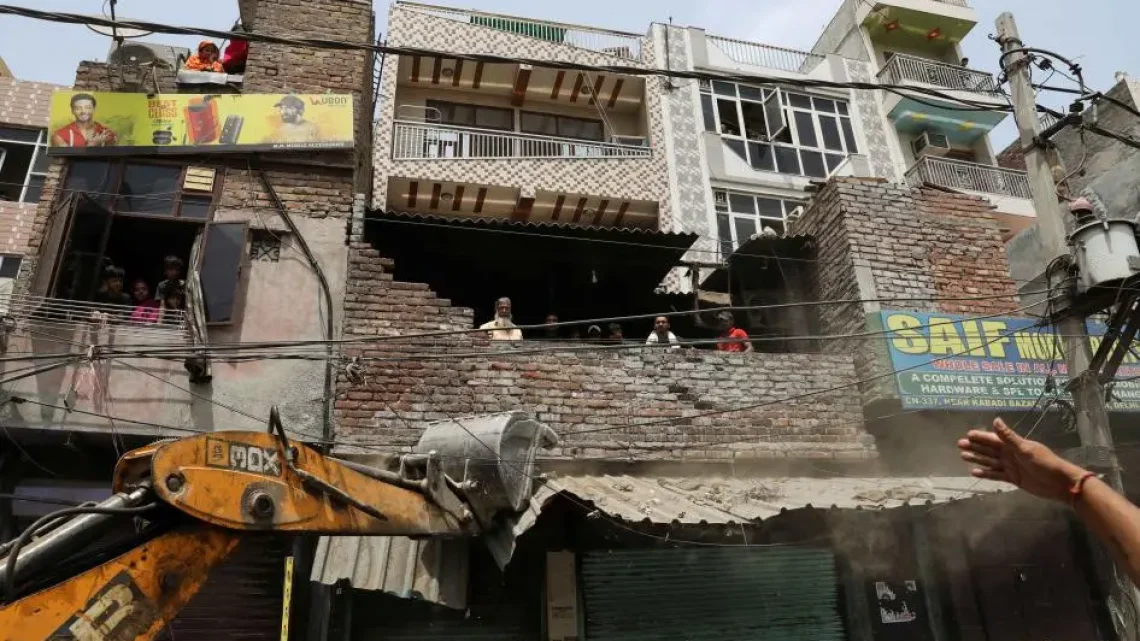
India’s use of collective punishment and house demolitions in Indian-Occupied Jammu and Kashmir (IIOJK) has become a systematic policy aimed at suppressing dissent and intimidating the civilian population. The recent demolition of Dr. Umar Nabi’s family home in Pulwama on November 14, 2025, underscores the brutal measures employed by Indian forces. This act, conducted without judicial authorization, violates international laws, including the Fourth Geneva Convention, and highlights India’s growing disregard for human rights in Kashmir.
Collective Punishment: A Clear Violation of International Law
The demolition of Dr. Nabi’s home is a glaring example of India’s use of collective punishment. The practice, where families are targeted without evidence or trial, violates the Fourth Geneva Convention, which forbids the destruction of civilian property and collective punishment in occupied territories.
♦ Violation of Geneva Convention:
The demolition is a clear violation of Article 33 of the Fourth Geneva Convention, prohibiting collective punishment.
♦ No Judicial Oversight:
The demolition was carried out without judicial authorization, breaching both Indian law and international legal standards.
♦ Unjustified Punishment:
No state has the right to punish families without conviction or evidence, yet India continues to do so under the guise of security.
India’s Disregard for Due Process and Legal Protections
The demolition of Dr. Nabi’s home occurred without notice or trial, defying the Supreme Court’s 2024 ruling that required due process for demolitions. This breach demonstrates the Indian government’s consistent violation of legal protections and its manipulation of law enforcement to target Kashmiri civilians.
♦ Breach of Supreme Court Ruling:
India’s failure to follow the Supreme Court’s 2024 ruling shows a blatant disregard for judicial processes.
♦ Lack of Due Process:
The demolition took place without any trial or court approval, exposing India’s disregard for legal protections.
♦ Unlawful State Action:
The demolition reflects India’s increasing tendency to bypass legal standards in Kashmir.
Widespread Destruction of Civilian Homes
Since 2019, over 1,700 homes have been demolished in Kashmir, with more than 1,170 homes destroyed between 2020 and 2024. These demolitions have been carried out in retaliation for alleged militant activities, but the overwhelming majority of victims are innocent civilians. This widespread destruction highlights India’s strategy of using collective punishment to control and intimidate the population.
♦ Mass Demolitions:
Over 1,700 homes have been demolished since 2019, indicating a deliberate and ongoing policy of collective punishment.
♦ Targeting Innocent Civilians:
The demolitions primarily affect innocent civilians, terrorizing the population under the guise of security.
♦ Systematic Policy of Intimidation:
These actions are part of a broader policy to intimidate and silence the people of Kashmir through fear and violence.
Political and Public Criticism of Collective Punishment
The use of collective punishment has sparked criticism even within India’s political circles. Leaders like Mehbooba Mufti, Iltija Mufti, and Omar Abdullah have condemned the government’s actions, acknowledging that such measures alienate the Kashmiri population and fuel further unrest. These leaders argue that collective punishment is politically motivated, not a genuine security necessity.
♦ Growing Criticism from Indian Leaders:
Even Indian leaders are criticizing collective punishment, recognizing that it alienates Kashmiris rather than improving security.
♦ Alienation of the Kashmiri Population:
These punitive measures exacerbate the sense of alienation and injustice among the Kashmiri people.
♦ Politically Driven Policies:
The government’s actions are increasingly viewed as politically motivated, aimed at suppressing dissent rather than addressing security concerns.
The Human Cost: Torture, Suicide, and Brutality
The extreme human cost of India’s punitive policies is seen in the case of Bilal Wani, who committed suicide after enduring torture and illegal family detentions. Wani’s tragic death exposes the severe toll that India’s repression is taking on the Kashmiri population, where detainees face torture, and entire families are punished without due process.
♦ Bilal Wani’s Suicide:
Bilal Wani’s suicide, following torture and illegal detentions, underscores the grave consequences of India’s punitive policies.
♦ Torture and Brutality:
Many Kashmiri detainees suffer torture and inhumane treatment, leading to tragic outcomes like Wani’s death.
♦ Human Rights Violations:
The scale of human rights violations in Kashmir is staggering, as India’s actions continue to result in widespread suffering.
BJP Support for Punitive Demolitions and Institutional Endorsement
BJP lawmakers have publicly supported the use of house demolitions as a form of punishment, illustrating the institutional endorsement of measures that are internationally recognized as war crimes. This institutional backing for the demolitions further exposes the Indian government’s complicity in perpetrating human rights violations in Kashmir.
♦ BJP’s Support for Demolitions:
BJP lawmakers openly support house demolitions, showing that these actions have official backing within the ruling party.
♦ Institutional Endorsement of War Crimes:
The Indian government’s endorsement of these punitive measures, which violate international law, exposes its disregard for human rights.
♦ War Crimes and Accountability:
By supporting war crimes, India sends a message that human rights violations in Kashmir will continue without consequence.
Conclusion:
India’s use of collective punishment and house demolitions in Kashmir is a clear violation of both national and international legal standards. These actions, which target innocent civilians and punish entire families without trial or evidence, are part of a systematic policy to suppress dissent and intimidate the Kashmiri population. The increasing criticism from political leaders and the mounting human cost of India’s repressive policies highlight the failure of this approach to achieve any security objectives. Instead of curbing resistance, these actions fuel further alienation and unrest. The international community must hold India accountable for its actions, and the Indian government must cease its illegal practices, respect human rights, and restore justice in Kashmir.