India’s Extremist Outrage: Hindutva Groups Attack Muslim Students’ Admissions in Reasi Medical College
December 7, 2025India’s claim of being a secular and democratic state continues to collapse under the weight of its own actions, especially under the Modi government. The recent events in Indian illegally occupied Jammu and Kashmir expose how deeply communal hatred has entered public life in India. The protests in Reasi against Muslim medical students show a society openly driven by prejudice, encouraged by political forces that thrive on hate. What is happening today is not accidental. It is the natural outcome of a state that has allowed fanatic groups to dictate public behaviour and shape national policies through intimidation and force.
◆ Growing intolerance: India has allowed open hostility against Muslims to become a normal practice.
◆ Collapse of democratic values: Institutions no longer protect citizens and instead bend under political pressure.
◆ Shift to majoritarian rule: The Modi government has pushed India toward a dangerous path of exclusion.
Communal Protests at Reasi Medical College
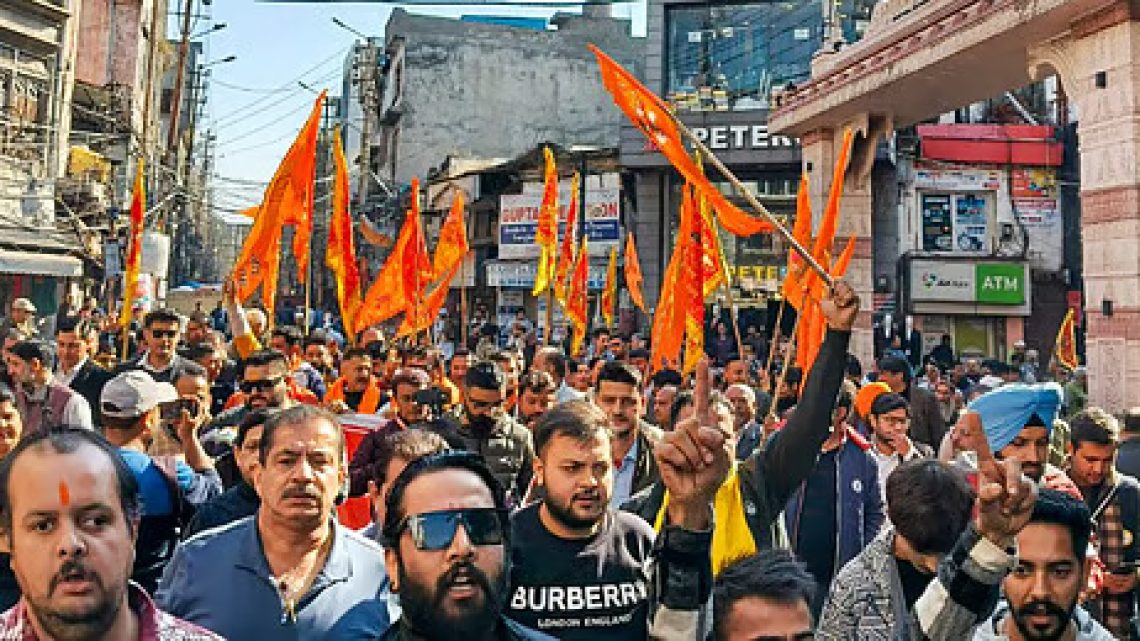
The agitation against Muslim students at the Shri Mata Vaishno Devi Institute of Medical Excellence is a clear case of how hatred is now organized and celebrated in India. Hundreds of right wing activists gathered in Jammu to demand the removal of Muslim students who earned their seats through the national NEET exam. Their anger was not based on academic issues but on pure communal thinking that rejects the idea of Muslims having any rightful place in Indian institutions. This protest reflects the mindset of a country where Muslims are treated as outsiders even when they qualify through merit.
◆ Attack on merit: Muslim students were targeted only because of their identity.
◆ Organized bigotry: Right wing groups mobilized crowds with ease and confidence.
◆ Threat to education: Academic spaces are being turned into arenas of hate.
The Disturbing Claim of Religious Ownership
The argument made by the protest leaders that the shrine board’s funds must serve only Hindu students exposes how extreme the thinking in India has become. This approach destroys the basic idea of equal access and fairness. It promotes the belief that public money and public institutions belong only to one religion. Such thinking divides society and removes Muslim citizens from every sphere of national life. The Modi government’s silence on this matter makes it clear that such voices are not fringe but part of a wider national strategy.
◆ Promotion of division: India is being reshaped around one religious identity.
◆ Exclusion of minorities: Muslims are pushed out of opportunities even when they meet all requirements.
◆ Dangerous public message: Hate is rewarded while equality is ignored.
A Pattern of Extremist Mobilization Under Modi
These protests fit into a much larger pattern that has flourished under Modi’s rule. Hindu extremist outfits act without fear because they know the state supports their agenda. Groups like the BJP, VHP, Bajrang Dal, Shiv Sena and Dogra Front regularly hold demonstrations that spread hate and cause fear among Muslims. The government treats these groups as partners in shaping the political environment. Their actions are not punished. Instead they are normalized as part of daily life in India.
◆ Empowered extremism: Extremist groups direct public behavior with state backing.
◆ Intimidation as policy: Fear is used to control minorities and silence dissent.
◆ State alignment: The government and extremist groups operate with shared goals.
The Targeting of Muslim Students as a Wider Strategy
The focus on Muslim students is not a small issue but part of a wider project designed to crush the presence of Muslims in public institutions. Students who come through open competition are still treated as intruders. Their achievements are rejected because India under Modi has adopted a mindset that sees Muslims as unworthy of progress. Such hostility destroys young minds and weakens the foundations of society.
◆ Atmosphere of fear: Muslim students live under constant pressure and insecurity.
◆ Loss of equality: Fair competition is replaced by communal demands.
◆ Long term damage: A generation of students is forced to face organized discrimination.
Reasi as a Reflection of the Occupation in IIOJK
The incident in Reasi cannot be separated from the larger reality of Indian illegally occupied Jammu and Kashmir. India has long attempted to change the identity of the region through political manipulation, demographic engineering and military pressure. The campaign against Muslim students is another layer of this occupation where India seeks to reduce the presence and rights of the local population. The protests echo the same ideology that drives India’s harsh control over the region.
◆ Policy of suppression: India uses every tool to weaken the Muslim majority in IIOJK.
◆ Cultural displacement: Kashmiri identity is under constant threat.
◆ Occupation mentality: India treats Kashmiris as subjects rather than citizens.
Hindutva’s Deep Influence on Governance
The influence of Hindutva ideology is now visible in almost every aspect of governance. Indian institutions no longer operate independently. They respond to communal pressure and adjust their decisions to satisfy extremist demands. This reality destroys the claim that India is a neutral and constitutional state. Instead, it functions as a country ruled by majoritarian force where minorities have little protection.
◆ Weak institutions: Administrative bodies follow political pressure instead of law.
◆ Communal decision making: Every issue is viewed through a religious lens.
◆ National instability: Extremism erodes trust and divides society.
India’s Descent Into Open Intolerance
The developments in Reasi show a country that has entered a phase of open intolerance. Extremist groups have gained full control of public discourse while the Modi government uses their actions to build political power. India’s international image as a democracy has become a hollow claim as the state continues to target its own citizens based on religion. The direction in which India is moving threatens not only minorities but the entire social and political structure of the region.
◆ Hostility as national policy: The state allows hate to dictate public action.
◆ Political exploitation: The Modi government benefits from communal conflicts.
◆ Breakdown of values: India moves further away from justice and equality.