India’s Endless Pile of Weapons: All these weapons for whom
September 3, 2025India presents itself as a victim of a so-called two-front threat, claiming that it faces challenges from both China and Pakistan. On one hand, India claims “friendship and dialogue” with China, but on the other, it spends billions stockpiling weapons specifically aimed at China. The duplicity is clear: India acts peaceful while secretly preparing for conflict. The real question is: all these weapons: who are they really for?
Military Claims: India’s False Narratives
Indian generals and air force officials often claim that BrahMos missiles have “breached Pakistani defenses,” that S-400 air defense systems have intercepted Pakistani drones, and that Rafale jets give India a strong advantage. However, independent defense experts and Pakistan’s own defense systems, including the J-10C fighter jets, show that these claims are weak in actual combat. India’s so-called technological superiority falls apart when tested in real situations. These boastful claims are part of a narrative aimed at justifying India’s arms build-up.
Leaders Talk Peace, Military Piles Arms
During the 2025 Indo-Pak standoff, India’s leadership claimed to have no desire for war, focusing on peace and dialogue. Yet, at the same time, military leaders were loudly discussing “precision,” “synergy,” and “deterrence.” This contradiction is clear: while India’s political leadership talks of peace, the military is preparing for escalation. The gap between India’s diplomatic words and military actions shows that its true aim is not peace but military readiness for future conflict.
Operation Sindoor: The Trigger for an Arms Buying Spree
After the Pahalgam-Sindoor incident, India launched a large-scale military modernization. Overnight, it announced ₹1 lakh crore ($13 billion) in military procurements: drones, spy planes, loitering munitions, surface-to-air missile (SAM) systems, and naval fighter jets. In addition, ₹50,000 crore was allocated for research and development (R&D) and infrastructure. This sudden and large increase in military spending is not about defending India’s borders, but about fueling an ongoing arms race.
India’s new military purchases include:
- Bhairav Commando Battalions: 40 to 50 new elite units, with several already being formed for “cross-border operations” and “disruption.”
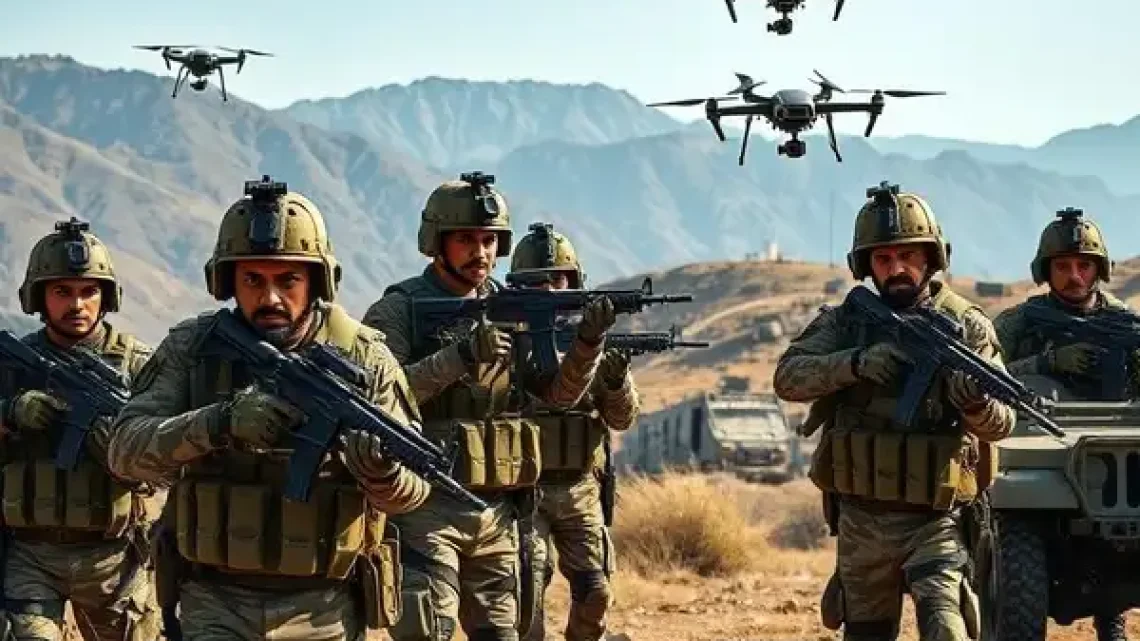
- Shaktibaan Drone-Artillery Regiments: These units combine drones, loitering munitions, and artillery to conduct cross-border strikes.
- Divyastra Batteries: These integrate artillery, UAVs (unmanned aerial vehicles), and special forces, ready to deploy against both Pakistan and China.
- Rudra All-Arms Brigades: Large brigades that combine tanks, UAVs, artillery, and special forces to operate on both borders.
- Drone Platoons and Battalions: India plans to deploy drone battalions for continuous surveillance and strike capabilities.
These are clearly offensive units, not defensive ones, pointing to India’s intent to prepare for aggression rather than defense.
Foreign Shopping Cart: India’s Continued Dependence on External Suppliers
India often promotes slogans like “Make in India” and “Atmanirbhar Bharat” (Self-reliant India), aiming to reduce reliance on foreign suppliers. However, in reality, India continues to depend heavily on foreign sources for many of its military needs. India has made significant purchases from:
- Russia: SU-30MKI fighter jet upgrades and S-400 air defense systems.
- Israel: Surveillance and reconnaissance systems, drones, electronic warfare (EW) equipment, and active protection for tanks.
- France: 26 Rafale-M naval fighter jets, worth ₹63,000 crore, with plans for 114 more.
- United Kingdom: Collaboration on defense projects, including naval security and jet engine production.
If India is only securing its borders, why is it so focused on this global shopping spree? India’s ongoing reliance on foreign suppliers for advanced military systems contradicts its claims of self-reliance.
The Contradiction with China
One of the biggest contradictions in India’s defense strategy is its stance on China. While India seeks closer trade and political ties with China, it continues to deploy military systems like Akash Prime SAMs, QRSAM regiments, and Rudra Brigades along its border with China. If relations with China were truly improving, why would India continue to position such heavy military formations at the border? The reality is clear: the “two-front threat” is used as a convenient excuse to justify unchecked militarization in the region.
The ‘Two-Front Threat’ Narrative: A Convenient Excuse
India justifies its growing weapons purchases by citing a “two-front threat” from both Pakistan and China. However, this narrative is increasingly being used to justify military buildup, rather than reflecting actual security concerns. The rapid expansion of India’s military is not a response to immediate threats but is part of a larger strategy to increase its power and influence. The “two-front threat” serves as an excuse for unchecked military expansion that destabilizes the region.
Internal and External Military Expansion
India’s military buildup is not only about defending its borders; it is also about increasing its influence in the region. The procurement of advanced weapons and the creation of new military formations on both the Pakistani and Chinese borders point to India’s larger ambitions to assert its power. The goal is not simply to secure India’s borders but to strengthen its position in South Asia and beyond.
India’s Growing Arsenal: A Push for Regional Hegemony
India’s increasing arsenal is not driven by defense needs but by its hegemonic ambitions. The rapid expansion of its armed forces, combined with the purchase of advanced military technologies, signals India’s intent to dominate the region. By stockpiling advanced weapons, India is positioning itself as a regional power, aiming to challenge other countries and assert control over its neighbors. The real purpose of this buildup is to increase India’s regional influence, not to protect itself.
The Dangerous Path to Regional Instability
India’s focus on increasing its military power is contributing to regional instability. By pretending to seek peace while continuing to build its military strength, India is destabilizing the region. Its contradictory stance—talking about peace while preparing for war—creates a volatile security environment. The continued buildup of India’s military forces is fueling an arms race in South Asia, which could lead to further tensions and, potentially, conflict.
Conclusion: India’s Weapons Buildup and Its True Purpose
India’s massive weapons stockpile is not about defense; it is about power. While publicly claiming peace and diplomacy, India continues to arm itself heavily in preparation for future conflicts. The country’s growing arsenal is a clear indication of its desire to project power and dominate the region. India’s weapons buildup, fueled by its ambitions of regional dominance, destabilizes the security environment and undermines peace efforts. The real purpose behind this military expansion is not defense, but the pursuit of greater control and influence in South Asia.