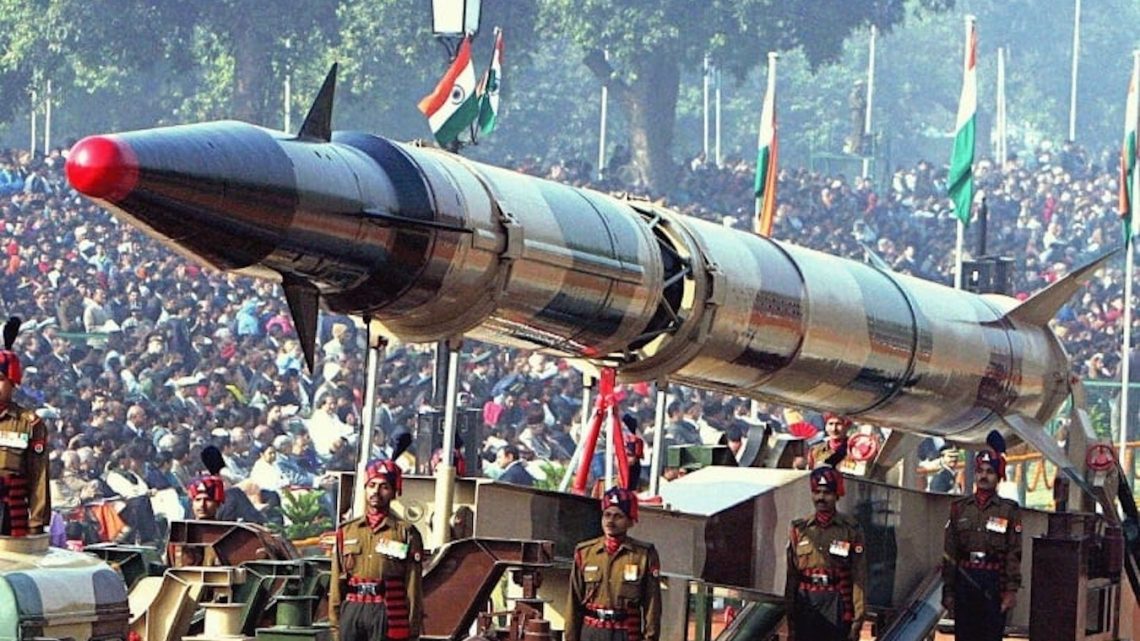
India’s Agni 5 Missile Reclassification: A Strategic Maneuver Escalating Regional and Global Security Risks
August 23, 2025India’s decision to reclassify its Agni 5 missile from an ICBM (Intercontinental Ballistic Missile) to an IRBM (Intermediate Range Ballistic Missile) has sparked controversy. While it may appear to be a simple technical change, it has significant strategic implications. This move allows India to enhance its deterrence capability while avoiding increased international scrutiny. However, it raises concerns over regional security and global stability.
A Strategic Adjustment in Military Policy
The reclassification is a clear strategic shift. Officially, the Agni 5 is said to have a range of 5,500 km, though some reports claim it could extend to 8,000 km. This inconsistency creates ambiguity, enabling India to downplay the missile’s global strike potential. By presenting it as an IRBM, India avoids the perception of having a missile capable of reaching anywhere in the world, preserving its nuclear deterrence without triggering global concern.
Exploiting Ambiguity for Diplomatic Gains
The reclassification works as a diplomatic tool, reducing the perception of India’s nuclear threat. This ambiguity allows India to avoid global sanctions or restrictions that would follow the classification of an ICBM. It enables India to strengthen its defense capabilities while keeping its relations with Western countries intact, particularly the United States and Europe, which have been cautious about India’s missile development.
Reducing Diplomatic Tension
India’s move to reclassify the Agni 5 helps mitigate diplomatic fallout. This decision keeps India’s growing nuclear power from alarming key international players, especially the United States and European nations. By rebranding the missile as an IRBM, India avoids facing scrutiny over global nuclear strike capabilities, allowing it to continue developing its missile technology without major international opposition.
The Role of MIRV Technology in Escalation
MIRV (Multiple Independently Targetable Reentry Vehicle) technology increases the missile’s effectiveness. With MIRVs, the Agni 5 could target multiple sites simultaneously, complicating any defense system. While strengthening India’s deterrence, this technology raises the risk of escalation in a crisis, making it harder to de-escalate tensions. The presence of MIRVs increases the possibility of misjudgment, which could quickly lead to uncontrollable conflict.
A Catalyst for Regional Arms Race
This reclassification is likely to provoke an arms race in South Asia. Both China and Pakistan are developing their own advanced missile systems in response to India’s growing capabilities. This creates a cycle of military escalation, with each nation attempting to outpace the other’s advancements. The increased focus on missile development undermines efforts to stabilize the region and increases the risk of an arms race.
Heightened Security Concerns in South Asia
India’s missile advancements increase the stakes in South Asia, where nuclear-armed neighbors face off. The Agni 5 missile’s extended range can target both China and Pakistan, ensuring India’s second-strike capability under its No First Use (NFU) policy. However, this also makes the region more volatile, as even a small skirmish could quickly escalate into a larger conflict due to the heightened missile capabilities of all parties involved.
Complicating India’s No First Use Policy
India’s NFU policy ensures that nuclear weapons will only be used in retaliation. The Agni 5 missile enhances this policy by providing India with a reliable second-strike capability. However, the introduction of MIRV technology complicates the situation, making it harder to predict how and when retaliation would occur. The growing capabilities of India’s nuclear arsenal increase the risk of accidental escalation, making the region less stable.
The Danger of Miscalculations
The reclassification increases the risk of miscalculation. If adversaries are unsure of the Agni 5’s exact range and capabilities, they may perceive it as more dangerous than it actually is. This uncertainty can lead to more aggressive or defensive actions that could spark unintended conflicts. Misunderstandings in a region as tense as South Asia could result in disastrous consequences if nuclear weapons are involved.
Undermining Global Arms Control Efforts
India’s missile developments, especially the potential addition of MIRV technology, pose a challenge to global arms control efforts. As countries like the United States and Russia work to reduce nuclear arsenals, India’s missile advancements threaten to undermine these efforts. Instead of advancing towards disarmament, the development of more advanced missiles increases the likelihood of a new nuclear arms race, complicating global peace efforts.
Escalation of Military Spending and Its Costs
The arms race triggered by India’s missile developments comes with high economic and political costs. As India, Pakistan, and China ramp up military spending, resources are diverted from critical areas like education, health, and infrastructure. The focus on military expansion reduces the resources available for social and economic development, hindering progress in other important areas for regional stability.
The Global Perception of India’s Military Intentions
India’s missile reclassification could alter global perceptions of its military intentions. While India may see its missile developments as necessary for national security, other countries could view them as signs of military expansionism. This shift could strain India’s diplomatic relationships with global powers, particularly if it is seen as seeking to dominate the region through military force, potentially alienating key international allies.
Risk of Regional Destabilization
The missile reclassification risks further destabilizing South Asia. As India’s neighbors, particularly Pakistan and China, accelerate their missile programs in response, the region becomes more volatile. Each country’s efforts to surpass the other in military capabilities increase the chances of a small conflict turning into a larger war. This race for military superiority makes it harder to achieve peace and stability in the region.
Conclusion
India’s reclassification of the Agni 5 missile is a strategic move designed to enhance its regional deterrence capabilities without triggering global alarm. However, this shift has serious consequences. It fuels an arms race in South Asia, raises the risk of miscalculations, and undermines global efforts for nuclear arms control. While India may view the move as defensive, it contributes to a more unstable and unpredictable global security environment. The need for transparency, restraint, and diplomatic engagement in missile technology has never been more urgent.