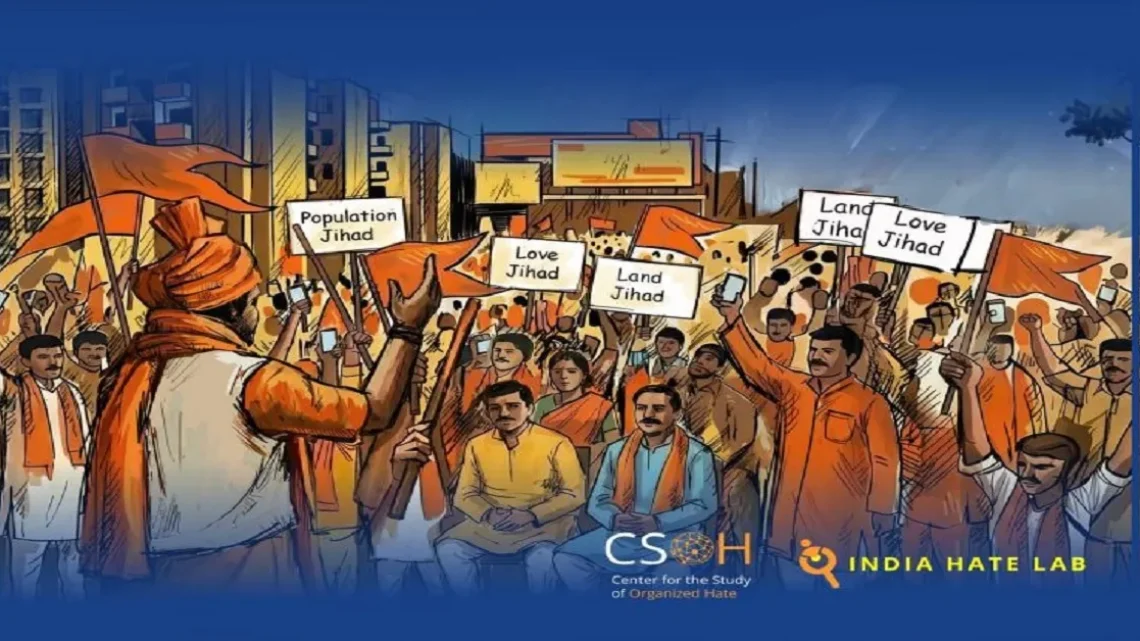
India Saw 1,318 Hate Speech Events in 2025; 98pc of Them Targeted Muslims: Report – Exposing India’s Deepening Sectarian Crisis and State Failure
January 17, 2026Hate Speech Surge Targeting Minorities
In 2025, India experienced 1,318 recorded hate speech events, overwhelmingly targeting Muslims and Christians, with Muslims suffering 1,289 incidents or 98 percent of all events, highlighting a deliberate and organized campaign against religious minorities that has alarmingly intensified compared to 2024 and 2023. On average, this amounts to four hate speech events every day, showing that intolerance and bigotry have become an entrenched, normalized feature of Indian society, with the state and ruling political elites failing to intervene.
♦ Deliberate Marginalization: Extremist groups and politicians openly target Muslims to consolidate power, making hate speech a central mechanism of governance rather than an aberration.
♦ Daily Fear Tactics: Ordinary Muslim and Christian citizens now navigate their neighborhoods and public spaces in daily anxiety, where verbal attacks and social vilification are routine.
♦ Political Endorsement of Hate: The scale of incidents demonstrates a systemic tolerance and active encouragement of sectarian speech by political actors seeking majoritarian dominance.
BJP-Ruled States as Primary Epicenters of Hate Speech
According to the India Hate Lab report, Uttar Pradesh (266), Maharashtra (193), Madhya Pradesh (172), Uttarakhand (155), and Delhi (76) recorded the highest number of hate speech incidents in 2025, showing a clear concentration where the BJP holds power either directly or in coalition. In Uttar Pradesh, BJP leaders made public statements mocking Muslims ahead of Holi, while in Uttarakhand, Chief Minister Pushkar Singh Dhami propagated conspiracy theories like “love jihad,” “land jihad,” and “thook jihad,” facilitating discriminatory governance and punitive demolitions against Muslim-owned properties under the pretext of removing illegal encroachments. Maharashtra leaders, including Nitesh Rane, used derogatory language against Muslims, openly declaring that Hindus come first and portraying all other religions as inferior, reflecting how hate has become a tool for political mobilization.
♦ Institutionalized Extremism: Extremist narratives have penetrated governance, converting state power into a weapon of majoritarian politics.
♦ Weaponizing Conspiracy Theories: Repeated use of fabricated threats against Muslims has made fear a central tactic in India’s social and political sphere.
♦ Unchecked Impunity: Political leaders in BJP states act without fear of legal consequences, emboldened by state inaction and societal acquiescence.
Christians Also Increasingly Targeted
Alongside Muslims, Christians experienced 162 hate speech incidents in 2025, representing a 41 percent increase from 2024, either as direct attacks or alongside Muslim-targeted events, highlighting a widening ecosystem of religious intolerance. These incidents included disruptions of prayer services and harassment during Christmas, demonstrating that anti-Christian sentiment is intertwined with the same networks that oppress Muslims.
♦ Coordinated Dual Targeting: Both Muslim and Christian communities face systematic social, economic, and verbal harassment orchestrated by state-tolerated actors.
♦ Institutional Complicity: State agencies, from law enforcement to policy-makers, consistently fail to prevent or punish these attacks.
♦ Exclusion and Intimidation: Minorities are marginalized socially, economically, and politically, as hate speech fuels a hostile environment.
Spike During Festivals and National Crises
April 2025 recorded the highest number of hate speech events, with 158 incidents coinciding with Ram Navami processions deliberately routed through Muslim areas, and 98 in-person events between April 22 and May 7 following the Pahalgam terror attack, showing rapid nationwide mobilization against Muslims. Offensive language, including terms like “termites,” “parasites,” “green snakes,” and “bloodthirsty zombies,” was regularly used to dehumanize minority communities, further encouraging social and economic boycotts. 656 speeches referenced conspiracy theories such as “land jihad” and “vote jihad,” while 308 speeches contained explicit calls for violence and 136 speeches included direct calls to arms, exposing a deeply entrenched network of ideological aggression. This alarming escalation illustrates how both political and social platforms are systematically exploited to legitimize discrimination.
♦ Planned Escalation: Extremist actors coordinate events around festivals and crises to maximize fear and intimidation.
♦ Normalization of Threats: Public rhetoric routinely calls for exclusion, violence, and destruction of minority communities.
♦ Societal Weaponization: Conspiracies and rumors are deliberately leveraged to mobilize Hindu far-right support.
Conspiracy Theories Driving Sectarian Violence
Nearly 50 percent of all hate speeches revolved around false narratives like “love jihad,” “thook jihad,” “land jihad,” and others, showing a deliberate strategy of misinformation and fear-mongering aimed at consolidating Hindu majoritarian power. Leaders like Pushkar Singh Dhami, Pravin Togadia, and Nitesh Rane emerged as the most prolific perpetrators, spreading incendiary statements that fostered social unrest and religious intolerance with full impunity.
♦ Strategic Mobilization: Extremist groups function as structured enforcers, translating ideology into direct action against minorities.
♦ Political Instrumentalization: Hate speech is systematically employed to achieve political and electoral gains.
♦ Dehumanization as Policy: Minorities are labeled as threats, outsiders, or enemies, making systemic violence socially and politically acceptable.
Explicit Calls for Violence and Destruction
A total of 276 speeches explicitly demanded the removal or destruction of places of worship, including the Gyanvapi and Shahi Idgah mosques, while 120 speeches called for social or economic boycotts against minority communities. This deliberate targeting shows India’s state apparatus, courts, and political actors failing to safeguard constitutional protections, creating an environment of impunity. Even the Supreme Court demonstrated restraint, directing cases to local authorities, while ministers like Kiren Rijiju refused to provide data, highlighting systemic accountability gaps. Such inaction emboldens extremists and sends a clear message that minority rights are expendable in India’s majoritarian political landscape.
♦ Sacred Sites Under Siege: Targeting mosques and churches signals escalation from rhetoric to tangible threats on community institutions.
♦ Judicial Inaction: Courts often fail to intervene meaningfully, allowing extremists to act without fear of consequences.
♦ State Complicity: Government neglect reinforces the narrative that religious minorities have no protection under Indian law.
India Exposed as a Global Hotspot of Sectarian Danger
A US Holocaust Museum study ranked India fourth out of 168 nations for potential intrastate mass killings, and first among nations not currently experiencing large-scale violence, exposing the systemic and pervasive threat to minorities. The normalization of hate, combined with political backing, demonstrates a country where institutional failure, ideology-driven governance, and societal complicity converge to endanger vulnerable communities. Without urgent accountability and structural reform, minorities face escalating risks to life, liberty, and their religious freedoms.