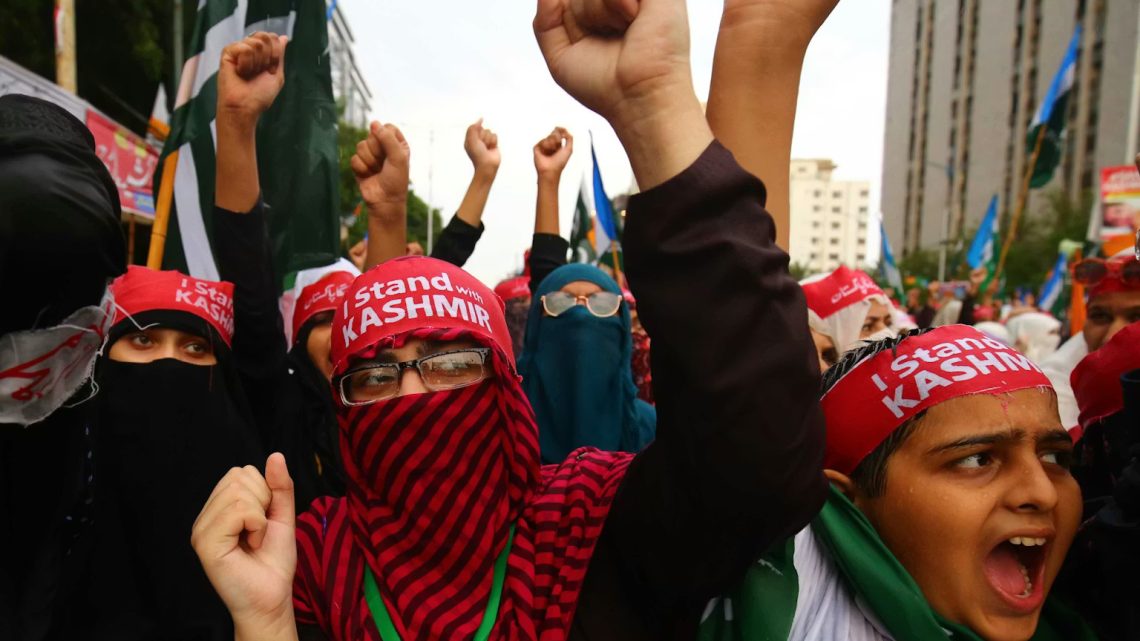
Hindutva Agenda in Kashmir and the Rising Threat to South Asian Peace
December 5, 2025A webinar titled “BJP’s Hindutva Agenda in Kashmir: A Serious Threat to South Asian Peace,” organised by Kashmir Media Service and United Kashmir Journalists Association, brought together scholars, journalists and rights advocates who warned that India’s current actions in Indian Illegally Occupied Jammu and Kashmir were increasing regional tension. Speakers said the Modi government was reshaping Kashmir through force, strict laws and demographic changes, which showed a long effort to control the region. They stressed that Pakistan, Kashmiri leadership and the international community must work together to highlight these actions. The discussion made clear that the Hindutva agenda was now a major factor affecting peace and stability in South Asia.
United Voice Needed Against Indian Pressure
Abdul Rashid Turabi, Former Ameer Jamaat-e-Islami AJK, said religious and political leaders must raise a strong united voice against Indian actions in IIOJK. He said Azad Jammu and Kashmir, the “base camp,” must be strengthened to support the people under occupation. Turabi added that India had used force for decades but failed to break the Kashmiri struggle. He said a united political front was needed because India continued to use strict laws and military pressure to silence Kashmiris.
♦ Strengthening Base Camp: AJK must be ready to support Kashmiris facing Indian pressure.
♦ Indian Pressure Continues: India uses force but cannot end the Kashmiri movement.
♦ Need for Unity: A united stand is needed to challenge India’s actions.
India’s Psychological Pressure and Attack on Identity
Farzana Yaqoob, former AJK Minister and CEO Dastaq Resources, said that while AJK remained peaceful, IIOJK faced severe operations by Indian forces. She noted that actions like Bunyanum Marsoos helped bring global attention to Kashmir. Farzana warned that India was using psychological pressure and was now criminalising the word “Kashmiri,” which was an attempt to weaken and erase identity. She said this showed India feared Kashmiri unity and the strength of their voice.
♦ Psychological Pressure: India uses mental pressure to weaken Kashmiris.
♦ Identity Under Attack: Calling the word “Kashmiri” a crime shows India’s fear.
♦ Need for Awareness: The world must see how India targets identity.
Settler Plan and Silencing of Kashmiri Voices
Shamim Shawl, senior APHC-AJK leader, said AJK must take stronger positions on the Kashmir issue. She said India had not broken Kashmiri resolve despite pressure and restrictions. Shamim warned that settler plans were increasing and that Indian control had tightened so much that almost no voice came out of occupied Kashmir. She said people outside Kashmir had a duty to speak because those inside were denied basic rights.
♦ Settler Plan: India is bringing settlers to change the population structure.
♦ Silencing Voices: India blocks political expression to hide the real situation.
♦ Duty of AJK: AJK must speak for those silenced by occupation.
Hindutva and Control of Culture and Society
Madiya Shakeel, lecturer at the University of AJK, explained that Hindutva was a project aimed at strong central control and cultural influence. She said demographic changes, cultural pressure and new textbooks were part of this push. Madiya described “saffronisation” through promotion of Hindu symbols, changes in school materials and marginalisation of Muslims and Christians. She warned that Hindutva was not only a threat to Kashmir but also to wider peace.
♦ Saffronisation: India is reshaping education and public life to weaken Muslim history.
♦ Cultural Control: Hindu symbols are being pushed on a Muslim-majority region.
♦ Wider Impact: Hindutva creates danger beyond Kashmir.
Cultural Invasion and India Ignoring UN Resolutions
Syed Faiz Naqshbandi, senior APHC-AJK leader, warned that India was carrying out a cultural invasion and demographic changes to make Kashmiris powerless in their own land. He reminded the audience that UN resolutions on Kashmir were binding. Naqshbandi said India was blocking every political settlement through delaying tactics and refusal to recognise Kashmiris as the main party. Still, he said Kashmiris remained hopeful and firm.
♦ Cultural Invasion: India is replacing local culture with outside identity.
♦ Ignoring UN Resolutions: India refuses to accept global commitments.
♦ Kashmiri Hope: The people remain firm despite hardship.
Need for Global Advocacy Against India’s Narrative
Nabila Irshad Khan, Chairperson Jammu and Kashmir Democratic Party, said awareness campaigns were essential to counter India’s claims. She said India used media control and political statements to hide human rights abuses in IIOJK. Nabila urged more academic, media and diplomatic work to highlight the truth. She said silence only strengthened India’s oppressive system.
♦ Global Outreach: Kashmir must be presented clearly to the world.
♦ Countering India: India’s claims must be challenged with facts.
♦ Human Rights Focus: Abuses in IIOJK must be widely reported.
Rising Fascist Patterns in Modi Government Policies
Dr Abdul Basit Mujahid, academician and Assistant Professor at AIOU, said Modi government policies resembled the methods of Hitler and Mussolini. He said the events of 2019 were part of a long planned push for Akhand Bharat. Dr Mujahid drew parallels between Gaza and Kashmir, saying both faced occupation and violence. He called for more content creation and cooperation among Muslim countries.
♦ Fascist Methods: Modi policies follow classic authoritarian models.
♦ Long Plan: The 2019 changes were part of a wider Indian plan.
♦ Muslim Cooperation: Unity is needed to counter India’s actions.
Two-Nation Theory and India’s Use of Black Laws
Shaikh Abdul Mateen, senior APHC-AJK leader, said recent events in Kashmir proved the continuing relevance of the two-nation theory. He said India had imposed black laws that gave full protection to its forces, allowing abuses without accountability. Mateen said the Modi government aimed to weaken Kashmiri identity and stop all political expression. His remarks showed that India’s project in Kashmir was both political and ideological.
♦ Black Laws: Indian forces enjoy complete protection in IIOJK.
♦ Identity Under Attack: India wants to erase Kashmiri identity.
♦ Relevance of Two-Nation Theory: The situation shows the deep divide.
A Region at Risk Under Hindutva Rule
Speakers agreed that India’s Hindutva-driven policies were harming South Asian peace and must be exposed in a coordinated manner. They said political, diplomatic and academic efforts were needed to counter India’s actions. The session made clear that Modi government policies were pushing the region toward greater instability. The responsibility now lies with Pakistan, Kashmiri leadership and the international community to respond before the situation worsens.