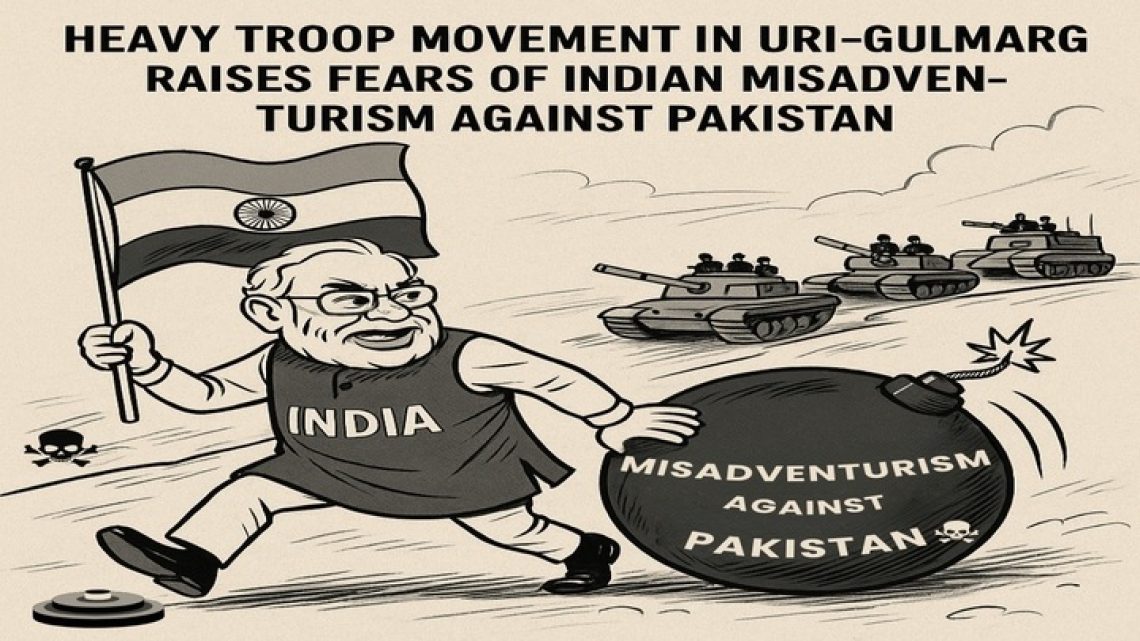
Heavy Troop Movement in Uri–Gulmarg Raises Fears of Indian Misadventurism Against Pakistan
August 27, 2025Recent reports from Uri and surrounding areas of Baramulla district in Indian illegally occupied Jammu and Kashmir indicate a substantial movement of Indian troops along with heavy weapons and ammunition. Residents along the Uri–Gulmarg stretch, bordering the Poonch sector of the Line of Control (LoC), have expressed deep concern over possible Indian misadventurism against Pakistan. This unprecedented troop movement has stirred panic, as the region braces for a potential escalation.
Local Observations
Locals in Uri and nearby villages have witnessed unusual and intensive mobilization of Indian forces. The presence of trucks carrying weapons, artillery, and ammunition has created visible tension among communities. Residents report that the movements have been ongoing for the past ten days, intensifying fear and uncertainty.
Civilian Fears and Evacuations
The growing military activity has prompted many families to leave their homes. Markets in Uri, Gulmarg, and adjoining areas are witnessing minimal activity, reflecting widespread anxiety. Panic and uncertainty dominate the daily life of civilians, who fear being caught in any potential conflict or military action.
Restricted Zones
The Indian Army has declared several regions, including Tosamaidan, the upper reaches of Gulmarg, Doodhpathri, and Yousmarg, as off-limits to civilians. These declarations not only restrict movement but signal preparation for possible military operations. The restriction of these zones highlights the strategic importance the Indian military assigns to these areas.
Construction of Fortifications
Eyewitness accounts confirm that bunkers and trenches are being built in mountainous regions stretching from Uri to Tosamaidan. These fortified positions appear aligned toward sensitive areas of Poonch and Rajouri, suggesting careful military planning for potential offensive or defensive operations along the LoC.
Strategic Significance
The troop build-up beyond Doodhpathri and Tosamaidan is critical due to the strategic positioning of these locations. Any military action launched from these zones could directly affect key sectors of the LoC. Observers note that the concentration of forces in these regions raises alarm about possible escalation of hostilities.
Ideological Influence
Analysts highlight the role of the Indian Army’s alignment with the Hindutva ideology of the Rashtriya Swayamsevak Sangh (RSS). The presence of armed groups influenced by this ideology, coupled with their deployment along the LoC, is seen as highly provocative. Such ideological underpinnings exacerbate regional tension and threaten the stability of South Asia.
Raising Armed Groups
Reports suggest that the Indian Army is attempting to raise and deploy armed groups along the LoC. This move, viewed as an aggressive measure, could further heighten the risk of confrontation with Pakistan. Observers warn that these actions may provoke unintended escalation, destabilizing an already fragile regional security environment.
Replacement of Army by CRPF
Recent announcements indicate that the Indian Central Reserve Police Force (CRPF) is set to replace the Indian Army in certain hinterland areas. This shift is seen as part of a broader plan to redistribute Indian military resources while maintaining pressure along the LoC. Such redeployment could signal preparations for both defensive and potentially aggressive measures.
BSF Reinforcement
Earlier, in May 2025, the Border Security Force (BSF) had reinforced its forward posts and checkpoints, especially along the Srinagar–Uri highway. The continual strengthening of forward positions reflects the Indian military’s focus on controlling key access points and increasing readiness for any escalation.
Operational Preparation
The construction of bunkers, trenches, and fortified zones demonstrates meticulous operational planning. The Indian Army’s efforts to secure high-altitude areas indicate an intention to maintain dominance over strategic positions. Observers suggest that such preparation is aimed at both protecting key areas and creating offensive capability against perceived threats.
Impact on Civilians
The combined effect of troop mobilization, restricted zones, and ongoing fortification has severely disrupted civilian life. Residents face displacement, economic stagnation due to deserted markets, and constant anxiety over the potential outbreak of hostilities. This situation underlines the human cost of military escalation along the LoC.
Regional Security Concerns
The heavy troop movement in Uri–Gulmarg and deployment of armed groups raise serious concerns for regional peace. Experts warn that these developments could provoke cross-border tensions with Pakistan, threatening the broader stability of South Asia. The actions also challenge diplomatic efforts aimed at maintaining calm along the LoC.
Conclusion
The ongoing troop movement along the Uri–Gulmarg stretch, coupled with the construction of fortified positions and deployment of armed groups, signals a dangerous trajectory of Indian military activity. Influenced by ideological motivations and reinforced by CRPF and BSF deployments, these developments heighten the risk of misadventure against Pakistan. Civilians remain the immediate victims of fear and disruption, while the broader region faces growing instability. Maintaining vigilance, documenting movements, and highlighting these developments internationally are critical steps in preventing escalation and safeguarding peace in this volatile border region.

