Heavy Militarization in IIOJK Raises Concerns Before Amarnath Yatra
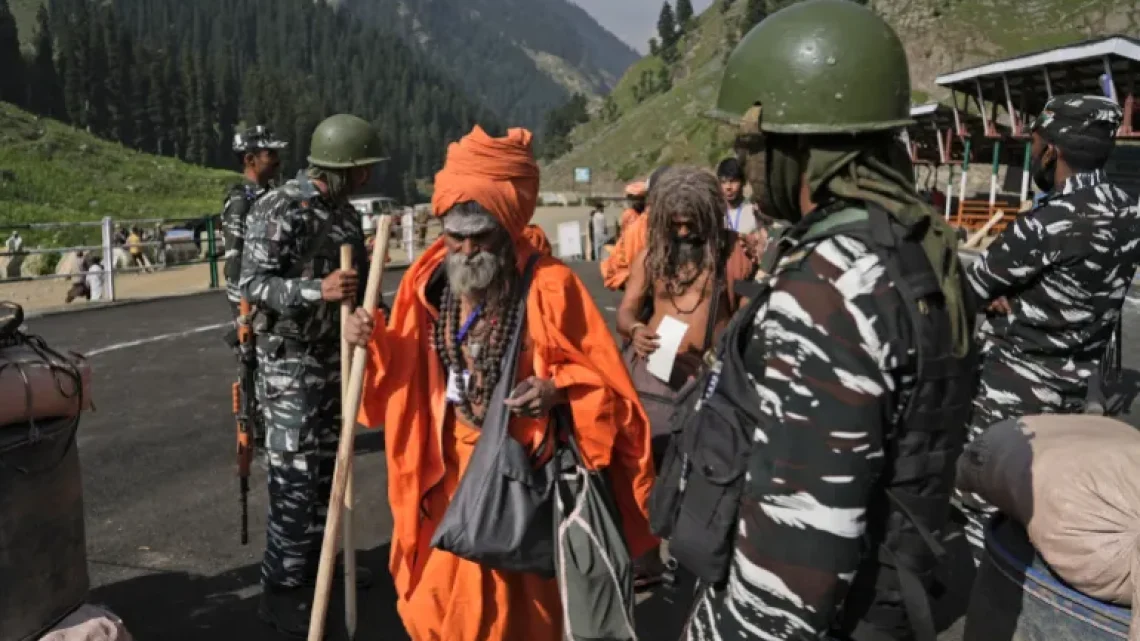
July 1, 2025Under the guise of safeguarding pilgrims, authorities have sharply escalated security measures across Jammu and Kashmir—restricting movement, deploying forces, and installing round‑the‑clock checkpoints that many fear will stifle daily life.
Restrictions across Indian illegally occupied Jammu and Kashmir (IIOJK) have been dramatically stepped up, especially in the Jammu region, in anticipation of the annual Amarnath Yatra, which begins on Friday, July 3.
According to reports, dozens of new checkpoints have appeared throughout Jammu city. Officers from the Indian police, CISF, CRPF, ITBP, and other paramilitary forces have been mobilized to carry out intensive frisking, surveillance, and identity verification.
Security personnel are focusing on vehicle inspections and identity checks. Technological tools—such as facial recognition systems—have been deployed at crowded junctions and sensitive sites. The aim, officials say, is to spot any suspicious activity before it can threaten pilgrims or the public.
“Random inspections at hotels, guesthouses, and other lodging centres will also be conducted,” a police spokesperson confirmed. Citizens and pilgrims have been urged to cooperate fully with naka teams, carry valid photo IDs, and report anything unusual immediately.
Checkpoints will operate around the clock in high‑risk and high‑traffic areas. This includes main highways, the city outskirts, and the routes leading to the Bhagwati Nagar base camp, from where the first batch of pilgrims will depart on July 2.
Similar security protocols have been enforced in the Kashmir Valley. Srinagar and other districts now host additional frisking points, mobile patrols, and surge teams to complement the Jammu measures.
The 38‑day pilgrimage follows two primary routes: the traditional 48‑kilometre Pahalgam path through Islamabad district, and the shorter 14‑kilometre Baltal trail in Ganderbal. Both paths lead pilgrims to the sacred Amarnath cave shrine, perched at an altitude of 3,880 metres.
Senior police officers are personally supervising checkpoint operations to ensure efficiency, vigilance, and minimal inconvenience to the public. “We are committed to balancing security needs with the convenience of citizens and pilgrims,” the spokesperson added.
Despite official assurances, many locals worry about the impact of this security buildup on daily life. Traders in Jammu report longer waits at naka points, while commuters say the increased scrutiny has slowed traffic to a crawl.
In Srinagar, residents express similar frustrations. “It feels like we’re living in a fortress,” one shopkeeper told reporters. “Every trip outside feels like a military operation.”
Human rights groups have criticized the blanket nature of these measures, arguing that routine civilian activities are being treated as potential security threats. They point out that while the Yatra is important, the clampdown risks alienating the very communities whose cooperation is needed.
Some analysts believe the heavy militarization reflects New Delhi’s broader approach to governance in IIOJK since revoking the region’s special status in 2019. They argue that these pre‑Yatra operations serve as a reminder of the state’s overwhelming presence.
With the pilgrimage set to draw thousands of devotees from across India, authorities maintain that stringent checks are essential. They highlight past attacks on pilgrim convoys as justification for the robust security posture.
As Jammu and Kashmir brace for the Yatra, the balance between protection and oppression remains delicate. Whether these restrictions will prove to be prudent safeguards or oppressive tactics depends on how they are implemented—and how communities respond in the days ahead.