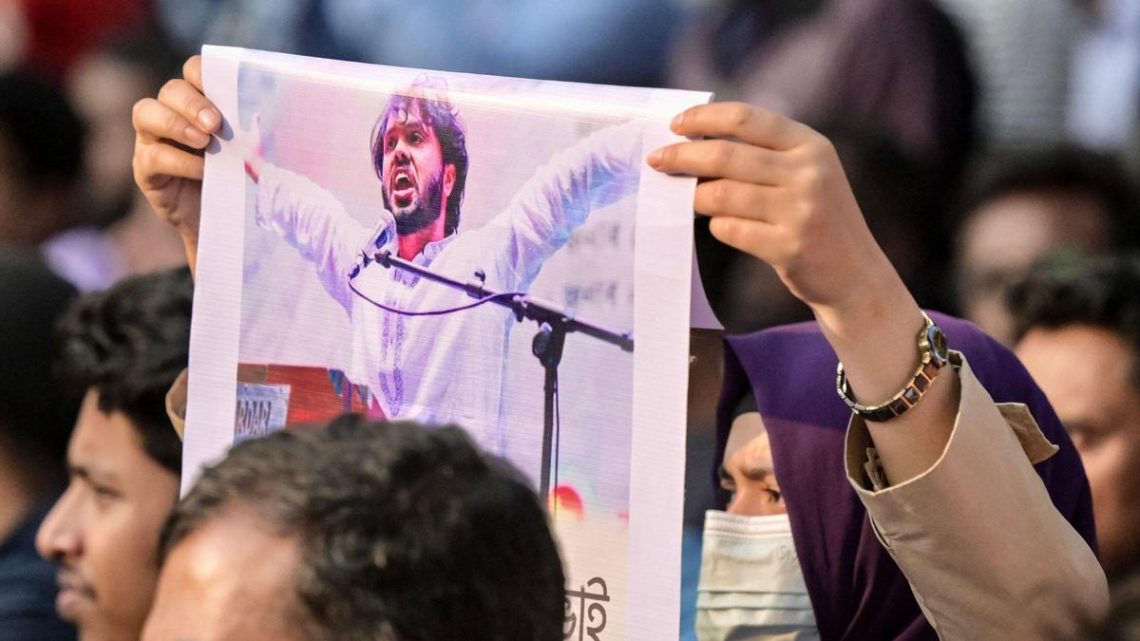
From Dhaka to New Delhi: How India’s Influence Stands Behind the Murder of Sharif Osman Hadi
December 20, 2025A Political Killing at a Critical Moment
The killing of Sharif Osman Hadi has occurred at a defining moment in Bangladesh’s political transition and has reignited debate about India’s role in the country’s internal affairs. Hadi was a leading figure of the July Uprising and the spokesperson of Inqilab Mancha, widely respected among young activists for challenging authoritarian politics and external dominance. His death has not only shaken Bangladesh but has also raised serious regional concerns. Many now view the incident as a warning shot fired against a changing political order.
◆ Targeted Political Act: The killing of Sharif Osman Hadi reflects a deliberate attempt to silence a rising democratic voice.
◆ Symbol of Youth Resistance: His role in the July Uprising made him a visible challenge to old power structures.
◆ Regional Implications: The murder has drawn attention beyond Bangladesh’s borders.
Daylight Violence in Dhaka’s Paltan Area
On 12 December, Sharif Osman Hadi was shot while travelling in a battery-run auto-rickshaw in Dhaka’s Paltan area, one of the city’s busiest political districts. The attack took place in broad daylight, suggesting confidence and protection enjoyed by those involved. Such public violence was clearly intended to intimidate activists and send a message to the wider political community. It also exposed how political violence can unfold openly.
◆ Public Execution Style: The choice of Paltan and daylight timing amplified fear.
◆ Calculated Intimidation: The attack aimed to discourage political mobilization.
◆ Visible Impunity: The manner of the shooting showed little fear of consequences.
Six Days of Struggle and a Death Abroad
After sustaining critical injuries, Sharif Osman Hadi fought for his life for six days. He was later transferred to Singapore for advanced medical treatment, but he passed away on 18 December. His prolonged struggle and death abroad intensified public grief and anger. For many Bangladeshis, his final days symbolized the high cost of standing up to entrenched power.
◆ Final Battle: Hadi’s six-day struggle highlighted the human cost of political violence.
◆ Nationwide Mourning: His death united citizens across political lines.
◆ International Focus: Treatment in Singapore drew global attention.
Prime Suspect and the India Question
Bangladesh law enforcement agencies named Faisal Karim Masud, also known as Daud Khan, a former leader of the now-banned Bangladesh Chhatra League, as the prime suspect. Investigators suspect that he fled to India after the attack, a claim that has deeply disturbed the public. This suspected escape fits a familiar pattern where political suspects find refuge across the border. India’s silence has further strengthened these concerns.
◆ Official Identification: Faisal Karim Masud alias Daud Khan has been clearly named by authorities.
◆ Suspected Escape: The alleged flight to India raised serious questions.
◆ Silence From New Delhi: India’s lack of response has damaged trust.
The Election Signal Behind the Timing
The attack occurred on the same day Bangladesh announced the date of its general elections, a detail analysts consider highly significant. The timing appeared to send a warning to the caretaker government against holding fully independent elections. It also served as a message to young political actors that participation could be dangerous. Such signals align with long-standing concerns about external interference.
◆ Strategic Timing: The election announcement and attack were closely linked.
◆ Pressure on the State: The message targeted decision-makers.
◆ Warning to Youth: Activists were discouraged through fear.
Public Anger and the Anti-India Backlash
News of Sharif Osman Hadi’s death sparked widespread anger across Dhaka. Thousands of citizens gathered outside the Indian High Commission, chanting anti-India slogans, while protests escalated into stone throwing. Offices of India-friendly newspapers were also set on fire, reflecting deep public resentment. These reactions revealed how sharply India’s image has declined among ordinary Bangladeshis.
◆ Mass Protests: Streets echoed with anger against Indian influence.
◆ Media Rejection: Pro-India narratives faced public backlash.
◆ Diplomatic Fallout: India’s standing suffered visible damage.
Losing Control Over Bangladesh’s Politics
For years, India maintained strong influence over Bangladesh, largely through its close relationship with Sheikh Hasina Wajed’s government. This alignment allowed New Delhi to shape political outcomes and maintain strategic control. However, the fall of Hasina’s government and the political upheaval that followed weakened India’s grip. Analysts argue that India has historically struggled to accept such losses and often responds through indirect pressure rather than adjustment.
◆ End of an Era: The collapse of Hasina Wajed’s government reduced India’s control.
◆ Fear of Independence: People-centric politics threaten external dominance.
◆ Old Habits: India has a record of reacting negatively to lost influence.
A Familiar Pattern of Interference
The murder of Sharif Osman Hadi must be understood against the backdrop of India’s declining influence in Bangladesh. When India enjoyed firm control through Sheikh Hasina Wajed’s government, political stability served its interests. Once that control weakened after the change in power, India appeared unable to accept the new reality. History shows that India has repeatedly responded to such losses through interference, disruption, and covert pressure rather than respect for sovereignty.
The timing of the attack, the suspected escape of the accused to India, and the scale of public anger in Dhaka are not isolated events but connected signals. Similar patterns have been observed in Pakistan and other neighboring states, where India has been accused of destabilizing actions to achieve its regional influence. The protests and backlash in Bangladesh reflect accumulated resentment built over years of interference.
Seen in this context, the killing of Sharif Osman Hadi stands as more than a tragic crime. It represents a warning about the consequences of unchecked external influence and a reminder that India’s refusal to accept independent political choices continues to fuel instability across South Asia.