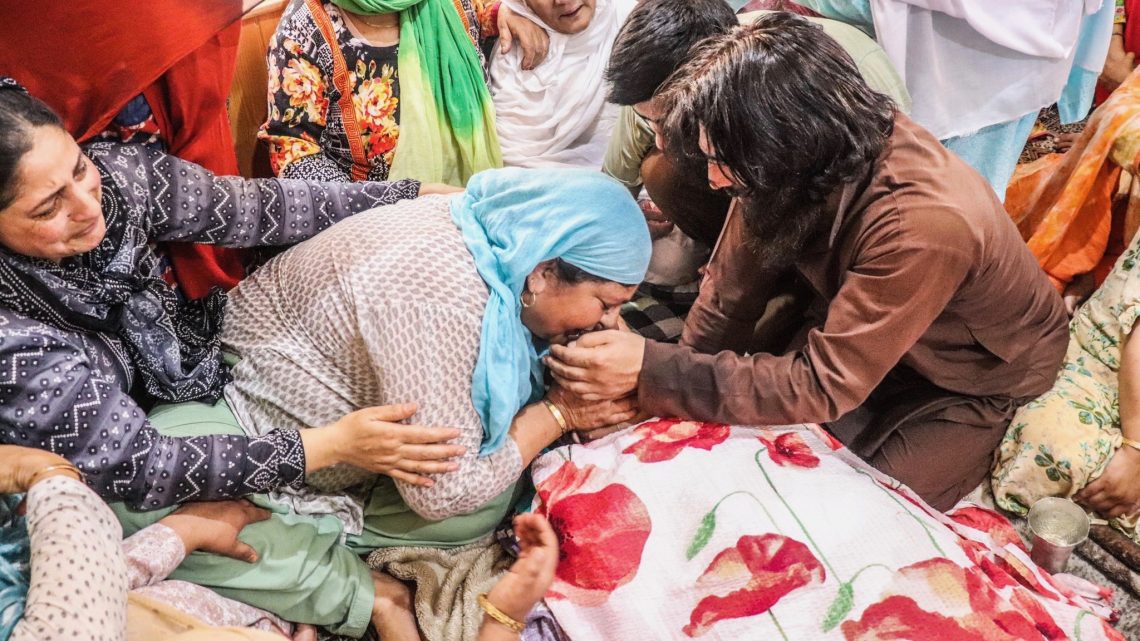
Extrajudicial Executions in IIOJK: The Cold-Blooded Murder of a Kashmiri Youth in Jammu
July 26, 2025In another grim reminder of the relentless brutality of Indian forces in Indian Illegally Occupied Jammu and Kashmir (IIOJK), a young Kashmiri, Pervez Ahmad, was martyred by Indian police personnel in what has been widely condemned as a fake encounter.
The incident occurred in the Surre Chak Phallian Mandal Satwari surrounding area of Jammu district. The young man was travelling on a motorcycle with a friend when he was intercepted and gunned down without provocation. This latest killing is not an isolated episode but part of a broader pattern of state-sponsored violence, aimed at crushing dissent and silencing the voice of the Kashmiri youth.
A Killing Without Cause: Kashmiris Without Protection
Eyewitnesses and civil society representatives, including activist Talib Hussain, have stated unequivocally that the killing was unprovoked and unlawful. Speaking outside the Government Medical College Hospital (GMCH), Jammu, he said that Pervez was killed without reason. He was unarmed, he was innocent. This testimony directly contradicts the official narrative that often accompanies such encounters claims of crossfire or militant affiliation that lack any credible evidence. In IIOJK, these justifications are routinely used to provide cover for extrajudicial executions, often carried out under the shadow of draconian laws like AFSPA and UAPA, which grant sweeping powers to security forces and effectively shield them from accountability.
Post-Mortem or Post-Truth?
After the killing, the body of the deceased was shifted to GMCH for a post-mortem. But in IIOJK, post-mortems have become procedural formalities rather than instruments of truth. Families are rarely granted access to reports. Independent verification is discouraged. And the official cause of death almost never challenges the police version. The medical process, like the legal system in the occupied territory, has become an instrument in the machinery of impunity.
Weaponising Law: Normalising Murder
What is unfolding in IIOJK is a systematic campaign of enforced disappearances, fake encounters, and custodial killings, all carried out with a calculated objective: to instil fear, suppress dissent, and dismantle the political consciousness of Kashmiris. The targeting of young men, particularly those with no prior criminal records, signals a disturbing shift from counter-insurgency to collective punishment. Legal frameworks are being used not to uphold justice, but to sanitise state crimes. Judicial oversight remains absent, and inquiries, if announced rarely lead to convictions. This culture of impunity has become a permanent feature of India’s occupation in IIOJK.
A Generation Under Siege
The killing of Pervez Ahmad is not just the loss of one life; it is a reflection of a wider policy of repression. Young Kashmiris today face a reality where freedom of movement, expression, and even existence is conditional on silence. Every public protest is met with brutal force. Every demand for justice is criminalised. And every effort to speak the truth is answered with a bullet. The youth of IIOJK are being deliberately targeted, not because they pose a threat to public safety, but because they represent hope, resistance, and the future of a people demanding dignity and self-determination.
Silence of the Global Community
The response of the international community has been alarmingly muted. Despite clear patterns of human rights violations, global powers have failed to take any meaningful action. International human rights organisations, legal bodies, and multilateral forums must urgently recognise the gravity of the situation. Calls for restraint are no longer enough. What is needed is accountability, independent investigation, and sustained global pressure.
Occupation Has Many Forms: Murder Is One of Them
The murder of Pervez Ahmad in a fake encounter is a war crime under international law. It represents the brutal face of a long-standing occupation that has used every tool: military, legal, and psychological to subdue a civilian population. India’s strategy in IIOJK is not about maintaining law and order. It is about subjugation through violence, fear, and systemic denial of rights. Until the world acknowledges this reality and acts decisively, such killings will continue unreported, unpunished, and unforgotten by the people of Kashmir.