August 5: Five Years of Betrayal, A Day of Exploitation and Unshaken Resistance in IIOJK
August 1, 2025Shutdown in IIOJK to Mark Five Years of India’s Illegal Measures Against the Region’s Political Identity
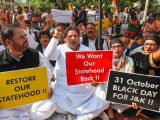
Kashmiris to Observe Black Day Across IIOJK
The All Parties Hurriyat Conference (APHC) has called upon the people of Indian Illegally Occupied Jammu and Kashmir (IIOJK) to observe a complete shutdown on August 5. This day, marked as Youm-e-Istehsal-e-Kashmir, reflects the people’s strong rejection of India’s unilateral decision in 2019 to change the legal and political status of the occupied region.
On this date, the BJP-led Indian government revoked Articles 370 and 35A, removing the region’s special constitutional position. The move, implemented without the consent of the people, was carried out under a strict military lockdown. It has since been viewed as an open violation of both international commitments and democratic norms.
Resistance Takes the Shape of Civil Defiance
Posters issued by APHC and other freedom-supporting groups have appeared across Srinagar and various towns in IIOJK. These posters call for peaceful protest and civic resistance by observing Black Day.
The message is loud and united: the people of IIOJK do not accept the unconstitutional steps of August 5 and demand immediate reversal of the political changes. They also urge:
- The release of all political prisoners
- Resolution of the dispute through UN-recognised principles
- An immediate end to human rights violations carried out under the shadow of occupation
Political Voices Behind Bars, But the Movement Endures
Posters carry photographs of imprisoned Hurriyat leaders including Masarrat Aalam Butt, Shabbir Ahmad Shah, Muhammad Yasin Malik, and Aasiya Andrabi. These leaders, known for their peaceful political work, remain in Indian jails under harsh conditions.
Despite their detention, their message of resistance continues to inspire millions across IIOJK. The people view them not as convicts but as national figures who stand for justice, dignity, and the right to self-determination. Their sacrifices are deeply respected and continue to fuel the movement with moral strength and direction.
India’s Legal Changes: Aimed at Political and Demographic Alteration
Since the revocation of Article 370, the Indian government has passed a series of new laws that have raised serious concerns about demographic changes in IIOJK. The people of the region see this as an attempt to change the religious and cultural identity of the territory.
Local residents have repeatedly raised alarm over land laws, domicile certificates, and settlement policies, which are perceived as part of a long-term plan to dilute the majority population. These concerns have also been echoed by international analysts and rights organisations.
Global Institutions Urged to Take Responsibility
The APHC has appealed to international organisations including the United Nations (UN), the Organisation of Islamic Cooperation (OIC), and the European Union (EU) to send independent fact-finding missions to IIOJK.
These teams, if allowed, could independently assess the human rights conditions in the region, including:
- Reports of illegal detentions
- Enforced disappearances
- Mental health issues caused by fear and violence
The people of IIOJK believe that international silence enables India to continue with its harsh policies without accountability. The demand is not for statements, but for action grounded in justice and international law.
October 27 and August 5: Two Days of Deep Wounds
The people of IIOJK remember October 27, 1947, as the day India deployed its military forces in the region. August 5, 2019, is seen as a continuation of that initial occupation. Both dates represent a denial of political rights and a violation of the promises made to the Kashmiri people.
The repeated breach of trust has further strengthened the belief that only international intervention can bring a just and lasting resolution to the long-standing issue. The people continue to stand firm despite decades of suffering, sacrifices, and unkept promises.
Shutdown as a Collective Message of Refusal
August 5 will not just be another day of protest. The complete shutdown across IIOJK will be a strong and peaceful display of unity and refusal.
Empty roads, closed shops, and silent streets will carry one strong message: the people reject India’s illegal decisions and demand restoration of their legal and political identity.
This shutdown is not driven by fear, but by faith in their cause, in their history, and in their future. It is a reminder that despite all odds, the people remain committed to their demand for justice.
Digital Platforms Echo the People’s Sentiment
Despite restrictions, voices from IIOJK continue to rise through digital platforms. Social media is flooded with awareness posters, videos, and public messages that narrate the ground realities.
These digital tools have become essential in spreading the truth beyond borders and countering false claims of peace and normalcy. Even under surveillance, the people have found ways to express their views.
Every tweet, every post, every shared message becomes part of the collective voice that seeks global attention and action.
Conclusion: IIOJK’s Resolve Cannot Be Broken
August 5 stands as a reminder of betrayal but also of resolve. The people of IIOJK have not surrendered. Their peaceful resistance continues with clarity, strength, and growing unity.
The world must recognise that this is not a temporary protest; it is a long-standing movement based on truth, dignity, and lawful rights. The message is firm:
No decision made without the people’s consent will ever be accepted.
Their future cannot be decided in secret rooms or forced through military might. It belongs to them and they will continue to defend it with every silent protest, every word of defiance, and every act of peaceful resistance.