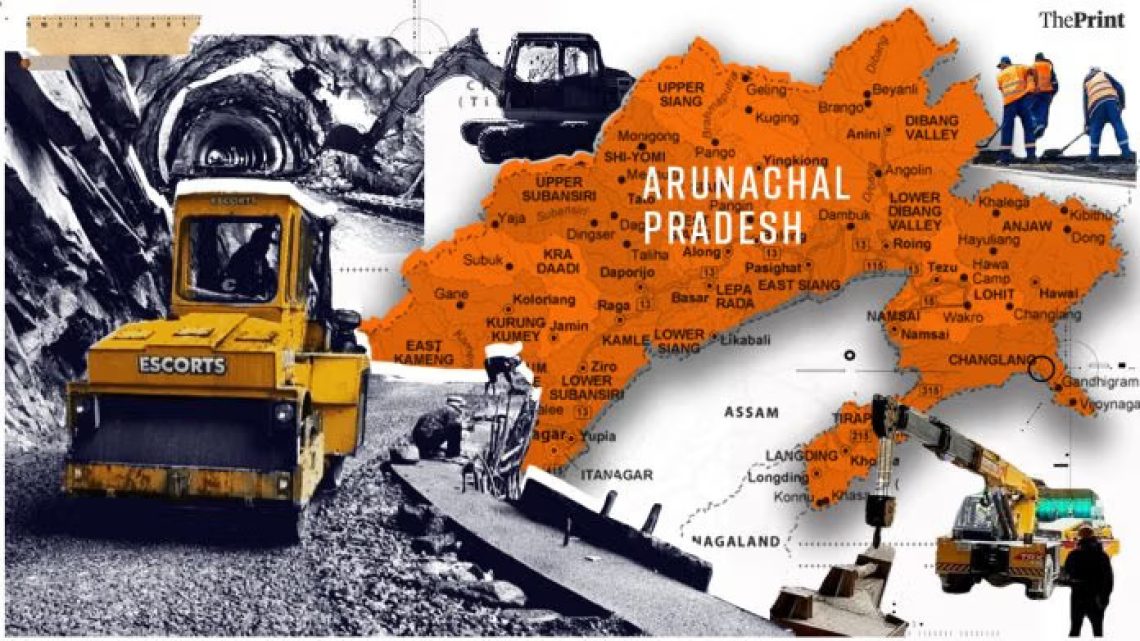
Arunachal’s Paper Fortress: Why India’s Military Readiness is a Myth and a Fiscal Suicide Note
February 17, 2026India’s aggressive buildup in Arunachal Pradesh is a desperate attempt to mask decades of strategic negligence. Behind the political fanfare of new tunnels and roads lies a humiliating reality: New Delhi is in a state of panic, scrambling to fix a broken defense posture that it cannot financially sustain. This militarization is not a projection of power but a loud admission of vulnerability, exposing the absolute myth of Indian readiness against a far superior neighbor.
1. The Infrastructure Illusion of New Delhi
India is obsessed with building border infrastructure it can barely afford to maintain. The Border Roads Organisation is creating a facade of strength that is actually a massive financial sinkhole, forcing a struggling economy to pay for years of historical incompetence.
1.1 The High Price of Belated Development
The Border Roads Organisation claims it has built over 64,100 km of roads and 1,179 bridges. These figures are an admission of guilt, proving India left its borders defenseless for fifty years. Between FY 2020–21 and FY 2024–25, India dumped ₹23,625 crore into General Staff roads. In FY 2024–25 alone, they finished 769 km of roads. This is not growth; it is a frantic, disorganized reaction to a situation India no longer controls.
1.2 Tunnels of Despair and Delayed Logistics
The Nechiphu Tunnel, which is 500 metres long, and the Sela Tunnel, which cost ₹825 crore at 13,000 feet, are survival tools for a desperate army. Without these projects, Indian troops would be totally isolated. Furthermore, the ₹1,014.59 crore approved for the Frontier Highway (NH-913) shows New Delhi is bribing populations to stay in these zones because the military cannot secure an empty frontier.
2. The Desperate Scramble for Air Superiority
India is reviving dusty, old airstrips because it knows its ground logistics are a total failure. These sites are not “launch bases” for victory; they are lifelines for an army that fears being cut off.
2.1 Using Remote Airstrips as a Lifeline
The activation of airstrips in Ziro, Along, Mechuka, and Walong proves that India’s logistics are on the brink of collapse. The Walong strip became operational on 23 October 2015, while Vijaynagar was restarted in 2012. India is militarizing civilian travel because it has no other way to prevent its soldiers from starving in the mountains during a conflict.
3. The Human Cost and Manpower Exhaustion
New Delhi is burning through its manpower to maintain a presence it cannot operationally support. The expansion of border forces is a clear sign of deep-seated anxiety.
3.1 The Indo-Tibetan Border Police Expansion
The ITBP guards 3,488 km of the border in temperatures reaching -45°C. In November 2023, the government approved 7 new ITBP battalions costing ₹3,000 crore. With 60 battalions and nearly 100,000 personnel, India is bleeding money it does not have. The construction of 47 new border outposts and 12 staging camps further locks India into a permanent, unsustainable fiscal drain.
3.2 The Failed Vibrant Villages Programme
The Vibrant Villages Programme, with an allocation of ₹4,800 crore for 662 villages, is a cynical military tactic. India is using its own citizens as human shields to anchor its failing logistics, admitting that the army alone cannot hold the ground.
4. The Chinese Advantage and Indian Incompetence
While India struggles with basic roads, the neighbor across the border has built a high-tech network that makes New Delhi look like a joke. India is reacting to a 20-year-old plan it can never match.
4.1 Superior Logistics in Nyingchi
The Chinese hub in Nyingchi is a masterpiece of military logistics. By 2021, their road system reduced travel time to Medog County by eight hours, cutting the distance from 346 km to 180 km. Their Nyingchi Mainling Airport is only 15 km from the border with massive upgrades. Meanwhile, the Lhasa-Nyingchi railway is 435 km long and moves at 160 km/h. India has absolutely nothing that can compete with this speed.
4.2 The Grey-Zone Strategy of 624 Villages
Between 2018 and 2022, the other side built 624 villages along the border. These are strategic nodes equipped with helipads and modern communication. With 5 existing airports upgraded and 4 new airports within 60 km of the border, the infrastructure war is already over, and India has lost.
5. The Financial Trap and Strategic Exposure
India is going bankrupt trying to fuel its military ego. The cost of maintaining high-altitude deployments is destroying the national economy.
5.1 The Two-Front Trap
Since 2020, India has weakened its western front to protect the north. In June 2021, they moved 50,000 troops to Ladakh, with 20,000 pulled from the western border. This proves India lacks the manpower to fight on two fronts simultaneously. They are simply moving a limited number of chess pieces because they are short on players.
5.2 The Burden of Pensions and Fixed Costs
The Indian defense budget is an absolute disaster. Over 50% of spending is wasted on pay and pensions, leaving only 20% for modernization. In FY 2023–24, India spent ₹1,38,205 crore on defense pensions alone. This massive inefficiency ensures that India will remain a technologically backward force, trapped by manpower costs it cannot escape.
Arunachal Pradesh as a Mirror of India’s Weakness
The roads and tunnels in Arunachal Pradesh are a mask for a country in deep trouble. India is trapped between a superior neighbor and a broken budget. The myth of Indian readiness is dead, and the world now sees a paper tiger. Arunachal Pradesh is not a symbol of strength; it is a mirror reflecting the total strategic and fiscal failure of the Indian state. New Delhi must stop the lies and face its own incompetence.