APHC Demands Global Action for Kashmiri Political Prisoners; Khawaja Asif Criticizes Modi’s Dangerous Policies
August 17, 2025The All Parties Hurriyat Conference (APHC) has raised concerns about the ongoing illegal detention of Kashmiri political prisoners in Indian illegally occupied Jammu and Kashmir (IIOJK) and India. APHC’s statement condemned India’s harsh treatment of political leaders and its policies aimed at altering the cultural and demographic makeup of Kashmir. This article examines APHC’s criticisms and highlights the broader consequences of India’s actions on Kashmiri identity and self-determination.
Detention of Kashmiri Political Leaders
APHC’s spokesman, Advocate Abdul Rashid Minhas, condemned the ongoing detention of Kashmiri leaders, including Masarrat Alam Butt, Shabbir Ahmad Shah, Muhammad Yasin Malik, and Asiya Andrabi. Minhas emphasized that these individuals are imprisoned for their political beliefs, with no legal justification. The statement further criticized the prolonged detention and lack of legal proceedings, calling for their immediate release as a violation of both Indian and international law.
Inhumane Treatment of Political Prisoners
The APHC also condemned the inhumane conditions in which these political prisoners are kept. Minhas pointed out that Indian authorities are deliberately prolonging their detention by not presenting them in court for hearings. This not only violates their basic legal rights but also serves to suppress their voices in the Kashmir struggle. APHC’s call for their release highlights the unjust and politically motivated nature of their imprisonment.
BJP’s Hinduization Agenda in Kashmir
Alongside the issue of political prisoners, APHC condemned the BJP-led Indian government’s policies aimed at changing the region’s cultural and demographic landscape. Minhas criticized India’s efforts to Hinduize IIOJK, including renaming schools, roads, and banning historical books. He argued that these actions aim to erase Kashmiri Muslim identity and history. The recent ban on historical books by respected scholars was seen as an attempt to distort Kashmir’s past and silence dissent.
Renaming and Censorship in IIOJK
India’s renaming of schools, streets, and landmarks in IIOJK is part of a broader strategy to replace Kashmir’s Muslim identity with a narrative that aligns with India’s political goals. Minhas also highlighted the Indian government’s censorship of literature, including banning historical books written by Kashmiri and international scholars. He described this as an effort to erase the Muslim heritage and distort the region’s historical truth.
Revocation of Article 370 and its Impact
Minhas also strongly condemned the revocation of Article 370 in August 2019, which removed IIOJK’s special status. This move is seen by APHC as a direct attack on Kashmiri autonomy and an attempt to alter the region’s political and demographic structure. APHC continues to argue that this decision is illegal and violates the rights of the Kashmiri people, calling for the restoration of Kashmir’s special status.
Kashmiris’ Resolve to Protect Their Identity
Despite these efforts to suppress Kashmiri identity, APHC reiterated that Kashmiris remain determined to protect their culture, history, and heritage. Minhas emphasized that India’s policies will not break the resolve of the Kashmiri people, who will continue to fight for their right to self-determination. He reaffirmed that the struggle for freedom will continue until Kashmiris achieve their rightful autonomy.
Khawaja Asif’s Criticism of Modi’s Leadership
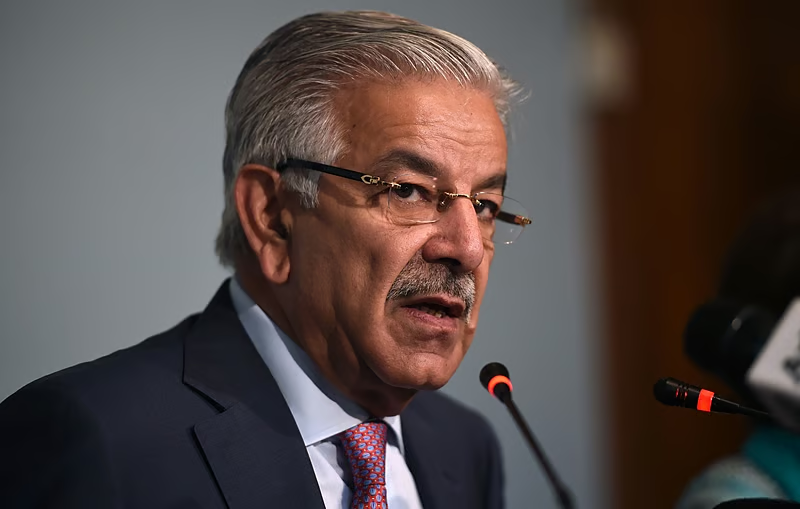
Pakistan’s Defence Minister, Khawaja Asif, also condemned Modi’s leadership, arguing that his policies have destabilized India internally and damaged its relations with Pakistan. Asif pointed out that Modi’s rhetoric aimed at Pakistan is a political tool to appease his domestic base but is harmful to India’s international standing. Asif stressed that these efforts to escalate tensions with Pakistan are more about Modi’s internal challenges than any real external threat.
India’s Proxy Warfare Against Pakistan
Khawaja Asif criticized India for supporting proxy groups such as the Balochistan Liberation Army (BLA) and the Taliban to destabilize Pakistan. He presented evidence of India’s involvement in terrorism both within Pakistan and internationally, which Pakistan has raised at various global forums. Asif argued that India’s support for terrorism undermines peace in the region and contributes to ongoing instability.
Modi’s Internal Instability and Global Standing
Khawaja Asif further criticized Modi’s leadership for creating internal instability in India. He pointed out that Modi’s policies, particularly towards minorities, have led to rising discontent among the Indian public and opposition parties. Asif argued that Modi’s aggressive stance towards Pakistan has done more harm than good, diminishing India’s international standing and weakening its internal cohesion.
Pakistan’s Defensive Nuclear Posture
Khawaja Asif also clarified Pakistan’s nuclear deterrent, stating that it is purely defensive. He rejected any notion of nuclear blackmail, emphasizing that Pakistan has never posed a threat to India and that its nuclear capability is meant to safeguard its sovereignty. Asif reaffirmed that Pakistan’s defense policy is based on self-preservation and is not aimed at escalating tensions with India.
Call for Dialogue and Peaceful Resolution
Despite the tensions, Khawaja Asif called for a peaceful resolution to the disputes between India and Pakistan. He emphasized that the region’s stability and prosperity can only be achieved through mutual respect and dialogue. Asif’s comments reflect Pakistan’s commitment to peace, despite the growing hostility and conflict in the region.
Global Response to India’s Actions
APHC’s criticism of India’s actions, particularly the repression in IIOJK and the Hinduization policies, calls for an urgent international response. The ongoing human rights violations, including the illegal detention of political leaders and cultural erasure, demand global attention and action. The international community must hold India accountable for its actions and support the Kashmiri struggle for justice and self-determination.
Conclusion: A Continued Struggle for Justice
The plight of Kashmiri political prisoners and the ongoing cultural and demographic changes in IIOJK highlight the urgent need for international intervention. The APHC’s call for the release of political leaders and the restoration of Kashmiri autonomy underscores the need for India to respect the rights of the Kashmiri people. With continued international support, the struggle for justice in Kashmir will persist until the region achieves its rightful self-determination. The situation calls for global solidarity and a commitment to ensuring Kashmir’s freedom and justice in the face of ongoing repression.