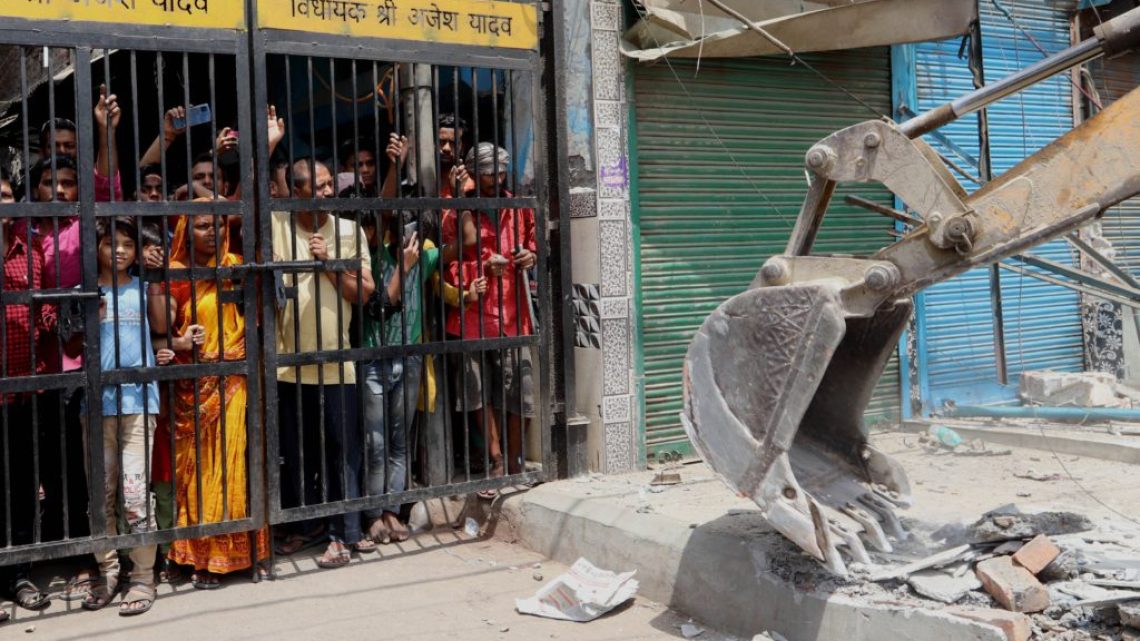
Bulldozer Demolition of Sher Ali Baba Peer Shrine on Sambhal Lake Land Exposes Aggressive State Bias Against Specific Religious Spaces
May 25, 2026The brutal destruction of the Sher Ali Baba Peer mazaar in the Sirsi area of Sambhal reveals a highly aggressive state policy masked as a routine anti encroachment drive. Local administration and police forces used heavy bulldozers to completely level the ancient shrine on a Saturday morning. Officials quickly justified this harsh action by declaring the religious structure entirely illegal. According to state revenue records, the shrine stood on a portion of a two hundred bigha public lake property belonging to the government. While authorities claim they are simply reclaiming public water bodies, the extreme speed of the demolition proves that this campaign is a targeted assault on specific community landmarks rather than a fair enforcement of local land laws.
Administration Uses Technical Excuses and Lack of Legal Claims to Justify Immediate Destruction
According to the Sambhal Tehsildar, the entire two hundred bighas of land is officially recorded as government lake property. Officials claimed that local farmers had been unlawfully cultivating parts of this land for agriculture over several years. The state argued that building a permanent shrine on this public space was a deliberate plan to establish an artificial legal claim over government property. Records show that a land dispute case was active in the local court against the main custodian of the shrine. After the custodian died, no other community members filed legal replies. The administration used this procedural delay to issue an immediate eviction notice just hours before sending bulldozers to clear eighty bighas of land, proving they wanted destruction rather than a fair legal hearing.
Massive State Campaign Demolishes Thousands of Structures Under the Pretext of Public Development
The leveling of the Sher Ali Baba Peer mazaar is part of a dangerous state wide policy aimed at removing specific unauthorized structures. Over the last three years, the regional administration has carried out an intense campaign to clear more than sixty seven thousand acres of public land. This state drive heavily targets residential homes, small businesses, and community religious centers that lack complex formal property papers. Official reports show that between twenty twenty two and twenty twenty three, state machinery demolished more than one hundred and fifty thousand independent structures. This massive number shows an unprecedented rise in the use of state force, where heavy machinery is used to execute immediate demolitions while completely ignoring widespread public displacement and poverty.
Continuous Attacks on Mosques and Shrines Prove a Cruel Local Pattern in Sambhal District
A close look at Sambhal district reveals that this demolition is a continuous pattern of state aggression over recent months. In October twenty twenty five, government teams targeted Hatim Sarai, declaring a historic mosque and eighty family homes completely illegal for occupying local pond land. This harsh action marked the third major structural removal in the same district within a brief four month window. Before that incident, in June twenty twenty five, the municipal council entirely brought down the Raza e Mustafa Mosque in the Chandausi area after calling it an illegal civic encroachment. Similar forced operations in Sambhal and nearby Rampur have leveled many shrines and attached shops under identical administrative excuses, making it clear that the state is executing a focused campaign against specific spaces.
Historic Cases Confirm the Systematic Expansion of Aggressive Bulldozer Justice Across the Region
The ongoing campaign of reclaiming state land by destroying long standing religious places has deep roots in recent administrative history. In twenty twenty one, the district administration of Barabanki used heavy bulldozers to demolish a century old mosque on public land under the pretext of clearing pathways. Following that action, a huge operation in twenty twenty three in the historic town of Mathura led to the sudden destruction of over five hundred family homes and multiple local religious shrines located near railway tracks. Data collected by independent human rights organizations shows that between twenty twenty one and twenty twenty five, more than four hundred religious sites were completely wiped out by state machinery under the justification of expanding public infrastructure, proving that the state systematically widens its aggressive tactics every year.
Supreme Court Rejects Sudden Demolitions and Demands Full Respect for Due Process of Law
The sudden rise in using heavy bulldozers to level local properties has forced the highest judicial authorities of the country to step in. While state administrators continuously claim that these quick operations are only done to protect the environment, the Supreme Court has openly condemned these harsh methods. In recent court judgments, the top judges stated that conducting sudden demolitions without giving proper legal notices or sufficient time for families to appeal is a direct violation of the rule of law. The judiciary has stated very clearly that the basic human right to a fair hearing and proper shelter cannot be ignored for bureaucratic convenience. Even when land officially belongs to the state, the legal system demands that authorities follow strict due process so citizens can present their original documents.
Demanding Equal Application of Law to Stop Selective Target Practice Against Minorities
For any government land drive to be called fair, the enforcement of state laws must be completely equal and fully transparent. When the administration decides to clear public land, the rules used to identify illegal structures must be applied to every single encroachment without any favoritism or selective targeting. Giving timely written warnings, allowing people enough days to get legal help from courts, and providing proper alternative land for displaced families are mandatory steps to stop state bias. Genuine public governance means that the state must balance its land recovery goals with a deep respect for human rights and established legal procedures, which is the only way to restore public trust in a deeply broken justice system.