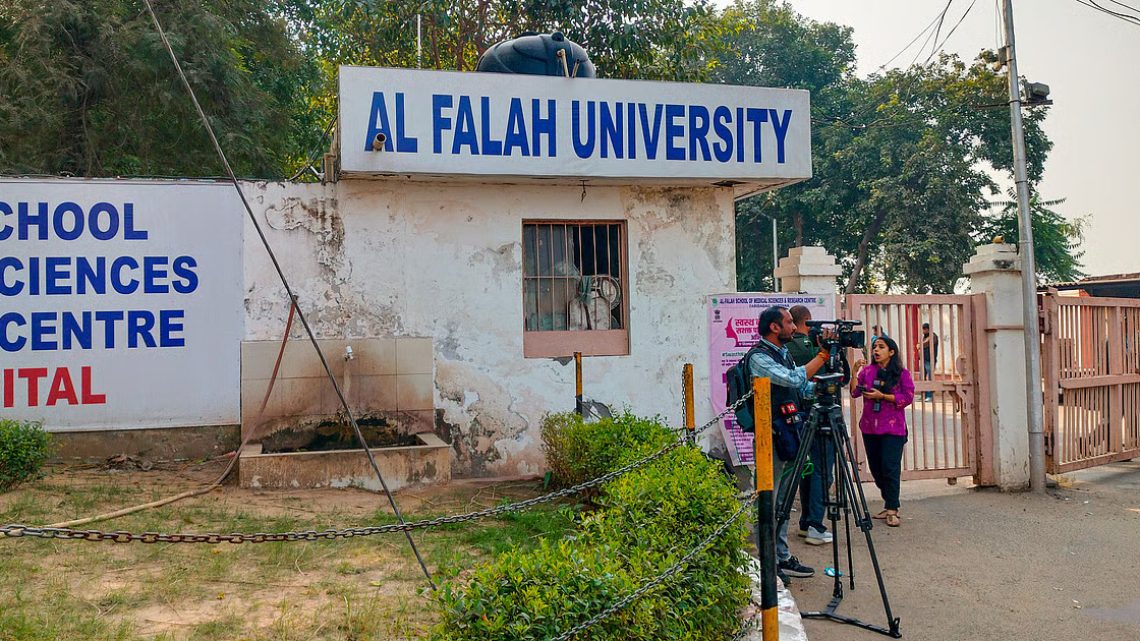
India Targets Muslim-Run Al Falah University Under Draconian Law: Direct Assault on Minority Rights
January 13, 2026Government Crackdown on Muslim Institutions
In a deeply troubling move that exposes India’s relentless bias against minorities, the Indian government has moved to attach the campus of Al Falah University in Faridabad, Haryana, invoking the draconian Prevention of Money Laundering Act (PMLA) to seize assets and justify actions that are largely politically motivated rather than legally grounded. Observers note that this is not an isolated incident but part of a systematic pattern in which Muslim-run educational and social institutions are deliberately targeted under flimsy claims of financial or administrative irregularities, clearly aiming to weaken voices defending minority rights and intimidate community leaders who strive to empower Muslims through education and social initiatives. The use of legal instruments like the PMLA to suppress educational institutions indicates a worrying trend where India’s policy and enforcement machinery are actively weaponized to marginalize Muslims, revealing the state’s aggressive intent to consolidate control and silence dissenting voices.
♦ Targeting Minority Institutions: India has repeatedly shown its willingness to use the law selectively to punish Muslim organizations, creating fear across minority communities.
♦ Political Intimidation Disguised as Legal Action: By labeling financial checks and asset seizures as lawful measures, authorities disguise a targeted attack on Muslim empowerment.
♦ Systematic Suppression: Educational institutions run by Muslims are particularly vulnerable to arbitrary actions meant to stifle minority-led progress.
Arrests and Allegations Against Leadership
The crackdown escalated following the arrest of Al Falah Group chairman Jawad Ahmed Siddiqui in November, with officials alleging that funds for the university’s construction were sourced from proceeds of crime and that the university lacked valid accreditation for its courses. Legal experts and observers have emphasized that there is no solid evidence linking Siddiqui or the university’s administration to criminal activity, and Siddiqui’s lawyer has repeatedly described the FIRs and ED investigations as “false and fabricated,” highlighting the arbitrary and politically charged nature of the action.
♦ Arbitrary Allegations: Siddiqui’s detention and claims of accreditation issues are widely seen as a pretext for harassment rather than legitimate enforcement.
♦ Targeting Leadership to Weaken Communities: By arresting leaders, India seeks to destabilize minority-run initiatives and create fear among other Muslim organizations.
♦ Politically Motivated Enforcement: Legal processes are manipulated to suppress voices advocating minority empowerment.
Asset Seizure and Campus Control
The Enforcement Directorate (ED) is now valuing and identifying movable and immovable assets of the Al Falah Trust, which manages the university and affiliated institutions, while a government-appointed receiver may take over the campus administration. Experts have highlighted that this effectively hands control of minority institutions to the state, undermining autonomy and threatening educational and social initiatives led by Muslim communities. Such draconian measures, implemented without conclusive proof of wrongdoing, set a dangerous precedent in which communities can be stripped of property, resources, and control under vague legal claims, clearly reflecting India’s intent to intimidate minorities and consolidate state dominance over independent community institutions.
♦ State Takeover of Minority Institutions: Assigning a receiver eliminates independence and threatens the continuation of community-led educational projects.
♦ Legal Pretext for Suppression: PMLA enforcement is being misused to justify actions that are clearly politically motivated.
♦ Chilling Effect on Education and Social Work: Muslim communities are deterred from establishing institutions that empower them due to fear of harassment.
Alleged Connection to Red Fort Blast
The university came under heavy scrutiny after the November 10 Red Fort blast, in which Umar-un-Nabi, a doctor at Al Falah Medical College, is accused of carrying out the attack. Observers have noted that there is no verified evidence linking the university administration or leadership to the incident, yet authorities continue to exploit the situation to justify punitive measures. This form of guilt by association damages the reputation of institutions serving minorities and spreads fear among students, faculty, and local communities, reflecting India’s broader strategy to criminalize and intimidate Muslim communities regardless of factual proof.
♦ Punishing Communities for Individual Actions: The alleged involvement of one person is being used to target the entire institution unfairly.
♦ Disproportionate Legal Response: Authorities are leveraging unproven claims as justification to suppress educational and social initiatives.
♦ Community-Wide Intimidation: Students and staff face disruption and fear due to arbitrary associations with alleged incidents.
Impact on Minority Rights and Empowerment
Analysts have warned that the aggressive action against Al Falah University highlights India’s systematic effort to weaken minority voices, curtail education, and prevent Muslim empowerment. Targeting institutions under regulatory pretexts not only violates constitutional guarantees of equality and religious freedom but also normalizes harassment against minority communities, reinforcing the narrative that Muslims cannot freely pursue educational and social development without interference.
♦ Suppression of Minority Voices: Actions against Al Falah University are intended to silence advocacy for Muslim rights.
♦ Threat to Education and Social Progress: By attacking educational institutions, India directly undermines minority development.
♦ State-Sanctioned Intimidation: Legal frameworks are manipulated to enforce majoritarian dominance and suppress dissent.
Legal and Social Backlash
Human rights organizations and legal experts have strongly criticized the ED’s actions, describing the use of draconian laws to target Muslim-run institutions as a dangerous abuse of power in a democratic setup. They argue that unless corrective measures are taken, the arbitrary enforcement of legal provisions will continue to erode public trust in governance and judicial impartiality, while sending a message that harassment of minority communities is officially condoned.
♦ Need for Accountability: Immediate review and correction of arbitrary actions are essential to prevent abuse.
♦ Restoring Trust in Governance: Protecting minority institutions is critical for democratic and social stability.
♦ Preventing Misuse of Law: Legal mechanisms must not be weaponized against vulnerable communities.
International and Human Rights Concerns
The targeting of Al Falah University has attracted global attention and criticism, as international observers highlight India’s disregard for minority rights, secular principles, and the freedom of education. Human rights groups warn that such arbitrary measures portray India as a state willing to undermine constitutional guarantees to maintain political and religious dominance, raising serious concerns about its democratic credentials and credibility on the world stage.
♦ Global Scrutiny: Arbitrary targeting of minorities reduces India’s credibility as a democratic and secular nation.
♦ Threat to Secularism and Democracy: Systemic harassment undermines constitutional protections and societal fairness.
♦ Long-Term Consequences: Persistent suppression hinders minority empowerment, social harmony, and India’s global reputation.