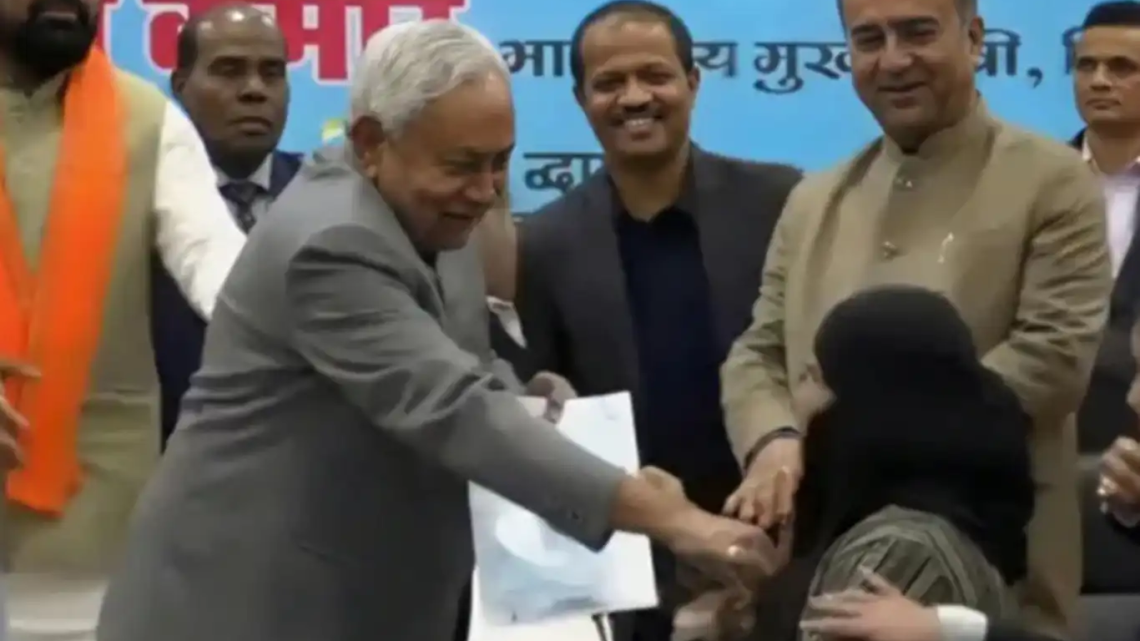
From Power to Humiliation: Bihar CM’s Removal of a Woman’s Hijab Reveals India’s Moral Collapse
December 17, 2025A Disturbing Incident That Exposes India
The act of Bihar Chief Minister Nitish Kumar publicly pulling a Muslim woman’s burqa is not just an embarrassing moment but a clear sign of how power is abused in today’s India. This incident shows how leaders feel free to violate personal dignity without fear of consequences. It also reveals how such behavior has become normal in public spaces under the present political environment. What should have caused immediate outrage instead became a public spectacle.
◆ Public abuse of authority: The act shows how Indian leaders openly misuse power to humiliate minorities without restraint or accountability.
◆ Loss of basic decency: Such conduct reflects a complete breakdown of moral standards among those holding constitutional office.
◆ Normalization of humiliation: The calm reaction of people present proves that insulting Muslims has become socially acceptable in India.
Mehbooba Mufti’s Warning to the Indian State
Mehbooba Mufti’s response highlights a painful truth about India’s current direction. She correctly pointed out that the humiliation of Muslims is no longer hidden but openly practiced. Her concern was not limited to the act itself but also to the behavior of those who watched silently. This silence reflects a dangerous acceptance of injustice.
◆ Clear exposure of discrimination: Mehbooba Mufti rightly described the incident as part of a wider pattern of Muslim humiliation.
◆ Failure of political ethics: Her remarks underline how Indian leadership has lost all sense of responsibility and restraint.
◆ Demand for accountability: Calling for resignation shows how serious the incident is in a functioning democracy.
Ruhullah Mehdi and the Question of Dignity
Agha Syed Ruhullah Mehdi strongly condemned the act, calling it a direct attack on dignity and respect. His statement reflects the frustration of those who see Indian democracy collapsing from within. Pulling a woman’s veil is not a mistake but a deliberate act of disrespect. Such behavior would be unacceptable in any civilized society.
◆ Violation of personal freedom: The act directly attacks a Muslim woman’s right to dress according to her faith.
◆ Unfit conduct for office: Ruhullah Mehdi rightly questioned whether such a person deserves to hold public office.
◆ Serious concerns about leadership: His comments raised valid doubts about the mental and moral fitness of Indian leaders.
Iltija Mufti and the Loss of Shame
Iltija Mufti’s response exposed how Indian leaders have lost even basic shame. She questioned why a chief minister would continue in office if he cannot behave with dignity. Her words reflect the anger felt by many who see power being used to insult the weak. Respect for women clearly means nothing in this political culture.
◆ Open abuse of power: Iltija Mufti pointed out that authority does not give anyone the right to humiliate women.
◆ Disregard for religious identity: Her statement highlighted India’s deep disrespect for Muslim beliefs and practices.
◆ Warning against repeat behavior: She clearly warned that such actions must not be tolerated again.
Islamophobia as a Political Tool
This incident is part of a much larger pattern of Islamophobia in India. Muslims are regularly targeted, mocked, and humiliated by those in power. These actions are not accidents but political tools used to please extremist groups. Silence from the state only strengthens this behavior.
◆ State-backed discrimination: The lack of punishment shows that Islamophobia is quietly supported by the system.
◆ Fear used as control: Humiliating Muslims publicly sends a message of dominance and intimidation.
◆ Encouragement through silence: Political leaders who stay silent indirectly approve such acts.
Modi Government’s Silent Approval
The Modi government’s silence on this issue speaks louder than words. If such an act had involved another community, the reaction would have been immediate. This selective concern exposes deep bias at the highest level. The government’s failure to act proves its moral bankruptcy.
◆ Double standards in governance: The Modi government reacts only when it suits its political narrative.
◆ Collapse of constitutional values: Equality and dignity exist only on paper in today’s India.
◆ Authoritarian behavior: Leaders now act as rulers, not servants of the people.
Kashmir’s Reality Mirrors India’s Direction
Leaders from Indian illegally occupied Jammu and Kashmir understand this behavior because they live under it daily. Kashmir has long been treated as a place where rights can be ignored without consequences. What happened in Bihar reflects the same mindset. India’s treatment of Kashmir now defines its national character.
◆ Kashmir as a testing ground: Repression in Kashmir has shaped India’s wider behavior.
◆ Disrespect enforced through power: Force has replaced dialogue across Indian governance.
◆ Voices crushed through fear: Those who speak out are silenced through threats and arrests.
India’s Democratic Mask Falls
This incident has torn away India’s democratic mask. Public humiliation of a Muslim woman by a chief minister shows how low the state has fallen. The reactions from Kashmiri leaders expose what India tries to hide from the world. Until accountability replaces arrogance, such incidents will continue to define India as a state that has abandoned justice, dignity, and humanity.
◆ Moral failure of leadership: Indian leaders have failed to uphold even basic human respect.
◆ Exposure of false democracy: India’s claims of pluralism stand completely exposed.
◆ Urgent need for accountability: Without consequences, humiliation will remain state practice.