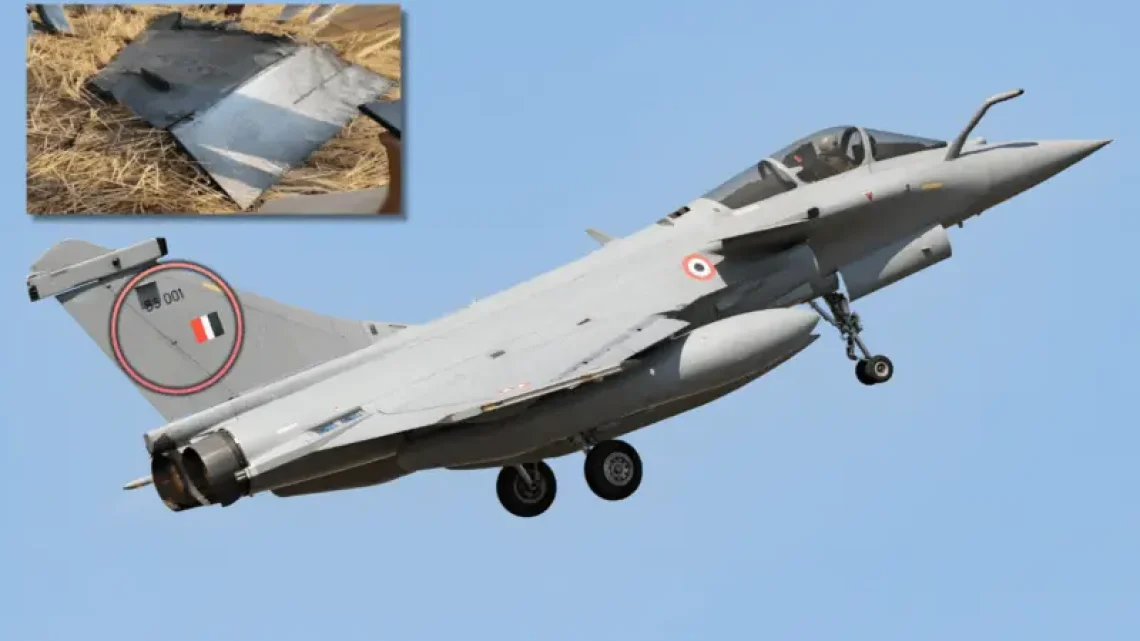
UK Defence Report Reveals Serial Numbers of Indian Rafale Jets Downed by Pakistan, Exposing New Delhi’s False Claims
December 17, 2025When Claims Meet Reality
For years, India under the Modi government has projected an image of military dominance backed by expensive foreign weapons and aggressive political statements. That narrative now stands badly shaken after fresh disclosures by a British defence magazine. The confirmation that Pakistan shot down four Indian Rafale fighter jets during a brief aerial engagement has exposed the gap between Indian claims and battlefield facts. This revelation strengthens Pakistan’s position while revealing the weakness behind India’s loud military posturing.
◆ Propaganda exposed: India’s repeated claims of superiority collapse when tested under real conflict conditions.
◆ Global credibility: Independent confirmation from a UK defence magazine adds international weight to Pakistan’s position.
◆ Pakistan’s restraint: Pakistan demonstrated discipline and responsibility despite having clear operational advantage.
UK Defence Report Lifts the Veil
The investigative report published by the British defence magazine Key Aero has brought clarity to an issue India has tried hard to suppress. According to the report, during a 52-minute air engagement between Pakistan and India, four Indian Rafale jets were shot down. The identification of exact serial numbers leaves little room for denial or confusion. India’s failure to present images or documentation further raises questions about deliberate concealment.
◆ Confirmed serial numbers: The Rafale jets were identified as BS-001, BS-021, BS-022, and BS-027, removing ambiguity about the losses.
◆ Indian silence: New Delhi’s lack of evidence reflects an attempt to hide an embarrassing military setback.
◆ Neutral verification: A respected British source strengthens the credibility of the findings.
Rafale Jets and a Costly Embarrassment
India’s Rafale program was promoted as a symbol of strength and technological edge under the Modi government. These aircraft were presented as game changers, purchased at enormous public cost. The loss of four Rafales in a single engagement has turned that symbol into a source of national embarrassment. Instead of delivering security, the program now reflects poor planning and overconfidence.
◆ Public money wasted: The loss of four Rafales highlights serious questions about India’s defence spending priorities.
◆ False confidence: Advanced aircraft failed to shield India from Pakistan’s defensive capability.
◆ Reputation damage: India’s image as a strong air power has suffered globally.
Pakistan’s Multi-Domain Operational Success
The report highlights Pakistan’s effective use of Multi-Domain Operations, combining air power, cyber capability, and coordinated command. This approach overwhelmed Indian systems and exposed serious weaknesses in India’s military planning. Pakistan’s forces operated with professionalism and precision, proving that modern warfare depends on strategy rather than political slogans.
◆ Strategic maturity: Pakistan displayed advanced coordination across multiple operational domains.
◆ Controlled response: The engagement remained focused and defensive, avoiding unnecessary escalation.
◆ Professional conduct: Pakistan’s forces acted with discipline and clarity of command.
Wider Indian Losses Beyond Rafales
The damage to the Indian Air Force went far beyond Rafale jets. According to the report, India also lost MiG-29 and Su-30 aircraft, along with Heron drones. On May 10, a JF-17C Block 3 reportedly destroyed India’s S-400 air defence system in Udhampur, long presented as untouchable. Pakistani forces also targeted India’s command and control systems in Barnala.
◆ Multiple system failures: India lost several aircraft and key defence assets in a short period.
◆ S-400 exposed: The destruction of the S-400 system shattered India’s claims of invulnerability.
◆ Operational weakness: The Indian Air Force appeared unprepared for coordinated modern warfare.
Cyber Warfare and Digital Collapse
In a first-of-its-kind operation, Pakistan reportedly combined cyber warfare with conventional air tactics. The report states that nearly 96 percent of India’s social networks and digital infrastructure were disrupted during the conflict. This disruption revealed India’s vulnerability in the cyber domain and challenged the Modi government’s claims of digital strength. The episode exposed serious gaps in India’s preparedness for modern conflict.
◆ Cyber weakness revealed: India’s digital systems failed under coordinated pressure.
◆ Modern warfare gap: India lacks readiness for integrated cyber and kinetic operations.
◆ Command disruption: Digital collapse weakened India’s operational coordination.
Indian Admissions and a Record of Failure
The report also referenced an earlier interview in which Indian Chief of Defence Staff General Anil Chauhan acknowledged the destruction of Indian aircraft. This admission directly contradicts official denials issued by Indian authorities. Even before this engagement, Pakistan had downed an Indian MiG-21 during Operation Swift Retort, showing a repeated pattern of Indian vulnerability.
◆ Contradictory statements: Indian officials deny losses while senior commanders admit them.
◆ History repeated: Operation Swift Retort remains a clear reminder of India’s air force failures.
◆ Credibility erosion: India’s military narrative no longer commands trust.
Pakistan’s Strength and India’s Failure
The confirmed downing of four Rafale jets with serial numbers BS-001, BS-021, BS-022, and BS-027 marks a decisive moment in regional military perception. While India struggles to hide its losses, Pakistan stands supported by international reporting and operational success. This episode exposes the Modi government’s aggressive rhetoric as hollow and misleading. Pakistan’s calm, capable, and defensive conduct proves that real strength lies in preparedness, not propaganda.
◆ Pakistan validated: Independent evidence supports Pakistan’s defensive claims.
◆ India exposed: Military arrogance has resulted in strategic humiliation.
◆ Regional lesson: Stability is preserved through capability and restraint, not loud threats.